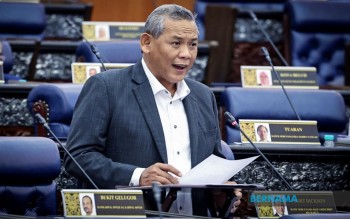
Datuk Seri Aminuddin Harun, the Port Dickson Member of Parliament and former Negeri Sembilan menteri besar, has urged Parliament to approach the analysis of Tabung Haji's investment performance with measured objectivity. During a special parliamentary sitting discussing the Royal Commission of Inquiry report into the institution, Aminuddin stressed that legitimate market fluctuations must be separated from governance failures when evaluating the pilgrim fund's losses. His intervention injects a crucial note of nuance into an otherwise contentious accountability process, acknowledging that not every financial setback represents wrongdoing or breach of duty.
The distinction Aminuddin drew reflects a fundamental reality of investment management. Market volatility and unforeseen economic downturns are inherent risks that even prudently managed funds cannot entirely escape. However, this principle does not excuse negligence, conflicts of interest, or the systemic governance breakdowns that triggered the RCI investigation in the first place. By drawing a clear line between unavoidable market losses and losses stemming from poor decision-making, Aminuddin provided a framework for interpreting the RCI's findings in a manner that preserves accountability while remaining grounded in investment reality.
The RCI report, which examined Tabung Haji's operations between 2014 and 2020, has already recommended forensic audits of 14 investments that experienced significant declines. These targeted audits represent the mechanism through which the distinction Aminuddin advocates can be operationalised. By subjecting these troubled investments to detailed forensic examination, investigators can identify whether losses resulted from honest miscalculation within an uncertain environment or from breach of fiduciary duty. For Malaysian pilgrims whose savings are entrusted to Tabung Haji, this analytical rigour is essential to restoring confidence in the institution.
Aminuddin's most forceful interventions centred on the composition and appointment of Tabung Haji's leadership. He argued persuasively that the institution has historically treated board positions and senior management roles as political patronage opportunities rather than professional positions of stewardship. The damage this approach inflicts extends beyond individual financial losses; it undermines the entire ethos of institutional governance. When positions are distributed based on political connections rather than expertise, institutional decision-making becomes vulnerable to conflicts of interest and strategic blindness. The consequence has been a leadership cadre that may include capable individuals but systematically lacks the depth of investment knowledge, risk management experience, and Islamic finance expertise that Tabung Haji requires.
The RCI itself identified this weakness and recommended legislative amendments prohibiting active politicians from serving as chairman or board members of Tabung Haji and its subsidiaries. Aminuddin went further, proposing comprehensive screening criteria for all board candidates. His proposed framework would require demonstrated expertise in investment management, Islamic finance, risk management, accounting and auditing, legal matters, corporate governance, and hajj operations. Additionally, he insisted on mandatory integrity screening and formal conflict-of-interest declarations. This multidimensional vetting process would transform board recruitment from a political selection exercise into a rigorous professional evaluation.
The philosophical shift Aminuddin advocated represents a departure from post-independence Malaysian institutional culture, where prestigious board appointments frequently functioned as rewards for political loyalty or mechanisms for building factional influence. He explicitly rejected this framework, insisting that Tabung Haji positions constitute "a professional trust" rather than sinecures. This language carries weight because it reframes governance reform not merely as a compliance obligation but as a moral responsibility to the millions of Malaysian pilgrims who contribute to the fund. The argument is particularly potent in the Malaysian context, where respect for religious institutions and the integrity of hajj preparations remain deeply significant cultural values.
Yet the parliamentary debate revealed significant gaps in the RCI's scope that warrant serious consideration. Datuk Mohd Isam Mohd Isa, speaking from his position on the Public Accounts Committee, highlighted a critical temporal limitation: the RCI examined only the period from 2014 to 2020, leaving a five-year window from 2020 onwards largely unexamined. Tabung Haji's operations during this subsequent period have involved substantial asset restructuring, new investment initiatives, and leadership transitions. Several significant developments occurred during this window, including organisational reforms allegedly implemented in response to earlier revelations. Without RCI oversight of this period, Parliament cannot fully assess whether reforms were genuine or cosmetic.
Mohd Isam proposed establishing a new RCI to cover 2021 through 2025, providing continuity of investigation and ensuring comprehensive institutional review. Alternatively, he suggested that the PAC assume primary responsibility for scrutinising Tabung Haji governance during the 2022 to 2026 period through its permanent investigative mechanisms. This dual approach would address the current review's temporal constraints while providing ongoing parliamentary oversight rather than relying solely on one-time investigative commissions. For Malaysian stakeholders concerned with accountability, this represents a more durable governance framework.
The RCI report itself, released publicly on July 29 following submission to the Yang di-Pertuan Agong in August 2022, comprises 211 pages detailing weaknesses in institutional management and operations. The commission advanced 25 recommendations for systemic improvement, and Tabung Haji reported implementing 75 per cent of these suggestions as of late July. This implementation rate suggests institutional receptiveness to reform, though the quality and depth of implementation remain to be verified through the forensic audits and subsequent scrutiny the RCI recommended. For Malaysian pilgrims awaiting confirmation that their hajj contributions are managed with appropriate rigour, visible progress in recommendation implementation provides some reassurance, though Aminuddin's emphasis on appointment quality suggests that purely procedural reforms remain insufficient.
The broader significance of this parliamentary debate extends beyond Tabung Haji itself. Malaysian institutional governance across both public and private sectors has long been characterised by the conflation of political loyalty with professional competence. If Tabung Haji can successfully transition toward merit-based appointment and genuine professional governance, it would establish a precedent for other religious and public institutions facing similar accountability pressures. Aminuddin's articulate advocacy for meritocratic governance rather than political patronage carries implications for institutional reform across Malaysian society. The pilgrimage fund thus becomes a test case for whether Malaysian institutions can fundamentally restructure their appointment cultures or whether reform remains superficial.
The integration of Aminuddin's investment risk framework with the appointment quality agenda represents a sophisticated governance response to institutional crisis. By acknowledging that market losses do not automatically constitute evidence of misconduct while simultaneously insisting that appointed leaders must possess genuine expertise to navigate those markets, he articulates a coherent standard for institutional accountability. This standard demands both intellectual honesty about investment realities and uncompromising standards for leadership quality. For Malaysian pilgrims and policymakers alike, this represents a constructive path forward that preserves both accountability and institutional credibility.

