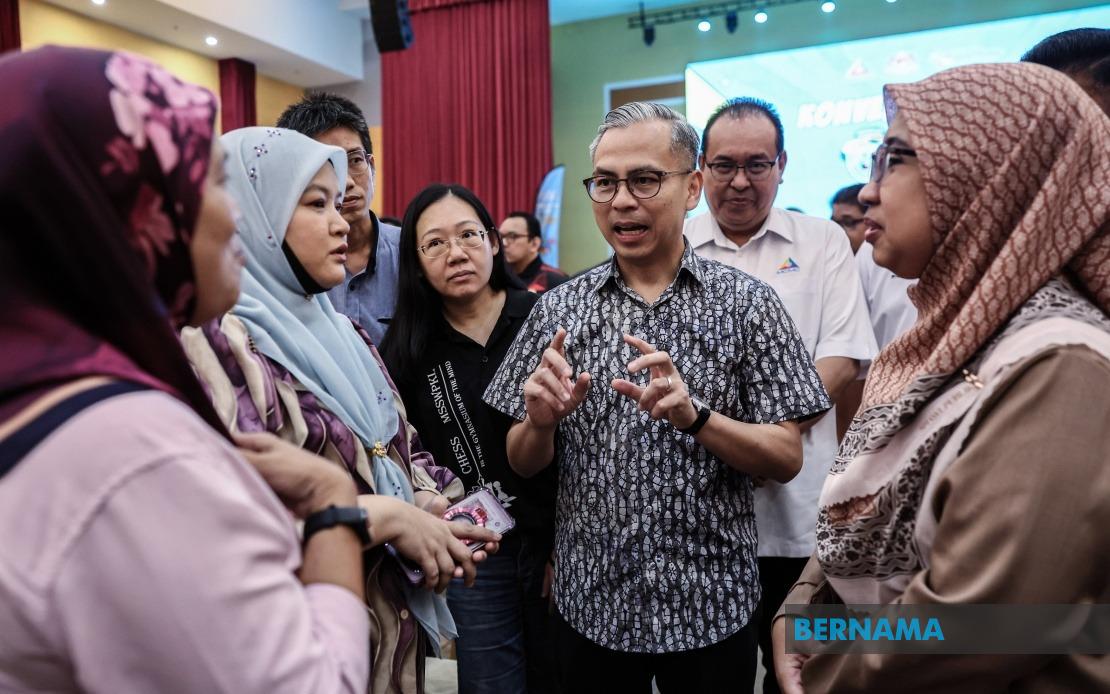
The People's Justice Party (PKR) moved swiftly to contain speculation over internal management changes on Thursday, with Information Chief Datuk Seri Fahmi Fadzil assuring party members and the public that ongoing operations will proceed without interruption following Nurul Izzah Anwar's decision to step back from her role as deputy president. Speaking after launching a digital safety initiative for parents and school officials, Fahmi outlined the party's succession arrangements and broader political positioning as the government navigates questions about electoral timing and reform implementation.
Nurul Izzah, the daughter of Prime Minister Datuk Seri Anwar Ibrahim, initially sought to resign from her deputy president post but the PKR Central Leadership Council determined that accepting her departure outright would be counterproductive. Instead, the party leadership approved a temporary leave arrangement, allowing her to concentrate on personal pursuits and postgraduate research without formally severing ties. This measured approach reflects a delicate balance between respecting her individual circumstances and maintaining continuity within the party hierarchy during a politically sensitive period.
The structural void created by her temporary absence has been addressed through delegation. Vice-president Datuk Seri Saifuddin Nasution Ismail will assume the full responsibilities associated with the deputy president portfolio during her leave. Saifuddin, a seasoned political operator with substantial parliamentary experience, brings established credibility to the interim arrangement. His elevation to oversee these functions signals that PKR has sufficient institutional depth to absorb such transitions without friction or operational degradation.
Fahmi's emphasis that Nurul Izzah remains fundamentally invested in party matters despite her leave underscores PKR's desire to prevent any perception of fractious disagreement. Her continued membership and pledge to contribute to the party's agenda once her personal circumstances stabilise present her departure as temporary and circumstantial rather than ideological or strategic. This framing is crucial for internal cohesion, particularly in a coalition government where perceived instability could invite opportunistic political manoeuvring by rivals or even sympathetic parties seeking to exploit perceived weakness.
Separate inquiries about whether Subang Member of Parliament Wong Chen might vacate his seat received a deflection from the Communications Minister. Fahmi stated that he possessed no verified information on the matter and directed speculation toward the parliamentary establishment. Such non-committal responses are standard procedure when sensitive internal discussions remain unresolved, though the topic's emergence suggests potential realignments within PKR's parliamentary representation may be under consideration at leadership level.
Regarding broader electoral prospects, Fahmi dismissed speculation that a snap general election might be called before mid-2026. The government's official position remains that elections will be conducted by the end of 2026 at the latest, in accordance with constitutional timelines. This reaffirmation attempts to inject predictability into political planning and signals that the Prime Minister's administration intends to complete its current term without triggering premature polls, despite external pressures or internal party dynamics that might tempt earlier contests.
The Communications Minister framed the government's immediate priorities around administrative continuity and stability rather than electoral positioning. He highlighted the commitment of all component parties within the Unity Government coalition to support Prime Minister Anwar Ibrahim's leadership through to the natural conclusion of the current parliamentary term. This emphasis on steadiness reflects recognition that Malaysia's economic challenges and international positioning require sustained, undisrupted governance rather than the distraction and uncertainty accompanying electoral campaigns.
Pakatan Harapan's wider agenda, operating within the Unity Government framework, centres on advancing reform initiatives and economic improvements that directly affect ordinary Malaysians. Fahmi articulated this as the governing coalition's unifying purpose across its disparate membership, suggesting that internal tensions—whether involving personnel changes or procedural matters—remain subordinate to collective commitments on substantive policy. This rhetorical positioning aims to reassure stakeholders that coalition governments, despite their inherent complexity, remain capable of purposeful governance.
Among specific policy matters requiring continued attention, Fahmi identified implementation of recommendations arising from the Royal Commission of Inquiry into the Lembaga Tabung Haji, the Islamic pilgrimage fund, during the 2014-2020 period. This institution faced significant difficulties during that span, and addressing deficiencies identified through the RCI process represents a visible demonstration of the government's commitment to accountability and institutional reform. Progress on this agenda signals responsiveness to concerns raised by Muslim constituencies and broader public interest in preventing future mismanagement of funds entrusted to state entities.
The Information Chief concluded his remarks with an oblique reference to forthcoming announcements from Prime Minister Anwar, characterising them as developments beneficial to the country and its citizens. This hint at pending policy declarations or political moves maintains momentum within coalition discussions while declining to provide specific details, a common tactical approach when formal announcements require careful coordination across multiple stakeholders. Such statements function to sustain public and internal interest while preserving the government's prerogative to control the timing and framing of significant announcements.
The handling of Nurul Izzah's leave demonstrates how contemporary Malaysian politics navigates the intersection of personal circumstances, party management, and broader coalition dynamics. While her temporary withdrawal from formal responsibilities might appear administratively routine, it occurs within a complex political ecosystem where personnel changes attract intense scrutiny and potential reinterpretation by opponents. PKR's measured response—emphasising continuity, institutional capacity, and her ongoing commitment—reflects lessons learned from previous political transitions and an appreciation for how such matters are received across Malaysia's diverse political landscape.

