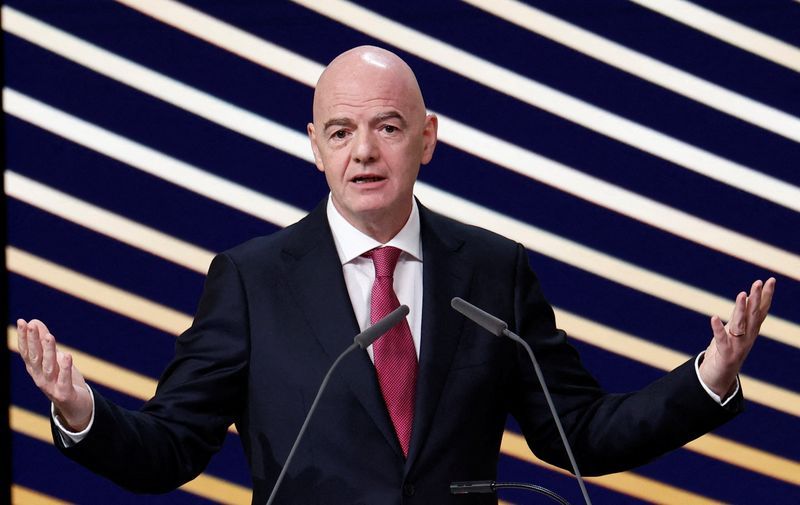
The Oceania Football Confederation has thrown its backing behind FIFA's decision to examine the botched attempt to inject private capital into World Cup competitions, signalling regional support for the governing body despite mounting international pressure on President Gianni Infantino. However, the unified stance among Oceania's 11 full members masks a significant fracture, with New Zealand—the region's solitary World Cup qualifier this year—publicly withdrawing its endorsement of Infantino's anticipated reelection campaign and calling for independent scrutiny of the failed initiative.
Infantino faces a critical juncture as he pursues another presidential term ahead of next year's FIFA Congress. Three continental powerhouses—UEFA, the AFC and CONCACAF—have jointly demanded a comprehensive review of his leadership and have publicly criticised his conduct surrounding the abandoned FIFA Forward Enterprise scheme. The defection of New Zealand, despite representing Oceania's strongest footballing presence, underscores deepening rifts within the global football hierarchy as confederation leaders weigh political calculations against institutional governance concerns.
The OFC's official statement, released following an executive committee gathering on Wednesday, frames FIFA's investment proposal withdrawal as evidence of responsive leadership rather than mismanagement. The confederation emphasised that Oceania has experienced meaningful development progress over the past decade under FIFA's stewardship, suggesting that regional football bodies have benefited from institutional support and funding mechanisms. This framing positions the failed investment scheme as a procedural misstep rather than a fundamental failure of governance, providing political cover for FIFA's leadership while validating continued partnership.
Yet New Zealand Football's statement reveals substantively different concerns permeating rugby football's small-nation cousins. The organisation contends that decision-making processes at FIFA have fractured institutional trust and intensified divisions within international football governance. By explicitly calling for independent investigation rather than internal FIFA-led reviews, New Zealand Football signals doubts about FIFA's capacity for objective self-assessment. This positioning carries particular weight given New Zealand's relative isolation—as an island nation removed from continental power dynamics, its withdrawal of support cannot be dismissed as regional jockeying.
The failed FIFA Forward Enterprise proposal carried significant financial incentives that amplified tensions around the private investment push. Member associations were offered immediate grants of $20 million for the current funding cycle, with the possibility of doubling that amount should confederations embrace the broader investment framework. For smaller football bodies like those in Oceania, such financial inducements represent consequential resources for youth development, infrastructure, and coaching programmes. New Zealand Football's willingness to forgo these potential gains to maintain principled opposition demonstrates genuine conviction regarding governance standards.
The contrast between Oceania's institutional acceptance and New Zealand's principled stance reflects broader patterns within international sports governance. Smaller confederations frequently depend upon central funding mechanisms and development assistance, creating structural incentives to accommodate leadership preferences. The OFC's position as soccer's smallest confederation heightens this dynamic—member nations collectively lack the economic or political weight to challenge FIFA independently. New Zealand's departure from this pattern suggests that certain national federations possess sufficient domestic resources and reputational stakes to prioritise governance integrity over fiscal advantage.
Infantino's reelection campaign now confronts an unprecedented coalition opposing his continuation in office. The simultaneous defections from UEFA, AFC, and CONCACAF represent continental-scale rejection encompassing Europe, Asia, and the Americas. New Zealand's additional withdrawal, though representing a single nation rather than an entire confederation, compounds the narrative of eroding support. Should momentum continue building among other member associations, Infantino could face genuine electoral uncertainty despite FIFA's official backing from its crisis management meeting in Morocco last week.
That Morocco gathering itself reflected the severity of institutional crisis. FIFA publicly apologised for mishandling the investment proposal and offered assurances of leadership unity, yet the subsequent defections suggest apologies and internal reassurances have failed to restore confidence among key stakeholders. The geographical and political diversity of opposing voices—from European federations to Oceania's isolated island nations—indicates the investment scheme damaged FIFA's credibility across fundamentally different footballing contexts and economic circumstances.
For Southeast Asian football governance, these dynamics carry cautionary implications. Regional confederations frequently navigate tensions between securing FIFA development funding and maintaining independence regarding governance matters. New Zealand Football's example demonstrates that principled opposition to questionable institutional decisions, while potentially sacrificing financial opportunity, can enhance long-term legitimacy and member-association autonomy. The ASEAN nations' football federations must weigh similar calculations as FIFA's internal politics continue evolving throughout the coming months leading toward the Congress vote.
The independent review New Zealand Football demands addresses essential questions about transparency in FIFA's decision-making architecture. How did proposals with such significant financial implications advance through governance structures without broader consultation? What safeguards exist to prevent future schemes from accumulating support through incentive structures that compromise federation autonomy? Answers to these questions will substantially influence whether Oceania's initial institutional acceptance proves prescient or premature as the broader crisis unfolds.

