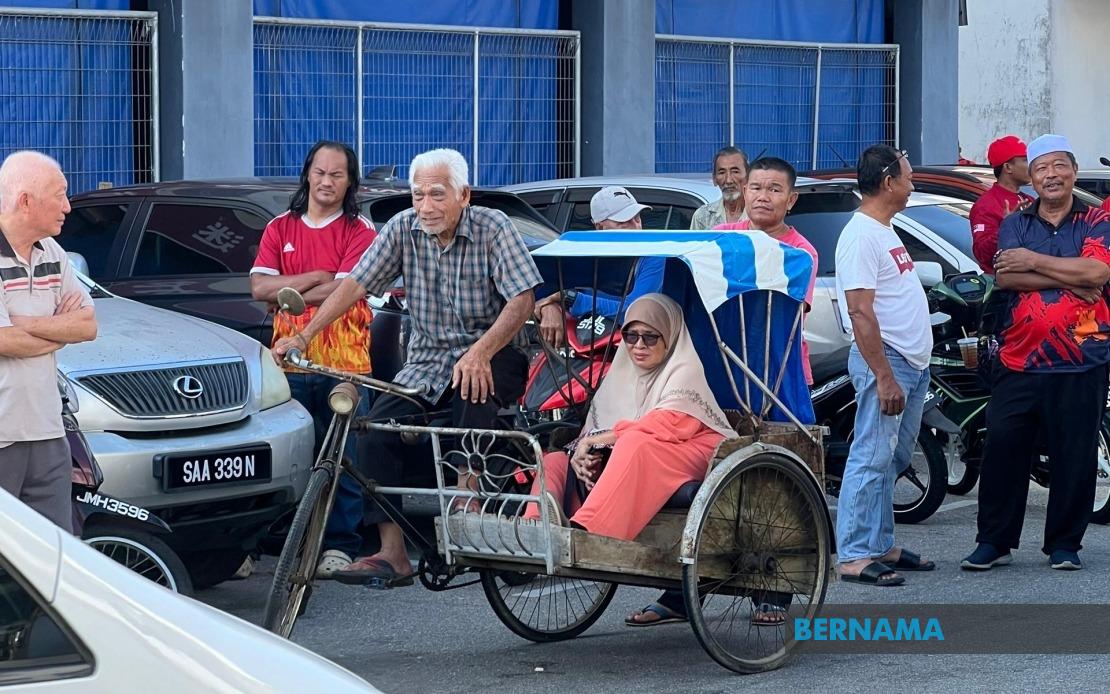
Abdul Razak Pelangga, 86, was undeterred by the oppressive heat blazing across Batu Pahat when he made the decision to pedal his trishaw nearly a kilometre from his home in Kampung Parit Bugis to a coffee shop in Senggarang. His mission was simple but meaningful: to bring his wife, Jamilah Samsudin, 64, to see Prime Minister Datuk Seri Anwar Ibrahim during a scheduled campaign stop in the small Johor town. The elderly couple's determination to witness the Prime Minister's visit offered a poignant reminder of the personal connections that political leadership can forge with ordinary Malaysians, particularly in rural communities.
Razak, who serves as the Imam of Masjid Raudhatul Jannah Parit Bugis, had compelling reasons for choosing the trishaw over more conventional modes of transport. Despite having access to a car or motorcycle, he deliberately opted for the traditional three-wheeled conveyance to sidestep the inevitable parking congestion that accompanies any high-level political visit. This pragmatic choice reflected both local knowledge and a certain charm of maintaining the slower, more accessible rhythm of village life even amid the excitement of a prime ministerial appearance.
The motivation behind Razak's efforts ran deeper than mere curiosity about a sitting prime minister. Years earlier, before Anwar ascended to the office of Prime Minister, the two men had crossed paths at the mosque during prayers. That earlier encounter left a lasting impression on Razak, who remembered Anwar's approachable demeanor and the warm greeting they exchanged after the congregational prayers concluded. Razak had treasured that memory and found occasion to share the experience with his wife over the years, painting a picture of a leader who seemed genuinely connected to the communities he visited.
When word reached Razak that Anwar would be making a campaign appearance in Senggarang during the Johor state election campaign, he saw an opportunity to rekindle that connection and allow his wife to experience a moment she had long anticipated. Television broadcasts had given the couple a distant view of their Prime Minister, but the prospect of witnessing him in person, even amidst a crowd, represented something altogether more tangible and memorable. For many Malaysians, particularly in communities far from the capital, such encounters carry profound symbolic weight, affirming a sense of inclusion in the national conversation.
Prime Minister Anwar spent approximately fifty minutes at Kedai Kopi Hailam Sri Medan, the venue that morning, engaging with local residents as part of the PMX Meet-and-Greet Programme designed to connect with voters in the Senggarang state constituency. The event aligned with Johor's broader electoral calendar, capitalizing on a moment of heightened civic engagement as the state prepared for polling. Communications Minister Datuk Fahmi Fadzil, who also serves as Pakatan Harapan Communications Director, accompanied the Prime Minister during the engagement, underscoring the coordinated nature of the campaign infrastructure.
Although the couple failed to achieve direct face-to-face contact with Anwar owing to the substantial crowd that inevitably gathers around a serving Prime Minister, they found the experience deeply satisfying nonetheless. The proximity alone, the ability to see Anwar in the flesh rather than through a television screen, vindicated the physical effort and heat endurance required for their trishaw journey. For Razak and Jamilah, the symbolic act of making the effort arguably mattered as much as the outcome itself, embodying a form of civic participation that transcends the formal mechanics of voting.
Razak's enthusiasm extended beyond the encounter with the Prime Minister to encompass his forthcoming electoral responsibilities. He expressed particular excitement about casting his vote on July 11, a date that coincided with his 87th birthday, transforming what might otherwise be a routine civic duty into a personally significant milestone. Despite his decades of voting experience in previous elections, Razak described something distinctly special about fulfilling his franchise obligations on the anniversary of his birth, suggesting that democratic participation resonates differently when marked by personal celebration.
The Johor state election, scheduled for July 11, represents one of Malaysia's significant electoral moments, with early voting already set for July 7. The campaign period has witnessed various engagement strategies aimed at mobilizing voters across diverse demographics and geographic areas. The Meet-and-Greet Programme exemplifies the direct engagement approach adopted by political leadership, attempting to bridge the distance between national-level governance and constituency-level concerns by bringing top officials to local establishments frequented by ordinary residents.
Razak's story illuminates the intersection of personal devotion, civic consciousness, and political engagement that characterizes Malaysian democracy at the grassroots level. His choice to undertake a physically demanding journey in adverse weather conditions to facilitate his wife's wish reveals how political leadership, when perceived as accessible and respectful, can inspire voluntary acts of participation. The trishaw ride from Kampung Parit Bugis to Senggarang thus becomes more than a mere transportation anecdote; it represents the enduring connection between citizens and their democratic institutions, rooted in respect and a desire to participate meaningfully in national life. For many Malaysians watching the Johor campaign unfold, such stories reinforce the fundamental importance of political engagement at every level of society, from bustling urban centers to quiet village communities.

