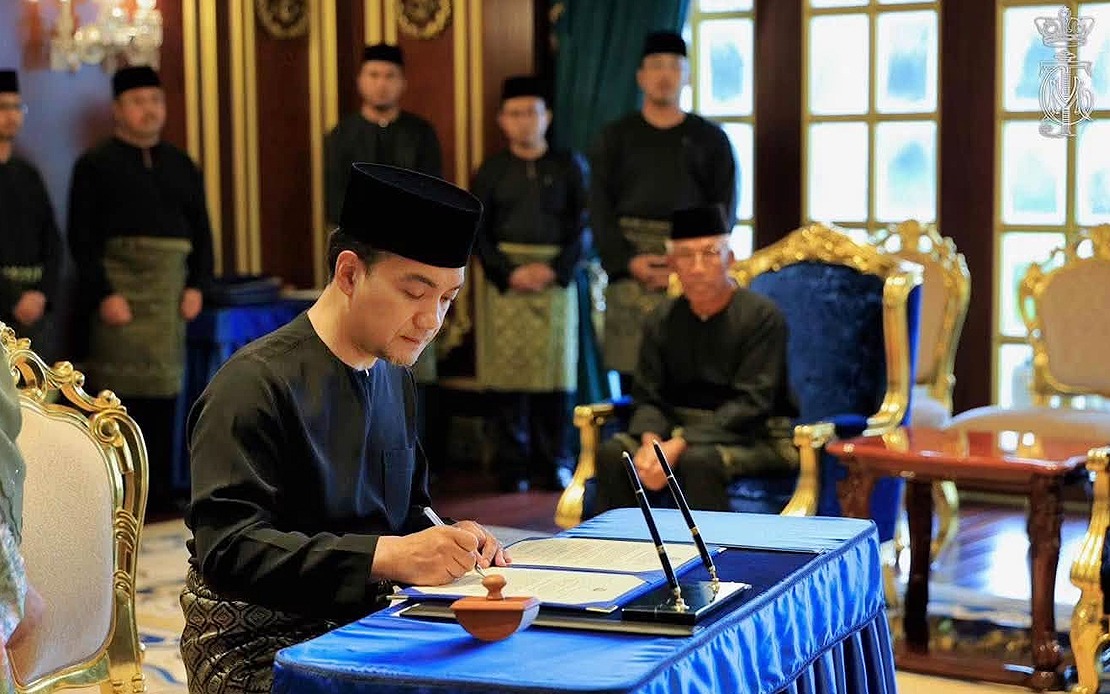
Datuk Onn Hafiz Ghazi takes the helm of Johor for a second consecutive term following Barisan Nasional's decisive performance in the state election, positioning him to deepen the development initiatives he has championed since assuming office. The coalition's capture of 48 out of 56 available seats represents a substantial mandate that extends beyond his initial 2022 appointment, demonstrating voter confidence in his stewardship of the southern state.
At 48 years old, Onn Hafiz carries one of Malaysia's most prominent political pedigrees. He represents the great-grandson of Datuk Onn Jaafar, the visionary founder of UMNO whose nationalist credentials shaped the party's early trajectory, and the grandson of Tun Hussein Onn, who served as the nation's third Prime Minister. This genealogical distinction positions him within a lineage that has wielded considerable influence over both Johor's governance and Malaysia's broader political development for nearly a century. The family's historical significance extends beyond symbolic value, as each generation has sought to shape policy directions and establish administrative legacies that reflect their particular governance philosophies.
The electoral outcome represents a marked improvement over Barisan Nasional's 2022 performance, when the coalition secured 40 seats in the same 56-seat legislature. This eight-seat gain translates into a more robust working majority, providing Onn Hafiz with enhanced parliamentary flexibility to advance his agenda without depending heavily on independent assemblymen or coalition partners for legislative support. The expansion of BN's dominance reflects either consolidation of voter preference toward the incumbent administration or successful efforts to recapture ground lost in the previous electoral cycle.
Onn Hafiz formally took his oath before the Regent of Johor, Tunku Mahkota Ismail, at Istana Bukit Serene, undergoing the constitutional ritual that validates his continued tenure. His appointment as the state's 19th Menteri Besar, initially conferred on March 15, 2022, preceded yesterday's electoral confirmation, meaning his second term represents continuity rather than a fresh political appointment. This distinction matters because it reflects that voters endorsed an incumbent administration rather than selecting a new direction.
Before entering electoral politics, Onn Hafiz accumulated professional credentials in the corporate and financial sectors that have evidently influenced his administrative approach. After completing early education at the Royal Military College, he pursued accounting studies at the University of Hertfordshire in the United Kingdom. Between 2001 and 2004, he worked as an auditor and consultant with PricewaterhouseCoopers, gaining exposure to multinational corporate practices and standards. Subsequent roles between 2005 and 2013 included positions at Chin Well Holdings Berhad and as chief executive officer of KMB Sdn Bhd, experiences that cultivated his emphasis on operational efficiency and commercial viability in governance.
His transition into full-time politics occurred systematically through UMNO's youth structures. Onn Hafiz served on the UMNO Youth executive council and led the Sembrong division's youth wing from 2012 to 2018, building grassroots networks and party credentials. Simultaneously, he worked as political secretary to the defence minister from 2013 to 2018, a role providing exposure to federal-level governance and ministerial operations. This dual trajectory through party machinery and government secretariat created the institutional knowledge necessary for higher office.
His electoral breakthrough came in 2018 when he won the Layang-Layang state seat, securing a legislative platform that eventually facilitated his rise to executive leadership. Following this victory, he chaired the Johor Tourism, Youth and Sports Committee from 2019 to 2022, a portfolio permitting him to develop policy expertise in sectors significant to Johor's economy and public profile. When the 2022 state election occurred, Onn Hafiz successfully contested the Machap state seat, cementing his electoral viability and positioning him for the chief minister's role following BN's formation of the state government.
Since March 2022, Onn Hafiz has centred his administration around the "Maju Johor 2030" agenda, a comprehensive development blueprint emphasizing economic diversification and foreign investment attraction. This framework reflects his corporate background and suggests a governance model prioritizing quantifiable economic metrics rather than purely social welfare provisions. The strategy appears designed to position Johor as a competitive investment destination within Southeast Asia, potentially leveraging its proximity to Singapore and established manufacturing base.
Within UMNO's organizational hierarchy, Onn Hafiz currently chairs the Johor UMNO Liaison Committee and leads the Simpang Renggam division as its chief, positions he has held since 2023 after previously serving the same division as deputy chief. These organizational roles reinforce his standing within party structures and maintain influence over UMNO's cadre development in the state. Such positions typically serve dual purposes: managing party discipline and resources while maintaining direct communication channels to federal UMNO leadership regarding state-level concerns.
The enhanced electoral majority permits Onn Hafiz to pursue more ambitious policy initiatives without immediate coalition management complications. With 48 seats from a 56-seat assembly, BN holds approximately 86 percent of available parliamentary representation, a dominance that historically correlates with reduced legislative scrutiny and expedited policy passage. For Malaysian observers and regional analysts, this concentration of power raises questions about opposition oversight and the balance of representative accountability, particularly in a multiethnic state where diverse communities benefit from competitive electoral contests.
Onn Hafiz's second term will inevitably face scrutiny regarding whether his corporate-inflected economic emphasis adequately addresses Johor's socioeconomic disparities, rural development needs, and the interests of constituencies beyond urban commercial centres. His family legacy carries expectations of principled governance and nation-building, standards that extend beyond electoral victories and administrative efficiency metrics. Whether his tenure builds upon these historical foundations or merely exploits family name recognition remains an open question that will likely shape assessments of his leadership legacy.
The political transition also carries implications for federal UMNO dynamics and potential succession planning within the party. As a younger-generation leader with established credentials and electoral legitimacy, Onn Hafiz occupies a position from which he might advance toward federal influence, though such trajectories remain speculative. His stewardship of Johor, Malaysia's second-largest state by economy, provides a substantial power base and platform for broader political ambitions within UMNO's internal structures.

