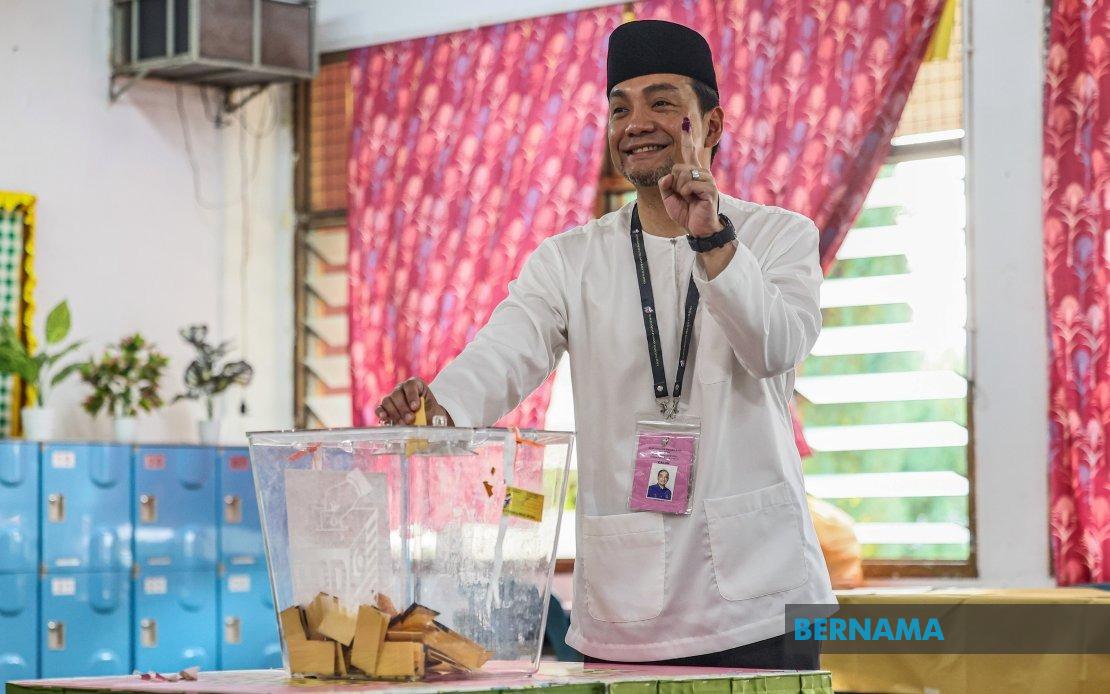
Johor Menteri Besar Datuk Onn Hafiz Ghazi exercised his franchise on Wednesday morning in the 16th state election, arriving at Sekolah Kebangsaan Simpang Renggam to vote at 8.33 am. The incumbent leader, who also chairs the Johor chapter of Barisan Nasional, took the opportunity to interact with other voters at the polling station, exchanging pleasantries and encouraging civic participation before proceeding to cast his ballot.
Onn Hafiz faces a two-way contest against Nur Hafiz Roslan of Pakatan Harapan as he pursues re-election to his position. His decision to personally engage with constituents during the voting process underscores the competitive nature of this election, particularly given the political dynamics that have reshaped Malaysia's electoral landscape in recent years. The direct challenger from the opposition coalition represents the central battle in what observers view as a significant test of voter sentiment in the southern state.
After completing his voting procedure in Stream 4, the Menteri Besar addressed media representatives with a call for broad public participation in the electoral process. He emphasised the importance of early turnout, framing voting as a fundamental democratic responsibility that extends beyond individual choice to encompass ensuring the efficient operation of polling stations throughout the day. This messaging reflects a common theme among political leaders seeking to legitimise their mandates through strong electoral participation.
The Johor election represents a pivotal moment for Barisan Nasional's coalition governance in the state, as voters determine whether the current administration receives continued confidence. For Onn Hafiz personally, a successful re-election would validate his leadership and provide a fresh five-year mandate to implement his administration's agenda. Conversely, an electoral setback would reshape the political balance in Johor and potentially signal shifts in voter preferences across the broader region.
Simultaneously at another polling station, Dr Maszlee Malik of Pakatan Harapan arrived at SJK (C) Tuan Poon in the same area to cast his vote for the Puteri Wangsa state seat contest. The former federal education minister faces a substantially more complex electoral scenario than Onn Hafiz, navigating a five-way race that includes multiple opposition and independent contenders competing for the same constituency.
Maszlee's opponents in the Puteri Wangsa contest span the political spectrum. Rashifa Aljunied represents MUDA, the younger Malaysian United Democratic Alliance that has emerged as a significant electoral force in recent years. Teow Chia Ling carries the Barisan Nasional banner, while Nicholas Paul Vincent campaigns for Parti Bersama Malaysia, a relative newcomer to the electoral arena. Additionally, independent candidate Wang Wee Siong seeks to capitalise on voter preference for non-partisan representation, a growing phenomenon in Malaysian elections.
The Puteri Wangsa multi-cornered contest illustrates the fragmentation occurring in Malaysian electoral politics at the state level. Rather than straightforward two-party or two-coalition competitions, constituencies increasingly feature five or more candidates drawing support from distinct voter segments. This atomisation complicates electoral mathematics and can produce outcomes where winning candidates represent minority preferences across the total vote cast, raising questions about representativeness and mandate clarity.
For Maszlee specifically, his transition from federal ministerial office to state-level electoral contest represents a repositioning within Pakatan Harapan's political hierarchy. His involvement in education policy during previous federal administrations provides name recognition and a platform based on governance experience, though state elections often turn on local issues and community relationships rather than national policy records. The competitive nature of the Puteri Wangsa race suggests that his ministerial background alone provides no guarantee of electoral success.
The 16th Johor state election carries implications extending beyond the state's boundaries. As Malaysia's largest state by population and a crucial economic hub, Johor's electoral outcome influences perceptions about governmental legitimacy and coalition stability nationwide. Additionally, the results may shape expectations for future national-level elections, as state contests frequently serve as indicators of shifting voter sentiment and emerging political trends.
Both contests occurring simultaneously in Simpang Renggam area underscore the geographic and institutional interconnection between state electoral politics. Voters in the same community determining outcomes for both the Menteri Besar position and the Puteri Wangsa seat effectively make compound choices about their state's future direction. The cumulative effect of numerous such local decisions across constituencies determines whether incumbent coalitions retain power or opposition alliances achieve breakthrough victories.
The voting process's efficiency and conduct remain significant considerations for election authorities managing simultaneous contests across multiple constituencies. Adequate polling station capacity, voter education, and administrative coordination become essential to fulfilling the democratic process smoothly. Both major candidates' public emphasis on encouraging early turnout reflects an understanding that electoral legitimacy depends partly on perceived fairness and accessibility of the voting process itself.
As voting continues throughout the day across Johor's constituencies, the results will determine not only the state's immediate political direction but also signal broader patterns in Malaysian electoral behaviour. The contests pitting establishment candidates like Onn Hafiz against challengers, combined with multi-way races fragmented among numerous candidates, present a complex portrait of contemporary Malaysian democracy at work at the subnational level.

