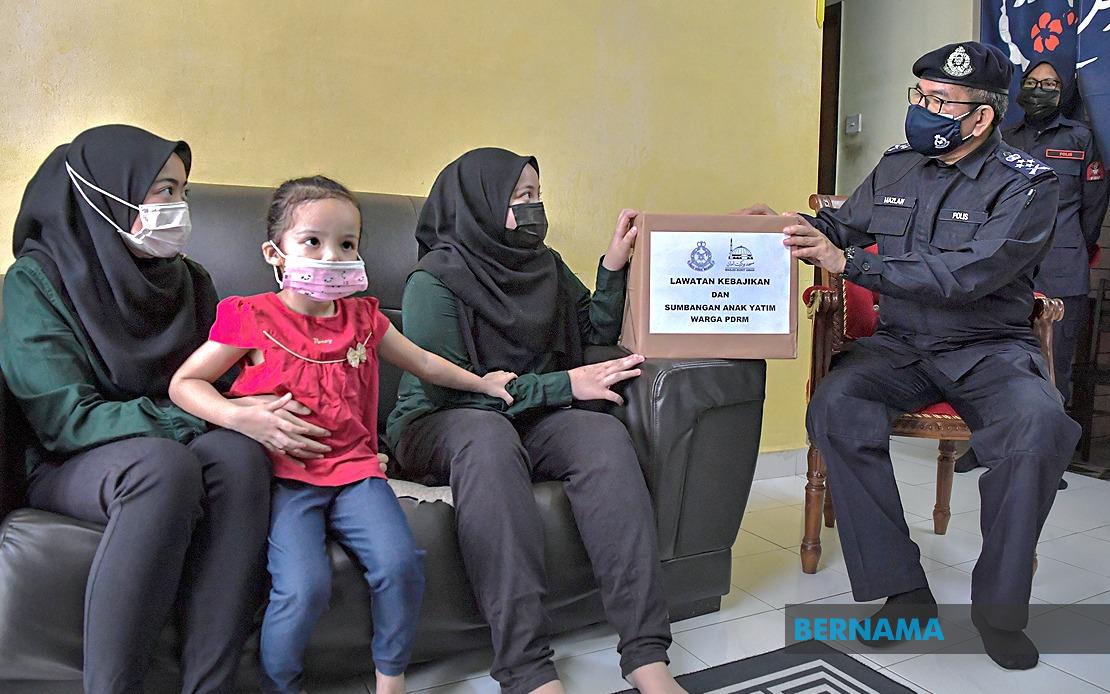
Auni Batrisya A. Rahman Siyutti's path to higher education reflects a determination forged through personal tragedy. At just 18 years old, the youngest of six siblings from Kampung Bukit Serdang in Air Panas Pengkalan Hulu, Perak, has navigated the loss of both parents while maintaining her academic aspirations. Her father, A. Rahman Siyutti, died from a heart attack in 2015, followed by her mother, Salbiah Ahmad, who succumbed to a lung infection in December 2021. Despite these devastating losses, Auni Batrisya has developed a steely resolve to build a better future for herself and support her grieving siblings.
Her determination caught the attention of Majlis Amanah Rakyat (MARA) chairman Datuk Dr Asyraf Wajdi Dusuki, transforming what could have been a routine bureaucratic process into a life-altering intervention. When Auni Batrisya visited the National Information Dissemination Centre (NADI) in Pengkalan Hulu to seek assistance acquiring a laptop—a necessity for her studies—she had already secured provisional admission to Politeknik Sultan Abdul Halim Muadzam Shah (POLIMAS) in Jitra, Kedah. The chance encounter led Asyraf Wajdi to contact her just days later with an alternative opportunity that would ultimately reshape her trajectory.
The placement at TVET MARA Seberang Perai Utara (SPU) offers Auni Batrisya enrolment in the Diploma in Electrical Engineering (Domestic and Industrial) programme, a field typically associated with strong employment prospects in Malaysia's manufacturing and energy sectors. What distinguishes this opportunity from typical vocational training placements is the additional layer of personal support Asyraf Wajdi has committed to providing. Beyond securing her institutional admission, he has extended an offer to become her foster parent, pledging to monitor her academic progress closely and provide comprehensive support for her material and educational needs throughout her studies.
For Auni Batrisya, the significance of this development extends far beyond immediate educational access. She views the diploma as both a personal achievement and a practical pathway to economic independence. Industry data suggests starting salaries for TVET graduates in electrical engineering fields range between RM4,000 and RM6,000 monthly—figures that would represent substantial household income elevation for her family. This financial prospect motivates her deeply, as she has explicitly stated her intention to repay her siblings' sacrifices and contribute meaningfully to household finances once she completes her training and secures employment.
The role of her siblings in enabling her educational pursuit cannot be understated. Her second brother, Mohd Zuhri, 36, has been instrumental in supporting Auni Batrisya's continued schooling during years of profound grief and uncertainty. He has witnessed firsthand her resilience through adversity—a quality he emphasises when describing his youngest sister. The family's collective sacrifice and Auni Batrisya's unwavering commitment to her studies demonstrate how household support systems, however strained by loss, can sustain academic ambition across generations.
Malaysia's Technical and Vocational Education and Training (TVET) sector has increasingly become positioned as a critical pathway for economically disadvantaged youth seeking stable employment. Unlike traditional university pathways that require significant upfront investment and extended study periods, TVET programmes emphasise practical competencies directly aligned with industry demands. For a student without parents to provide financial backing or professional guidance, this alternative route offers both accessibility and relevance. The electrical engineering specialisation Auni Batrisya has chosen taps into growing demand within Malaysia's industrial and infrastructural development initiatives.
The involvement of MARA, a government-linked development agency traditionally focused on bumiputera advancement, underscores institutional recognition of gaps in educational access among economically vulnerable households. TVET MARA SPU specifically serves the northern Perak region, making Auni Batrisya's admission particularly significant for rural communities where vocational training infrastructure remains relatively sparse compared to urban centres. The institution's location in Tasek Gelugor positions it within reasonable proximity to her Perak hometown, potentially allowing her to maintain family connections while pursuing her studies.
Auni Batrisya's registration at TVET MARA SPU, completed with her two older brothers present, marks a formal transition point in her journey from grieving teenager to vocational student with clear career direction. The public recognition of her story—and Asyraf Wajdi's personal intervention—also highlights how individual narratives of educational perseverance can influence institutional policy and foster care approaches. Her case demonstrates that orphaned and disadvantaged youth in Malaysia's secondary school system may lack not capacity or ambition, but rather visibility and institutional linkages that connect them to opportunity.
The foster care arrangement Asyraf Wajdi has initiated represents an innovative complementary support model. Rather than relying solely on institutional assistance, the addition of personal mentorship and welfare oversight addresses the holistic challenges facing parentless students navigating tertiary education. This approach acknowledges that educational success for vulnerable youth depends not only on tuition access but also on emotional support, practical guidance, and stable social bonds. The arrangement also signals MARA's willingness to extend support beyond conventional scholarships into sustained personal engagement.
Looking forward, Auni Batrisya's trajectory will likely influence perceptions of TVET pathways among Perak's orphaned and disadvantaged youth. Success in her diploma programme could generate broader institutional focus on identifying and supporting similar students who possess academic potential but face extraordinary socioeconomic barriers. Her story also reflects broader Southeast Asian patterns wherein vocational education increasingly offers viable alternatives to academic routes for economically constrained students seeking middle-class employment stability.
The timing of her admission carries additional significance within Malaysia's post-pandemic economic context. As labour market recovery emphasises skilled technical workers across manufacturing, construction, and utilities sectors, TVET graduates equipped with recognised qualifications face favourable employment prospects. For Auni Batrisya specifically, the electrical engineering specialisation positions her within sectors experiencing persistent worker shortages, enhancing her likelihood of gainful employment upon graduation and fulfilment of her commitment to her siblings.

