The authorities in Malaysia's three Federal Territories—Kuala Lumpur, Putrajaya, and Labuan—have rolled out an extensive flag distribution campaign ahead of the 2026 National Day and Malaysia Day celebrations. Since the beginning of August, a total of 62,386 Jalur Gemilang flags have been circulated throughout the region, appearing on protocol roads, public facilities, and residential neighbourhoods. This broad-based initiative reflects a concerted effort to foster national spirit during a significant moment in the Malaysian calendar, when citizens traditionally reflect on their nation's independence and shared values.
The campaign has been coordinated by Hannah Yeoh, the Minister in the Prime Minister's Department overseeing the Federal Territories portfolio. Yeoh emphasised that the distribution forms part of a larger push to encourage Malaysians to visibly demonstrate their patriotism and gratitude for the freedoms and independence the nation enjoys. Beyond physical flags, she has also urged citizens to extend this expression of national pride to social media platforms, creating a contemporary dimension to traditional flag-flying practices that resonates with younger demographics and digital-native communities.
A notable concern underpinning the campaign is the proper and respectful display of the national flag. Yeoh acknowledged that some citizens harbour anxieties about handling the Jalur Gemilang correctly, fearing they might inadvertently breach protocols or display etiquette. Rather than allowing such hesitation to dampen enthusiasm, the government has addressed this directly by making comprehensive guidelines readily available. Officials have emphasised that detailed resources—including visual examples and instructional materials—are accessible online to guide anyone uncertain about correct flag handling, thereby removing barriers to participation.
The emphasis on proper flag protocol extends beyond individual households to the corporate and commercial sectors. Yeoh advised business owners to ensure that their staff members responsible for hoisting or maintaining the Jalur Gemilang receive adequate training and understand the correct procedures. She further stressed that management should conduct regular inspections to prevent inadvertent errors, recognising that incorrect flag display in prominent commercial or institutional settings could send mixed messages about national respect. This two-tier approach—encouraging participation while enforcing standards—reflects a balanced strategy that seeks both widespread engagement and cultural dignity.
At the heart of this initiative lies a broader philosophy about cultivating patriotism from an early age. Yeoh expressed conviction that the spirit of flying the national flag should be normalised and instilled during childhood and school years, creating generational continuity in how Malaysians relate to their national symbols. By framing flag-flying not as an obligation bounded by bureaucratic rules but as an accessible and encouraged expression of identity, the campaign attempts to recast patriotic behaviour as inclusive rather than prescriptive. This pedagogical angle suggests that government thinking extends beyond the immediate 2026 celebrations to longer-term nation-building objectives.
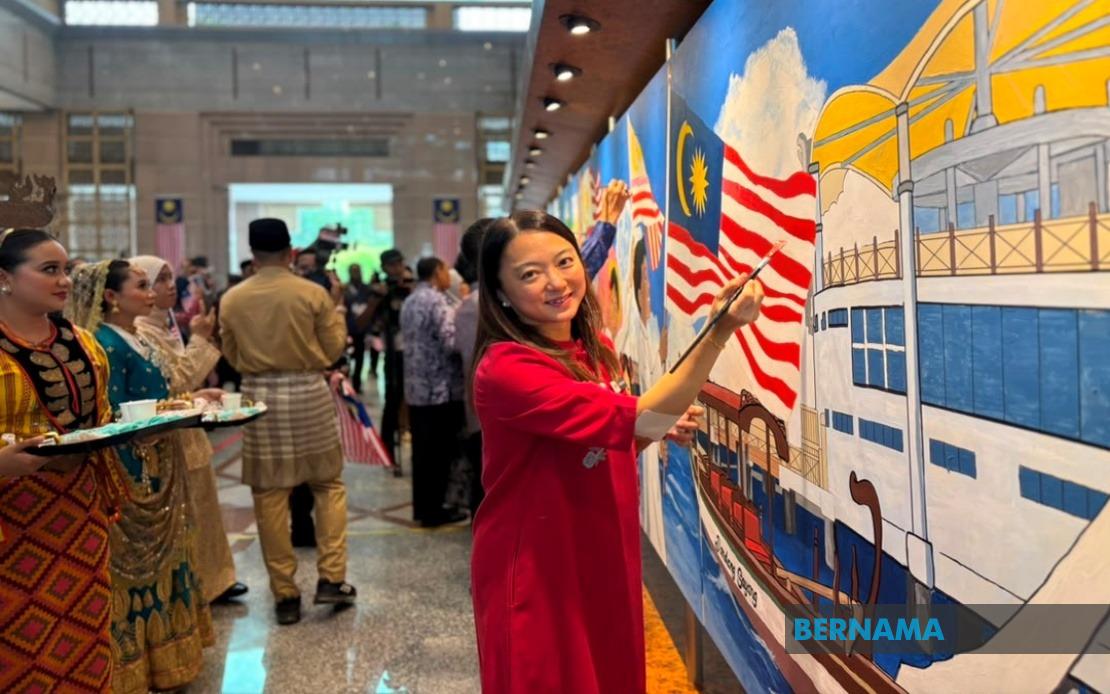
The campaign gained tangible expression through the Aspirasi Jalur Gemilang: Mural Kemerdekaan programme, which saw the completion of a distinctive public artwork at Menara Seri Wilayah in Putrajaya. The 25.40-metre-long Independence Mural represents a collaborative effort between Hannah Yeoh and personnel from the Federal Territories Department (JWP), transforming the abstract concept of national unity into a concrete visual landmark. The mural's design incorporates iconic architectural and geographical features representing all three Federal Territories—Kuala Lumpur's distinctive urban skyline, Putrajaya's purpose-built administrative landscape, and Labuan's maritime identity—alongside depictions of the Jalur Gemilang itself.
This artistic approach serves multiple communicative functions simultaneously. The mural functions as public commemoration and as educational material for residents unfamiliar with the geography and character of the Federal Territories. It grounds the abstract concept of national sovereignty in specific, recognisable places that Malaysians encounter in their daily lives. Furthermore, the public nature of the artwork and the involvement of government officials in its creation sends a signal that patriotic expression is not merely permitted but actively championed by those in authority. For residents of the Federal Territories, the mural becomes a shared point of reference and pride.
The involvement of senior officials amplifies the campaign's institutional weight. Beyond Hannah Yeoh's participation, the event included Datuk Muhammad Azmi Mohd Zain, the director-general of the Federal Territories Department, and Datuk Mohd Sakeri Abdul Kadir, president of Putrajaya Corporation. Their presence underscores that flag distribution and patriotic messaging represent priorities at the highest administrative levels, not merely grassroots initiatives. This hierarchical endorsement lends credibility and resources to the campaign while signalling to citizens that expressions of national pride carry official sanction and support.
For Malaysian and Southeast Asian observers, this flag distribution exercise reflects broader regional trends in how governments balance liberal democratic values with nationalist sentiment. Malaysia, as a multi-ethnic and multi-religious federation, has historically navigated the challenge of fostering cohesive national identity while respecting diverse community identities. The emphasis on accessibility and inclusivity in the flag campaign—removing anxiety and providing clear guidance—suggests an evolved approach that seeks to make patriotic expression welcoming rather than gatekept. This contrasts with some regional contexts where nationalist symbolism has become contentious or exclusive.
The timing of the campaign, launching in August ahead of August 31 National Day and September 16 Malaysia Day, reflects Malaysian institutional calendars. However, the emphasis on distribution and display protocols suggests that authorities recognise historical tensions surrounding flag etiquette in the country. By proactively addressing potential concerns and providing guidance, the campaign attempts to depoliticise flag-flying and reframe it as a universal, non-partisan expression of civic attachment. Whether this inclusive framing successfully broadens participation across Malaysia's diverse communities will become apparent as the 2026 celebrations approach.
The distribution of over 62,000 flags across the Federal Territories ultimately represents an investment in visible, material expressions of national identity at a scale and with intentionality that typically accompanies significant anniversaries or political inflection points. The 2026 celebrations will mark a notable moment in Malaysia's post-independence trajectory, and this early preparation suggests that government bodies are determined to ensure the occasion receives prominent public acknowledgment. Whether through flags on protocol roads, murals on prominent buildings, or social media expressions, the campaign seeks to transform individual acts of flag-flying into a collective national performance—one that, according to official messaging, should feel accessible, encouraged, and genuinely celebratory rather than obligatory or fraught with procedural anxiety.

