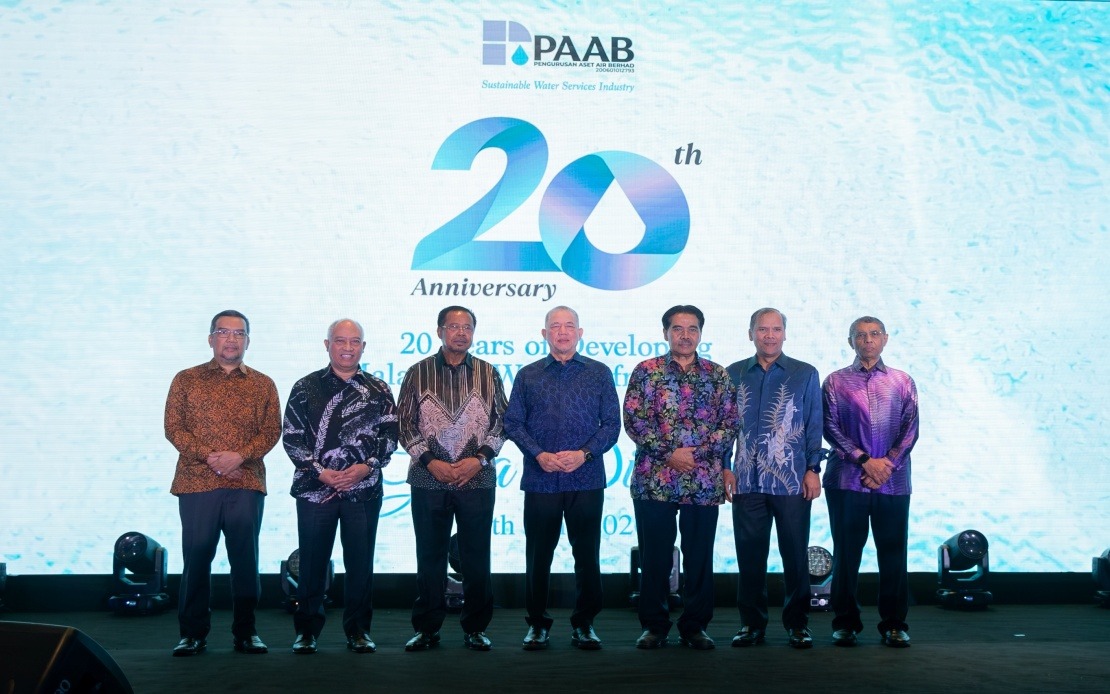
Malaysia's water asset management company, Pengurusan Aset Air Berhad (PAAB), reached a significant milestone this week as it marked two decades of driving restructuring in the country's water services sector. Established on May 5, 2006, as a wholly owned subsidiary of the Minister of Finance Incorporated, the organisation has become instrumental in reshaping how Malaysia manages and develops its critical water infrastructure—a transformation that remains central to the nation's economic competitiveness and public welfare. The milestone comes at a particularly acute moment, as the country grapples with persistent challenges in water delivery efficiency and distribution loss.
Over its 20-year tenure, PAAB has orchestrated a comprehensive financial and operational restructuring of the water industry. The organisation has assumed responsibility for RM23.04 billion in water sector loans previously scattered across multiple operators and state authorities, effectively consolidating the financial architecture of the industry under unified management. Simultaneously, the company has committed RM23.84 billion to capital investments in new infrastructure, bringing total financial commitments to RM46.88 billion. This scale of intervention positions PAAB as one of the largest drivers of public infrastructure development in Malaysia, with implications extending far beyond water delivery into economic development, public health, and environmental sustainability.
The physical footprint of these investments became tangible during ceremonies marking the anniversary. As of December 2025, ten Malaysian states have formally signed onto the National Water Services Industry Restructuring Plan, unlocking coordinated development across fragmented jurisdictions. The completed infrastructure now includes 21 water treatment plants collectively capable of processing 2,085 million litres daily, 42 storage facilities holding 783 million litres, and 3,263 kilometres of upgraded or newly laid pipe networks stretching across the nation. These figures translate into expanded capacity and modernised distribution networks, yet they simultaneously underscore how much more work remains to be done.
Deputy Prime Minister Datuk Seri Fadillah Yusof, who holds the portfolio of Energy Transition and Water Transformation Minister, used the occasion to deliver a notably candid assessment of the sector's most intractable problem: non-revenue water. This technical term refers to water that enters the distribution system but never reaches paying consumers—lost to leakage, theft, measurement errors, and system inefficiencies. At approximately 40 per cent nationwide, Malaysia's non-revenue water rate represents an enormous wastage of a finite resource and a persistent drag on the financial viability of water operators. For context, most developed nations operate systems with non-revenue water rates between 10 and 20 per cent, making Malaysia's figure a significant outlier.
Fadillah's remarks reflected frustration with the pace of improvement despite sustained investment. He argued forcefully that waiting for long-term remediation plans stretching to 2050 was inadequate given the urgency of the challenge. His insistence on coordinated and immediate action reflects a critical insight: new treatment plants and storage facilities, while essential, cannot solve the problem if the infrastructure delivering water to consumers remains riddled with leaks and losses. The Deputy Prime Minister specifically highlighted the stakes for Malaysia's economic future, noting that major foreign investors—particularly those in data centre development—require stable and abundant water supplies alongside reliable electricity. Data centre operators are increasingly attracted to Southeast Asia, but competition among nations for these high-value investments remains intense, and infrastructure reliability is a decisive factor in site selection.
The structural complexity of Malaysia's water challenge complicates rapid remediation. Water services remain primarily a state responsibility, creating 13 separate administrative jurisdictions across peninsular Malaysia, Sabah, and Sarawak. Federal oversight through bodies like the National Water Services Commission and PAAB must navigate these state prerogatives while incentivising uniform standards and coordinated action. Ten states having signed the Restructuring Plan represents meaningful progress, but complete national coverage remains elusive. Additionally, many of Malaysia's urban water networks were built decades ago and now require systematic replacement or rehabilitation—a capital-intensive undertaking competing with other infrastructure priorities.
PAAB's strategic framework envisages four distinct phases extending to 2050. The Migration phase (2008–2020) involved transferring assets and liabilities into the restructured framework. The Stabilisation phase (2021–2030) focuses on establishing operational consistency and improving financial viability. Consolidation (2031–2040) targets deeper integration and optimisation, while Full Cost Recovery (2041–2050) aims for water services to become fully self-sustaining without subsidy. This timeframe, while ambitious, underscores how entrenched the sector's structural challenges truly are. PAAB's chairman Datuk Seri Jaseni Maidinsa noted that the organisation measures success not merely by investment volume or assets constructed but by tangible improvements in water security and quality for Malaysian households and businesses.
Of the RM23.84 billion invested in capital expenditure through December 2025, approximately RM8.33 billion has been spent on completed projects handed to operators, RM1.84 billion supports projects currently under construction, and RM13.67 billion remains allocated for schemes still in design and planning phases. This distribution suggests that the most labour-intensive and capital-demanding work lies ahead. Ramping up delivery rates while maintaining quality and managing the non-revenue water problem simultaneously will test PAAB's operational capacity and the willingness of state governments to embrace change.
The challenges confronting Malaysia's water sector also carry profound implications for Southeast Asia's broader development. As regional economies compete to attract manufacturing, technology centres, and renewable energy facilities, water security increasingly determines investment patterns. Thailand, Vietnam, and Singapore have already undertaken substantial water infrastructure modernisation efforts. Malaysia's progress—or lack thereof—will shape investor confidence in the country's ability to support major industrial development. The data centre sector specifically represents a growing opportunity, but operators require guarantees of supply reliability that current loss levels cannot provide.
Malaysia's non-revenue water problem, while technically a utility management issue, ultimately reflects deeper questions about institutional capacity, political will, and investment prioritisation. Technology to detect and repair leaks exists and is being deployed, but scaling such measures across fragmented systems requires sustained coordination and funding. Fadillah's warning that ten years is insufficient to solve the problem reflects realism about the pace of systemic change, yet it also acknowledges that the current trajectory—driven by incremental improvements within existing structural constraints—will not suffice. Whether the next decade brings genuine acceleration or merely incremental progress remains the defining question for Malaysian water security.
As PAAB moves forward from its 20-year milestone, the organisation faces mounting pressure to demonstrate that financial restructuring and new infrastructure investment translate into tangible improvements in the water security experienced by ordinary Malaysians. The investment numbers are impressive, but they mean little if 40 per cent of treated water continues disappearing into leaking pipes before reaching consumers. Success will require not only continued capital deployment but also the political will to undertake system-wide reforms that may impose short-term disruption on existing water supply patterns. The next decade will reveal whether Malaysia's water sector restructuring represents transformational change or merely a more organised approach to managing persistent inefficiency.

