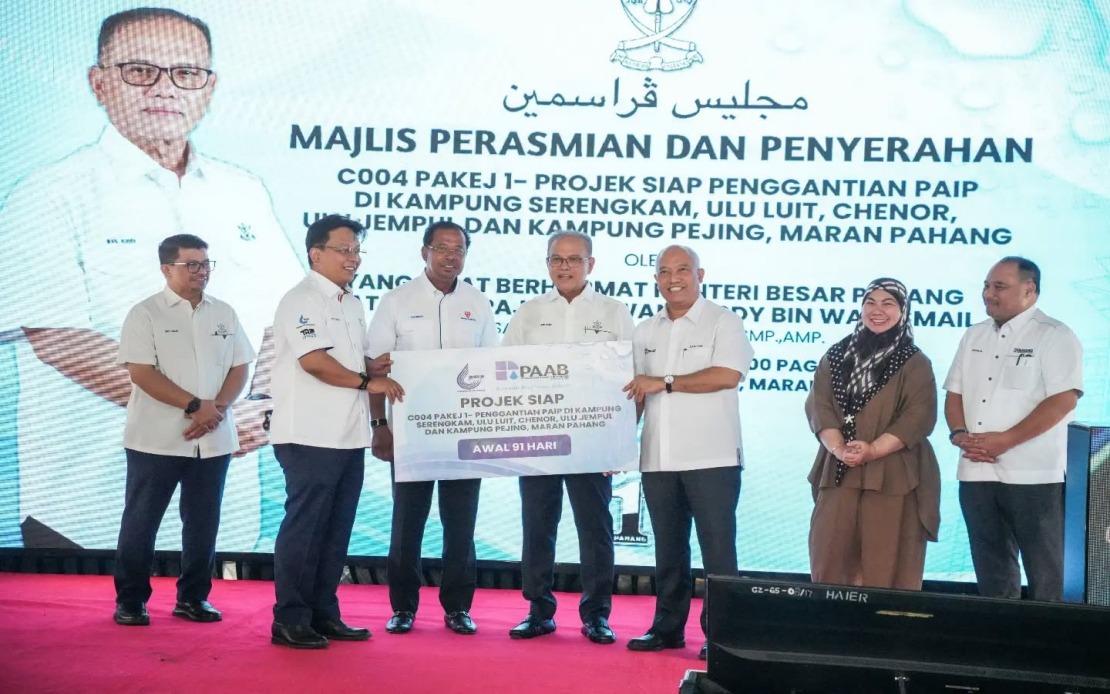
A major water infrastructure overhaul in Maran has finally brought relief to communities that have endured nearly 20 years of intermittent supply and pressure failures. Pengurusan Aset Air Berhad (PAAB) completed the RM11.19 million pipe replacement initiative three months ahead of schedule, with an official handover ceremony held today at the Chenor Water Treatment Plant by Pahang Menteri Besar Datuk Seri Wan Rosdy Wan Ismail.
The project targeted some of the most problematic zones in the district, where ageing infrastructure had created a cascade of service disruptions. Across five separate localities—Kampung Serengkam, Ulu Luit, Pejing, Ulu Jempul and Chenor—technicians replaced 29.6 kilometres of deteriorating pipes, a massive undertaking that required careful coordination to minimise further disruption to residents already accustomed to unreliable water access. The scale of the replacement speaks to how extensively the underground network had degraded over the years, with sections dating back decades in some cases.
The human impact of this infrastructure failure cannot be understated. Nearly 10,000 residents across Maran have depended on water supplies plagued by frequent burst pipes, particularly acute during dry seasons and major festive periods when demand surges strain an already fragile system. Households and businesses in Chenor sub-district bore the brunt of these disruptions, facing unexpected outages that disrupted daily routines, threatened food security for farming communities and created genuine hardship for families managing with unreliable water access.
Beyond restoring basic service continuity, the project addresses several interconnected infrastructure challenges that had compounded the problem. The replacement of pipes significantly reduces non-revenue water loss—water that seeps from deteriorated pipes before reaching consumers—a persistent drain on system efficiency that wastes both the precious resource and operational investment. By stabilising water pressure throughout the network, the new infrastructure ensures more equitable distribution, particularly benefiting residents at the end of supply lines who previously experienced the worst pressure failures. These improvements become especially critical during peak demand periods typical of Malaysian climate patterns and the consumption surges accompanying Aidilfitri, Chinese New Year and other major festivals.
PAAB's decision to fully fund the project underscores a strategic commitment to rehabilitating water infrastructure across economically significant regions. The company, established in 2006 under the Water Services Industry Act 2006 and wholly owned by Minister of Finance Incorporated, functions as the federal government's principal vehicle for implementing the National Water Services Industry Restructuring Plan. By absorbing the entire cost, PAAB has signalled that addressing chronic infrastructure deficits in districts like Maran represents a national priority rather than an expense to be passed to already-burdened state governments.
The Maran project represents merely one component of an ambitious three-year strategy that PAAB is executing jointly with Pengurusan Air Pahang Berhad (PAIP). This broader collaboration encompasses multiple high-impact initiatives across the state. Complementary work is already advancing in Jengka, where electrical upgrades at the Jengka Utama Water Treatment Plant's clean water pumping station will resolve longstanding supply disruptions affecting Felda settlements. Simultaneously, PAAB is undertaking a RM35.7 million endeavour to replace 76.2 kilometres of ageing pipes across Jerantut and Lipis, connecting peripheral areas around Pulau Tawar and Kuala Tahan that have suffered from similarly chronic infrastructure limitations.
Additionally, work in Felda Keratong exemplifies the multi-district approach. A RM13 million initiative targeting 11 kilometres of pipe replacement specifically aims to enhance water supply efficiency in Rompin district, addressing a region where agricultural communities particularly depend on reliable water access for both domestic and productive purposes. Each project responds to specific geographic and demographic circumstances, indicating that PAAB has moved beyond generic solutions toward tailored approaches reflecting local conditions.
The financial commitment underpinning these efforts is substantial and demonstrates genuine long-term engagement. As of July this year, PAAB had allocated RM1.17 billion specifically for Pahang water infrastructure projects. This allocation breaks down into RM69.79 million for projects already completed, RM66.94 million for projects currently under active construction and a substantial RM981.04 million earmarked for projects in planning and design phases. This distribution suggests that significant further work remains in the pipeline, with a multi-year trajectory of continued investment extending well beyond immediate needs.
For Malaysian readers, particularly those in Pahang and other East Coast states, the Maran project illustrates how national water sector reform is transitioning from policy announcements to tangible infrastructure outcomes. Malaysia's water sector has long been criticised for fragmentation, aging infrastructure and inefficient operations, particularly in rural and semi-urban areas that fall outside the spotlight of major urban centres. PAAB's structured approach to systematic pipe replacement, combined with related electrical and operational upgrades, represents the kind of comprehensive intervention that experts have advocated as necessary to transform water services from crisis-management mode into sustainable reliability.
The regulatory framework governing these initiatives reinforces their strategic significance. PAAB operates under oversight from the Ministry of Energy Transition and Water Transformation (PETRA), positioning water infrastructure within the broader energy and environmental transition agenda. PAIP's signing of the Pahang State Water Supply Services Restructuring Agreement in 2020 formalised collaborative mechanisms that now enable coordinated investment and planning across state-managed assets. This institutional architecture means that improvements like those in Maran reflect not isolated charity but systematic policy implementation.
Looking forward, the implications extend beyond Pahang's borders. As water scarcity and infrastructure inadequacy emerge as increasingly acute challenges across Southeast Asia, Malaysia's efforts to modernise and rehabilitate its water systems carry regional significance. The visible success of projects like Maran's pipe replacement, where tangible benefits reach nearly 10,000 residents within a defined timeframe, provides both domestic validation for continued investment and evidence of the feasibility of large-scale infrastructure transformation. The federal government's goal of cultivating a water sector that is more resilient, efficient and sustainable gains credibility through such concrete demonstrations of commitment and capability.
For communities like those in Maran who have endured two decades of intermittent supply, the completion of this infrastructure project represents vindication of their persistence in demanding better service and evidence that government institutions, despite chronic pressures and competing demands, can ultimately deliver meaningful improvements to fundamental services that enable dignified living standards and genuine development opportunity.

