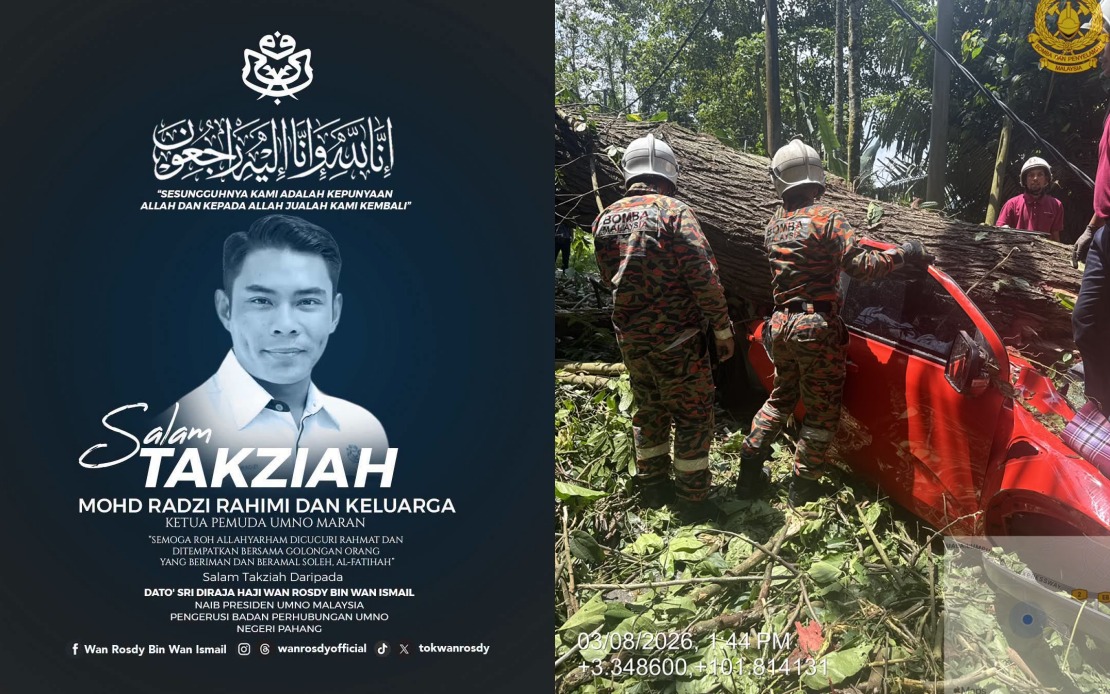
The Pahang political establishment is mourning the unexpected death of Mohd Radzi Rahimi, the chief of Maran UMNO Youth, who was killed in a tragic accident on the old Kuala Lumpur-Bentong road near Janda Baik. The incident, which involved a four-wheel-drive vehicle being crushed by a fallen tree, claimed four lives and left a child injured. The loss has reverberated across party structures at the division, state, and national levels, with senior leaders reflecting on the contributions Rahimi made to youth mobilization and community engagement in Pahang.
In his statement, Pahang Menteri Besar Datuk Seri Wan Rosdy Wan Ismail characterized Rahimi—commonly known as Edy Radzi—as someone who embodied a service-oriented approach to politics. The description of Rahimi as a leader who consistently prioritized community welfare underscores the value placed on grassroots engagement within UMNO's organizational hierarchy. This personal dimension to the tribute signals how the accident has affected not just the formal party apparatus but also the relationships built through day-to-day youth work in the constituent assembly.
The victims of the tree-falling incident extended beyond Rahimi. Nuriani Mohammad Jafri, her son Muhammad Rizz Hazim, and her younger brother Mohammad Nizam also perished in the tragedy. The concentration of fatalities in a single vehicle highlights the random and devastating nature of such accidents along Malaysian highways, particularly during weather conditions that may render trees unstable. The incident underscores ongoing safety concerns on older arterial routes connecting urban centres, where maintenance and hazard mitigation remain inconsistent.
Wan Rosdy emphasized that Rahimi's loss resonated across multiple organizational echelons. Beyond his role as Maran UMNO Youth chief, Rahimi's involvement extended to the broader Pahang UMNO Youth movement and the state liaison committee's operations. This multi-level engagement suggests that Rahimi had cultivated relationships and credibility that transcended his specific divisional position, positioning him as a rising figure within the party's youth wing. Such individuals often serve as bridges between grassroots concerns and party leadership, making their sudden absence felt acutely.
The condolence message issued by UMNO Youth chief Datuk Dr Muhammad Akmal Saleh at the national level indicates that Rahimi's profile had gained recognition beyond Pahang. In Malaysian political culture, youth chiefs occupy strategic positions within their respective parties, responsible for mobilizing younger voters, organizing community programmes, and developing future leadership cadres. Rahimi's death thus removes not only an individual but potentially disrupts organizational continuity and mentorship networks within UMNO's youth structure.
From a broader political perspective, the incident highlights vulnerabilities in Malaysia's infrastructure safety systems. The old Kuala Lumpur-Bentong road, while bypassed by newer expressways, still carries significant traffic and remains a vital link for communities in that corridor. The tree-falling incident suggests that periodic maintenance, vegetation management, and hazard assessment along such routes require more rigorous implementation. Authorities responsible for highway safety will likely face questions about inspection protocols and preventive measures.
The tragedy also touches on the human dimension of political leadership in Malaysia. While politicians are often perceived through the lens of power and position, Rahimi's characterization as a leader focused on serving people rather than merely holding office reflects an idealized vision of public service that resonates within UMNO's discourse. Whether accurate or partly ceremonial, such tributes establish expectations for how leaders should conduct themselves, particularly those in youth-facing roles where idealism and authentic engagement carry weight.
For Pahang UMNO specifically, the loss creates immediate succession questions. The Maran division will need to identify a new youth chief, and that selection process will likely involve considerations of experience, local rootedness, and ability to maintain Rahimi's perceived legacy of community engagement. Such transitions, while routine in organizational terms, carry political weight in Malaysia's federal system, where divisional strength translates into electoral performance and influence within state governance structures.
The incident also serves as a sobering reminder of mortality and vulnerability that transcends political rank. Whether one holds position within party hierarchies or operates in the private sphere, accidents of this nature strike indiscriminately. The injury sustained by a child in the vehicle adds another layer of tragedy, highlighting the collateral human cost beyond the four fatalities. This broader context of loss and grief shapes how communities process such incidents and how political organizations memorialize their fallen members.
Moving forward, Rahimi's memory will likely be preserved through organizational tributes, perhaps through initiatives bearing his name or commemorating his contributions to Maran and Pahang UMNO Youth. In Malaysian political culture, fallen leaders are often lionized, their shortcomings overlooked in favour of celebrating their idealized contributions. Whether sustained memorialization occurs will depend partly on the institutional mechanisms UMNO establishes and the degree to which Rahimi's family and colleagues remain engaged with such efforts. For now, the immediate focus rests on condolences and supporting those bereaved by this sudden tragedy.

