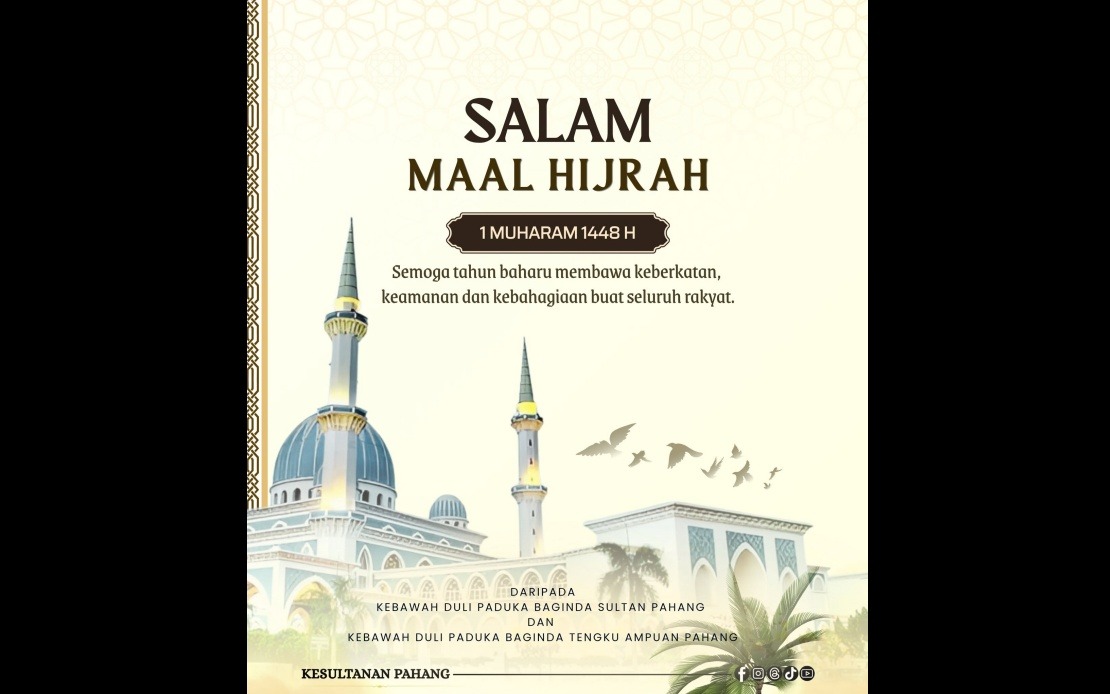
The Sultan of Pahang, Al-Sultan Abdullah Ri'ayatuddin Al-Mustafa Billah Shah, and the Tengku Ampuan of Pahang, Tunku Azizah Aminah Maimunah Iskandariah, have marked the beginning of the Islamic year 1448 Hijrah by sharing their good wishes with the Muslim community across the state. Through an official statement released via the Kesultanan Pahang's social media channels on June 16, the royal couple conveyed their hopes that the new Islamic year would usher in an era enriched by divine grace, tranquility and contentment for all residents of Pahang.
The gesture reflects a longstanding tradition where Malaysian royalty addresses the Muslim populace during significant religious occasions, reaffirming their role as custodians of Islamic values within their respective territories. For Pahang, one of the oldest sultanates in the Malaysian federation, such pronouncements carry particular weight given the state's historical importance to Islam in the region and its status as a major population centre in peninsular Malaysia.
Pahang's leadership has extended the occasion as an opportunity for introspection and spiritual recommitment. Menteri Besar Datuk Seri Wan Rosdy Wan Ismail used the platform to encourage Muslims throughout the state to view the new Islamic year as a fresh beginning. His message emphasised the importance of Muslims using this moment to reassess their personal resolutions, deepen their connection to Islamic teachings, and expand their engagement in acts of charity and compassionate service.
The Menteri Besar drew a deliberate parallel between the Hijrah—the Prophet Muhammad's historic migration from Mecca to Medina—and the contemporary challenges facing Malaysian society. This framing transforms a commemorative religious observance into a call for actionable social change. He stressed that embodying the spirit of the Hijrah requires more than ritualistic acknowledgement; it demands tangible transformation in how individuals and communities conduct themselves.
Central to Wan Rosdy's message was an appeal for enhanced social cohesion at a time when Malaysian society faces pressures from various quarters. He called upon residents to strengthen the bonds of unity, a particularly resonant theme in a diverse state like Pahang where multiple ethnic and religious communities coexist. The emphasis on unity serves both a spiritual purpose—drawing together the Muslim population around shared values—and a practical governance objective of fostering social stability.
Integrity featured prominently in the state leadership's vision for the new Islamic year. The Menteri Besar highlighted the need to instil integrity as a foundational value across society, addressing concerns about ethical standards in both public and private spheres. This emphasis reflects broader conversations in Malaysia about governance, transparency, and the moral dimensions of development, particularly as the nation pursues economic and social progress.
Wan Rosdy's statement also connected spiritual renewal directly to state development goals. Rather than treating religious observance and economic advancement as separate domains, the message integrated them, suggesting that deepened faith and moral commitment naturally lead to better stewardship of resources and more effective governance. This approach aligns with Islamic principles that view worldly success and spiritual growth as complementary rather than contradictory.
The timing of these messages coincides with a period when Malaysian states are navigating post-pandemic recovery and pursuing ambitious development agendas. For Pahang specifically, which has undergone significant infrastructure expansion and economic diversification initiatives, the religious leadership's call to strengthen commitment to state development carries contemporary relevance. The message implicitly acknowledges that sustainable progress depends not merely on capital investment and technical expertise, but on the moral and spiritual foundation of the populace.
The invocation of divine blessing at the conclusion of the Menteri Besar's remarks reflects the integration of Islamic concepts within Malaysia's constitutional framework, where the Yang di-Pertuan Agong and state sultans hold formal positions as protectors of Islam. These messages thus operate simultaneously on multiple registers: as spiritual exhortations to the Muslim faithful, as expressions of state values, and as governance communications affirming the leadership's commitment to holistic development that encompasses both material and moral dimensions.
For Malaysian readers, particularly those in Pahang and neighbouring states, these greetings underscore how religious occasions serve as platforms for leaders to articulate their vision for society. The emphasis on unity, integrity and spiritual deepening in the context of state development suggests that the Pahang leadership views the Islamic calendar not merely as a marking of time, but as a framework for reflecting on collective progress and shared responsibilities. Such messages contribute to the ongoing conversation about what kind of society Malaysians are building and what values should guide that endeavour as the nation moves forward.