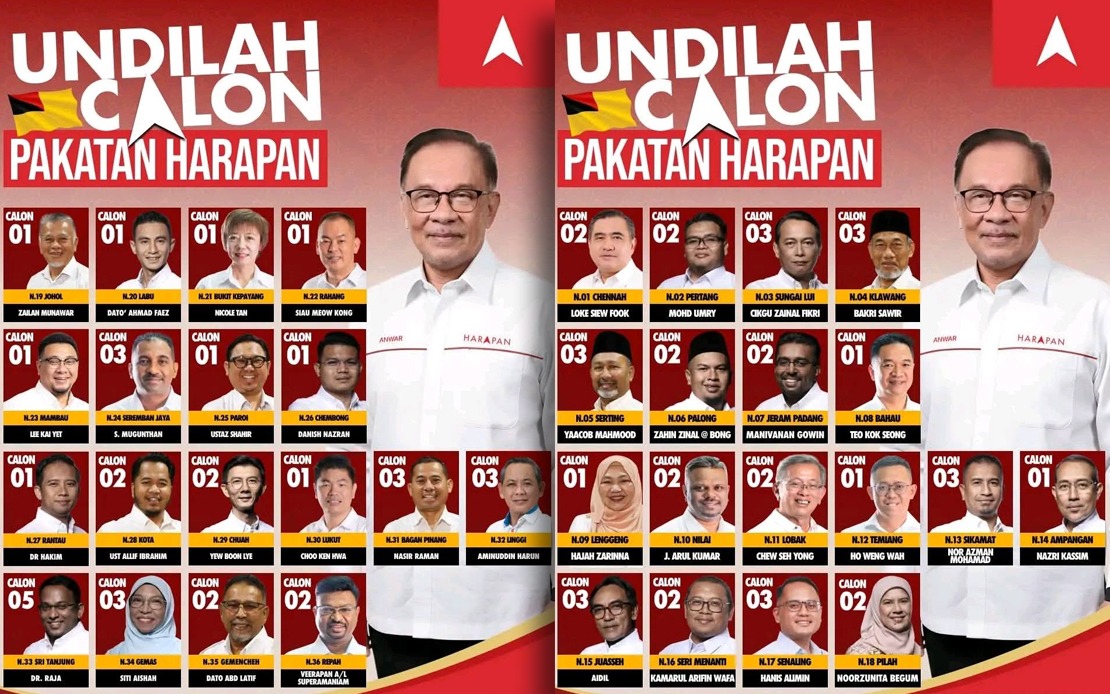
Pakatan Harapan is pursuing a commanding victory in the Negeri Sembilan state election scheduled for August 1, targeting at least 23 of the 36 available seats to build a government with sufficient stability and resilience. Deputy chairman Anthony Loke outlined the strategy during a campaign dinner in Seremban, emphasising that winning beyond a bare majority is essential for effective administration in the state.
The coalition's current strength of 17 assemblymen falls well short of the 19 seats required for simple majority control, creating vulnerability in a closely contested political environment. Loke stressed that holding exactly 19 seats, while technically sufficient to form government, leaves little room for error and could expose the coalition to defections, unexpected absences, or procedural challenges that might undermine its legislative agenda. The additional four-seat buffer sought through the 23-seat target would provide the breathing room necessary to weather political pressures and maintain continuity in governance.
Loke, who serves as both Seremban MP and assemblyman for Chennah, grounded the target in empirical analysis rather than mere ambition. The party has conducted demographic studies of electoral areas and voter composition across the state, identifying constituencies where PH possesses realistic prospects of victory. This data-driven approach suggests the 23-seat goal reflects genuine competitive positioning rather than wishful thinking, though electoral surveys can often underestimate organisational challenges and ground-level dynamics.
A central pillar of PH's Negeri Sembilan campaign revolves around retaining Menteri Besar Datuk Seri Aminuddin Harun, whom Loke characterised as an administrator of integrity and humility. The party is framing the election as a referendum on Aminuddin's performance, arguing his record demonstrates competence in steering development initiatives and maintaining inclusive governance across communal lines. This personalisation of the campaign reflects a broader PH strategy of anchoring state campaigns to popular incumbents whose track records can speak for themselves.
The emphasis on inclusion and multi-racial governance represents PH's attempt to position itself as a coalition transcending ethnic and religious divisions. Loke articulated this vision explicitly, noting that PH government exists to serve all citizens regardless of background, a message pitched to increasingly heterogeneous voter bases across urban and semi-urban areas of the state. Such framing seeks to counter opposition narratives depicting PH as beholden to particular communities and challenges the traditional communal polarisation that has long defined Malaysian state politics.
Connectivity improvements between Seremban and Kuala Lumpur featured prominently in Loke's appeal to voters, suggesting that PH intends to campaign on tangible infrastructure and quality-of-life improvements. As Negeri Sembilan sits geographically between the national capital and the southern states, enhanced transport links carry economic significance for residents commuting to employment in Kuala Lumpur and for businesses seeking to access broader markets. Framing development continuity as dependent upon stable government creates a utilitarian argument for voter support beyond traditional partisan appeals.
Beyond state-level politics, Loke sought to broaden the campaign narrative by invoking Prime Minister Datuk Seri Anwar Ibrahim's international diplomacy and its domestic economic consequences. His assertion that Malaysia has avoided fuel shortages experienced elsewhere stems from maintaining constructive relations with oil-producing nations including Russia, a claim that underscores how foreign policy performance intersects with cost-of-living concerns affecting ordinary Malaysians. This linkage between international statecraft and household pocketbooks represents an unconventional but potentially potent campaign argument, particularly for voters experiencing economic strain.
Loke's reference to Malaysia's diplomatic engagement with diverse powers—China, the United States, India, Türkiye, Brazil, and Russia—characterises the Anwar government as actively managing Malaysia's position in an increasingly multipolar international order. The implicit message positions PH as a force sustaining Malaysia's strategic autonomy and economic resilience through adroit diplomacy. Such rhetoric appeals particularly to voters concerned about Malaysia's geopolitical standing and vulnerability to external economic shocks.
The explicit call for objective assessment of Prime Minister Anwar's leadership suggests PH recognises public scepticism toward national government and seeks to reframe the evaluation criteria. Rather than accepting opposition characterisations, Loke invites voters to judge the Prime Minister against international standards and outcomes, a rhetorical move that shifts the burden of proof onto critics to demonstrate tangible failures. This defensive posture indicates awareness that national sentiment may not automatically translate into enthusiasm for state-level PH candidates.
The presence of DAP national chairman Gobind Singh Deo and other party leaders at the Seremban dinner underscores the coalition's concentration of resources and attention on Negeri Sembilan, signalling that the state election carries weight beyond its immediate territorial significance. As DAP holds substantial representation within PH, the party's performance in Negeri Sembilan will be closely scrutinised as a barometer of coalition health and electoral competitiveness heading into potential future national contests.
The 23-seat target occupies a strategic position within Malaysian electoral mathematics, representing neither overconfidence nor undue caution. Should PH achieve this figure, it would provide the coalition with a commanding presence in the state assembly and substantial leeway for policy implementation without constant legislative anxiety. Conversely, falling short of this target while maintaining the 19-seat minimum would vindicate opposition claims of declining PH support and potentially embolden coalition partners or dissident lawmakers to extract greater concessions.
For Malaysian voters, particularly those in Negeri Sembilan, the state election presents an opportunity to evaluate PH's governance record since the 2022 general election and to assess whether the coalition's message of inclusive, competent administration resonates sufficiently to justify an expanded mandate. The outcome will reverberate beyond state boundaries, influencing perceptions of PH's momentum and viability as a governing force heading into the remainder of the current parliamentary term.

