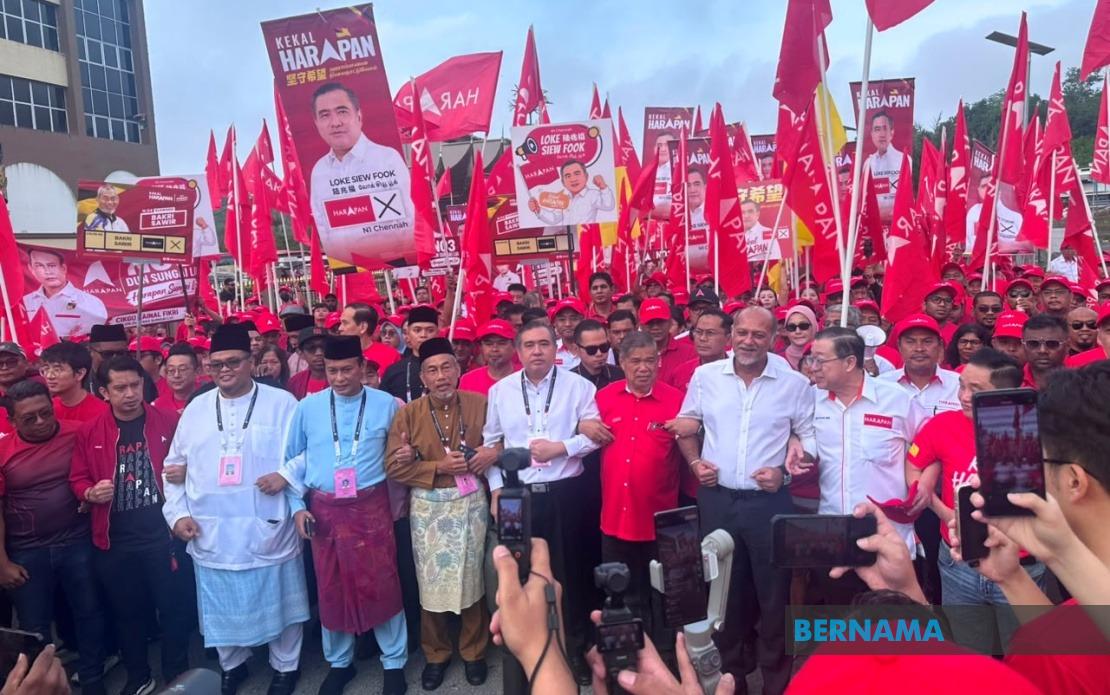
The Pakatan Harapan coalition deployed its senior leadership across Negeri Sembilan on July 18 to publicly endorse candidates submitting their nomination papers for the 16th state election, a show of force that underscored the coalition's determination to consolidate its hold on the legislature. The coordinated turnout of ministers and party officials at multiple nomination centres demonstrated PH's strategic approach to the contest, where it seeks to maintain the majority it won in 2023.
In Jelebu, Transport Minister Anthony Loke, who serves as DAP secretary-general, lodged his own nomination papers for the Chennah state seat at Dewan Besar Kuala Klawang, flanked by a delegation that included DAP chairman Gobind Singh Deo, former Finance Minister Lim Guan Eng, and Amanah president Datuk Seri Mohamad Sabu. This convergence of party heavyweights at a single nomination centre reflected the significance PH attached to retaining influence across different constituencies and demonstrated the coalition's internal cohesion despite occasional public tensions between its component parties.
Across the state's administrative divisions, party operatives orchestrated similar backing for candidates filing in different districts. In Jempol, Deputy Communications Minister Teo Nie Ching, who leads the women's wing of the DAP, shepherded PH nominee Teo Kok Seong through the submission process for the Bahau seat, where he seeks to retain the position he has held since the 2018 general election. The presence of Communications Minister Datuk Seri Fahmi Fadzil at the same venue underscored the importance of this district to PH's overall strategy, as he supported four separate candidates contesting the Serting, Palong, Jeram Padang and Bahau seats.
Fahmi's role in shepherding multiple nominees highlighted a deliberate division of labour within PH's campaign machinery. Alongside the incumbent Teo, the coalition fielded three first-time candidates: Yaacob Mahmood, Muhammad Zahin Zinal Abidin and Manivanan Gowin. This mix of experienced legislators and fresh faces suggests PH's attempt to balance continuity with renewal, a strategy increasingly common among Malaysian political coalitions seeking to respond to voter fatigue while preserving institutional knowledge.
In Port Dickson, Negeri Sembilan Menteri Besar Datuk Seri Aminuddin Harun, who also chairs PH's state branch, arrived at the District Administration Complex to file his nomination for the Linggi seat. His entourage included DAP deputy secretary-general Hannah Yeoh, PKR secretary-general Datuk Dr Fuziah Salleh, and the Prime Minister's political secretary Datuk Farhan Fauzi. The presence of this constellation of federal and state-level figures suggested anxiety within PH about protecting the menteri besar position, a symbolically crucial role for maintaining coalition dominance in the state.
Aminuddin was accompanied by three state incumbents seeking re-election: Yew Boon Lye from Chuah, Choo Ken Hwa from Lukut, and Dr G Rajassekaran defending Sri Tanjung. These recurring candidates form the backbone of PH's legislative contingent and their continued candidature signals party confidence in their electoral prospects. However, the reliance on these incumbents also raises questions about whether PH is adequately regenerating its talent pool in a state where political competition remains intense.
In Seremban, Minister for Entrepreneur and Cooperatives Development Steven Sim conducted yet another endorsement operation, presenting six PH nominees at Wisma Majlis Bandaraya Seremban nomination centre. Reinforcing Sim's efforts were Selangor State Legislative Assembly Speaker Lau Weng San, Bukit Gelugor MP Ramkarpal Singh and PKR vice-president Datuk Seri R. Ramanan. The deployment of figures from outside Negeri Sembilan, particularly from neighbouring Selangor, demonstrates how Malaysian political coalitions now operate as integrated campaign machines, with resources and personnel flowing across state boundaries to support key contests.
The coordination across multiple nomination centres reflects PH's recognition that this election carries implications beyond Negeri Sembilan's borders. Negeri Sembilan's 36 legislative seats represent a microcosm of national political balance, and the coalition's performance here could influence morale within its three constituent parties and send signals to voters in other states. In the 2023 state election, PH secured 17 seats compared to Barisan Nasional's 14 and Perikatan Nasional's five, a distribution that provides the coalition with a working majority but leaves limited room for complacency.
The state assembly's dissolution on June 5, following consent from Yang Dipertuan Besar of Negeri Sembilan Tuanku Muhriz Tuanku Munawir, triggered the nomination process and set in motion a campaign that would determine whether PH could hold ground against BN's resurgence and PN's continuing challenge for opposition Malay votes. Early voting was scheduled for July 28, with the main polling date set for August 1, compressing the campaign into a brief window that would test each coalition's organisational capacity.
The visible mobilisation of federal ministers and party machinery at nomination centres carries multiple strategic messages. For PH supporters, it signals that the coalition treats this state election as consequential and worthy of investment from the national leadership. For rival parties, it demonstrates PH's confidence and organisational depth. For the wider Malaysian electorate, the spectacle of coordinated senior leadership appearances reflects how contemporary state elections have become occasions for testing national political narratives and coalition mechanics.
The interplay between state-level challenges and federal political positioning remains critical to understanding Negeri Sembilan elections. Aminuddin's tenure as menteri besar depends partly on his ability to retain an electoral majority, while his standing within PH's federal hierarchy influences his capacity to attract resources and talent to the state coalition. Similarly, the appearance of figures like Lim Guan Eng, whose political rehabilitation after previous controversies remains a subject of internal coalition dynamics, sends signals about where each PH component party stands in the national pecking order.
For Malaysian observers tracking intra-coalition dynamics, the nomination day turnout offered glimpses into PH's internal workings. The balanced representation of DAP, PKR, and Amanah figures across different constituencies suggests careful negotiation over seat allocation, reflecting broader patterns of power-sharing that define PH's unstable equilibrium. Whether this orchestrated unity could survive the rigours of a competitive campaign remained uncertain, particularly if early opinion polling suggested vulnerability in any particular district.

