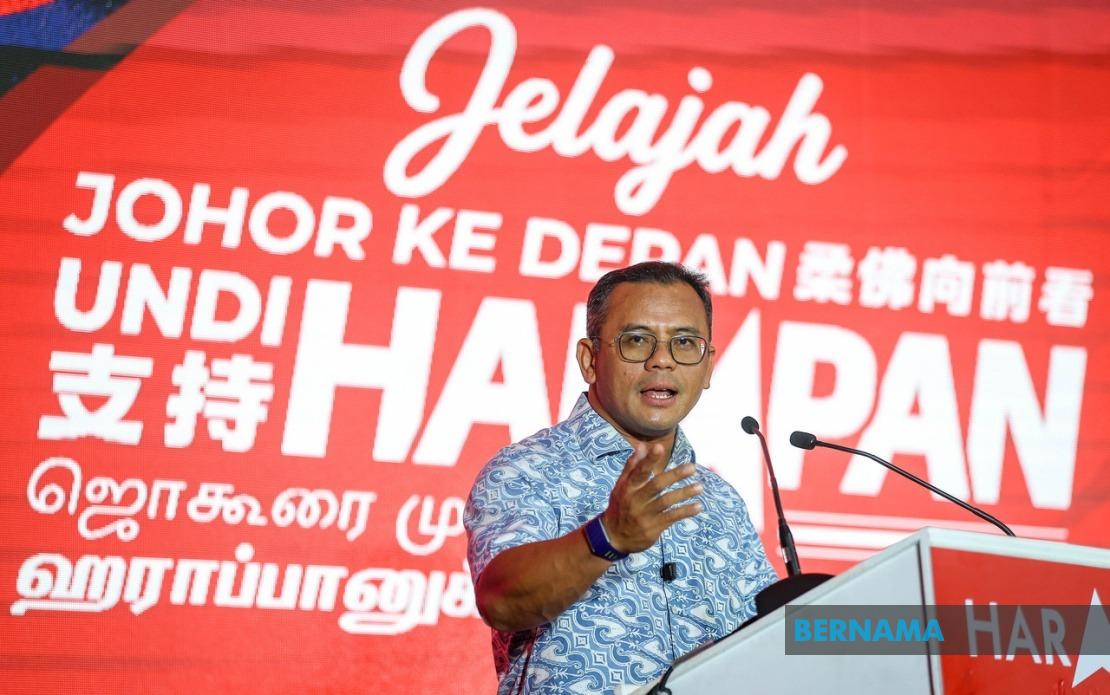
Pakatan Harapan has framed its participation in the upcoming Johor state election as a blueprint for transforming the state's economic landscape, moving beyond what party leaders describe as the concentrated development that has long characterised the region. Speaking in Batu Pahat on July 1, PKR vice-president Datuk Seri Amirudin Shari—who doubles as Selangor Menteri Besar—articulated a vision that extends opportunity beyond the traditional economic powerhouse of Johor Bahru, arguing that the state's true potential remains largely untapped across its less developed districts. This messaging represents a calculated effort to position PH as an agent of structural economic reform in a state where governance will be contested on July 11, with early voting set for July 7.
The coalition's central grievance centres on what Amirudin characterises as a pronounced geographic imbalance in prosperity and opportunity. Rather than viewing Johor as a monolithic entity dominated by its southern commercial hub, PH highlights the relative neglect of the northern, eastern, and western districts, which have languished in the shadow of Johor Bahru's dominance. The income disparity between Johor Bahru and Segamat, mentioned specifically by Amirudin, serves as a concrete illustration of this inequality. This regional fragmentation has created a two-tier economy where wealth and employment remain concentrated in the state capital, while peripheral areas struggle to diversify their economic base or attract comparable investment. The party's framing suggests that rectifying this imbalance is not merely a matter of local administration but a fundamental question of social cohesion and equitable opportunity across the state.
To bolster its argument, PH cites comparative investment and employment data that reveals troubling gaps between Johor and its sister state Selangor. While Johor recorded RM101 billion in investments during the preceding year, the number of jobs created fell significantly short of similar investment levels in Selangor, which attracted RM83 billion yet generated 60,000 new employment opportunities compared to an estimated fewer than 40,000 in Johor. This disparity raises questions about the quality and labour intensity of investments flowing into the state, suggesting that Johor is attracting capital-heavy projects that employ fewer workers relative to funding received. For a state seeking to absorb its growing workforce and retain young professionals, this employment generation gap poses a significant political vulnerability, particularly when competing states demonstrate superior capacity to convert investment into genuine livelihood opportunities.
The coalition's proposed solution hinges on strategic alignment between state governance and federal initiatives, specifically the Johor-Singapore Special Economic Zone (JS-SEZ). Rather than attempting to compete with Singapore as a standalone entity, PH envisions leveraging federal government backing to create competitive advantages within this binational framework. The logic is straightforward: by channelling high-impact investments through a coordinated state-federal approach that capitalises on Singapore's proximity, Johor can generate employment in sectors that command higher wage premiums. This would theoretically address a persistent migration challenge whereby thousands of Johoreans commute daily across the border to secure better-paying opportunities, a pattern that represents both a loss of economic productivity for Johor and a demographic brain drain.
For Malaysian readers, particularly those in Johor, the employment dimension of PH's pitch carries immediate resonance. The daily cross-border commute has become normalised in the Johor-Johor Bahru-Singapore corridor, reflecting a resignation that quality employment simply exists elsewhere. By pledging to reverse this dynamic through superior investment and job creation strategies, PH is essentially promising to restore economic self-sufficiency to the state. This addresses not merely personal finances but deeper anxieties about local economic vitality and whether Johor's future will be shaped by local decision-making or by dependency on external economic forces. The credibility of this pledge will likely hinge on whether voters perceive PH—particularly in Selangor—as genuinely committed to replicating its employment generation success in a different political and economic context.
Amirudin's assertion that PH seeks to establish Johor as the "Jewel of the South" represents both a rhetorical flourish and a substantive repositioning of how the state should define itself. Rather than accepting the narrative of Johor as primarily a buffer zone or satellite to Singapore, the framing elevates the entire state as a destination worthy of pride, investment, and centre-stage political attention. This rebranding is not incidental; it reflects an understanding that perception shapes investment decisions, workforce retention, and political legitimacy. A state that sees itself as capable of generating prosperity internally will project different signals to investors and residents than one that implicitly cedes economic leadership to its neighbours.
The emphasis on an "open leadership approach" constitutes a further implicit critique of current governance, suggesting that decisions affecting Johor's development have been made through channels insufficiently responsive to broader stakeholder input. PH's commitment to greater transparency and inclusivity in governance decisions appeals to constituencies that feel excluded from economic planning processes. This resonates particularly in districts beyond Johor Bahru, where residents may perceive that their interests receive minimal consideration in state-level strategic planning. For a coalition that has staked its political fortunes on governance reform and anti-corruption messaging at the federal level, extending these themes to state administration represents a coherent application of core party principles.
Contextually, PH's focus on sustainable and balanced development carries implications beyond Johor itself. The coalition's approach implicitly rejects the extractive development model sometimes associated with purely growth-oriented strategies, instead advocating for patterns that build local capacity and distribute opportunities more equitably. This aligns with broader Southeast Asian conversations about inclusive growth and the dangers of widening inequality within states and regions. For investors and observers assessing Johor's trajectory, PH's framework offers a counternarrative to the assumption that rapid, concentrated development necessarily serves long-term state interests. Whether this messaging persuades voters—and whether the coalition can demonstrate in office that it can deliver on these promises—will significantly influence not only Johor's immediate political complexion but regional perceptions of alternative development models in Malaysia's most strategically important state.

