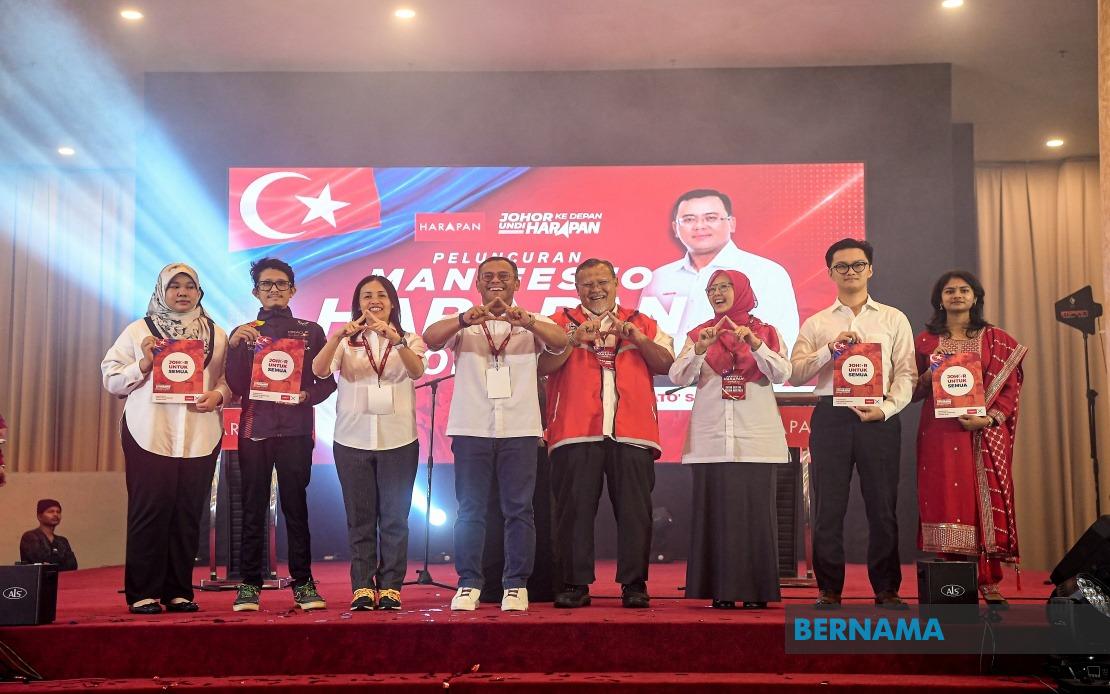
Pakatan Harapan's campaign strategy for the upcoming Johor state election rests substantially on its historical record of translating electoral promises into tangible government action. Speaking at the launch of the coalition's manifesto here on July 3, Johor PH chairman Aminolhuda Hassan pointed to the completion of all ten initiatives contained in the coalition's 100-day agenda following the 14th General Election as evidence that voters can trust PH to deliver on its stated objectives. The messaging carries particular weight in a state where governance track records have become increasingly central to electoral calculation, especially as Malaysians grow more discerning about distinguishing rhetoric from results on the campaign trail.
The specific initiatives that PH successfully implemented during its previous tenure in Johor offer a broad-based platform spanning social welfare, governance reform, and economic support. These included constraining the Menteri Besar's term limit to two consecutive terms—a structural reform aimed at preventing concentrated executive power—alongside the introduction of the Johor Health Card, a subsidised healthcare initiative targeting vulnerable populations. The implementation of an open tender system for government procurement marked a significant administrative transparency measure, whilst the provision of ten cubic metres of free water monthly to eligible households directly addressed cost-of-living pressures affecting lower-income groups.
Beyond these headline commitments, the coalition points to a series of targeted assistance schemes that underscored its stated commitment to economically disadvantaged constituencies. A takaful scheme providing financial protection for senior citizens, coupled with incentives designed to enhance accessibility to tertiary education, addressed long-standing gaps in the social safety net. Licence fee exemptions for street hawkers and petty traders represented direct relief for the informal economy, whilst a 50 per cent reduction in outstanding rental arrears for residents of People's Housing Project units provided meaningful debt relief. Additionally, the introduction of what the coalition terms the vertical government quota and marriage incentives for younger couples rounded out a comprehensive policy portfolio touching multiple demographic and economic segments.
Aminolhuda's framing of these achievements as a performance benchmark carries strategic implications for the election narrative. Rather than positioning PH solely on ideological or aspirational grounds, the coalition is deliberately constructing an empirical foundation for voter confidence—arguing that past behaviour represents a reliable predictor of future performance. This approach acknowledges a shifting voter psychology in Malaysian electoral contests, where tangible service delivery and demonstrable competence increasingly outweigh traditional party loyalty or factional affiliation. For a regional electorate that has witnessed multiple changes in state government in recent election cycles, the emphasis on verifiable implementation provides a counterweight to campaign promises that remain abstract or unverified.
The presence of senior PH figures at the manifesto launch, including PH Presidential Council member Amirudin Shari, PKR secretary-general Dr Fuziah Salleh, and state-level party leaders, underscored the coalition's commitment to presenting a unified front heading into the July 11 polling. The coalition's decision to contest all 56 state seats represents a show of confidence and indicates that PH is not conceding ground in any constituency, a posture that signals competitive ambition across the state's geographic and demographic breadth. This comprehensive candidacy also reflects the coalition's assessment that momentum exists to recapture state-level administration.
Aminolhuda's explicit invocation of Prime Minister Anwar Ibrahim's federal leadership provided a connecting thread between national and state-level governance narratives. By anchoring the Johor campaign in the broader PH federal project, the Johor PH chairman sought to leverage whatever positive sentiment exists toward the national administration whilst simultaneously suggesting that state-level continuation would reinforce coherence across governmental tiers. This linkage, however, cuts both ways—any antipathy toward federal performance could similarly redound negatively on state candidates, making the coalition's broader governance narrative a critical variable in voter calculation.
The Johor election assumes significance within the broader Malaysian political landscape as a barometer of coalition health and electoral viability. The state has historically served as a testing ground for political alignments, and the outcome on July 11 will provide early indication of whether PH can sustain or rebuild support following years of political turbulence at both national and regional levels. The coalition's emphasis on delivery records rather than purely prospective pledging suggests a strategy rooted in addressing voter scepticism about political commitment—a rational response to decades of unfulfilled campaign promises across Malaysian politics.
For Malaysian voters evaluating competing political offers, the distinction between what governments have actually accomplished versus what they have merely promised represents a valuable decision-making criterion. PH's historical list of completed initiatives provides a concrete reference point, though independent assessment of implementation quality and lasting impact would be necessary to fully evaluate the claim. The coalition's strategy implicitly acknowledges that contemporary voters demand evidence-based reasoning rather than emotional appeals or ideological positioning alone.
The manifesto launch event reflected PH's broader campaign strategy of emphasising competence, inclusivity, and demonstrated capability across diverse policy domains. The coalition appears intent on recapturing the political momentum that propelled it to power in 2018, even as it acknowledges the more competitive and fractionalised electoral environment that currently prevails. With voting scheduled for July 11, the coming weeks will test whether voters in Johor credit PH's historical record sufficiently to mandate continued or renewed state-level governance under the coalition's direction.

