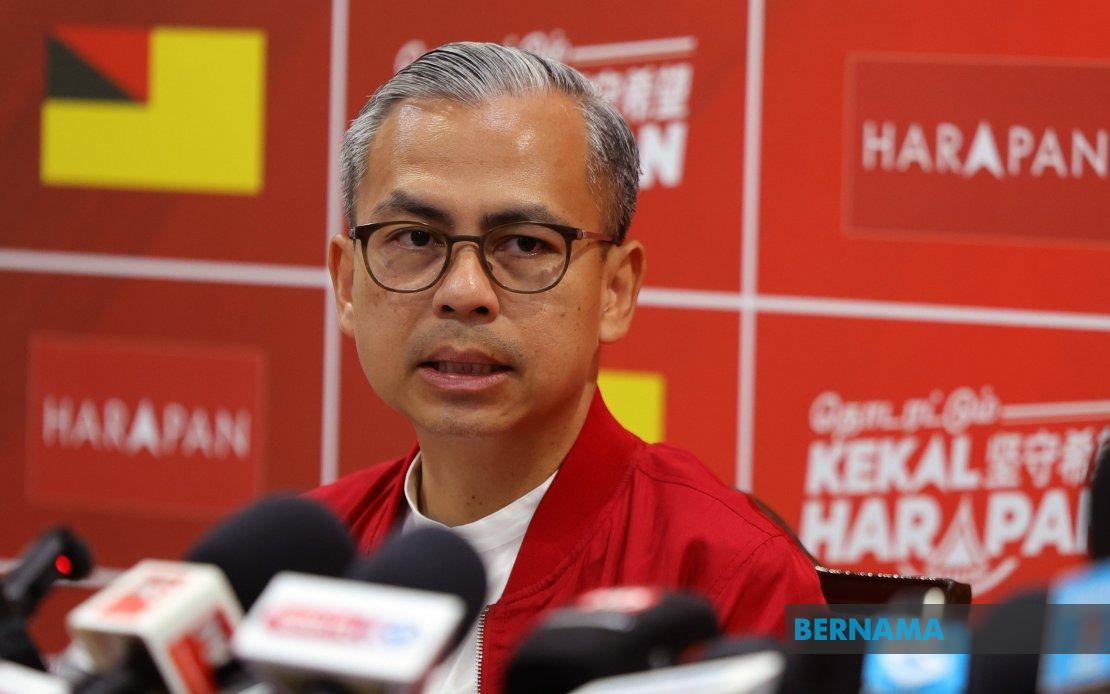
Seremban — Pakatan Harapan pushed back sharply against divisive political narratives during campaigning for the Negeri Sembilan state election, asserting that the characterisation of any single political bloc as the sole representative of Malay-Muslims fundamentally misrepresents Malaysia's pluralistic society. Communications director Datuk Seri Fahmi Fadzil launched the challenge during a press conference, contesting claims that have surfaced during the electoral campaign and underscoring what the coalition views as a troubling trend toward identity-based political messaging.
Fahmi, who holds the concurrent positions of PKR information chief and Communications Minister, highlighted the presence of prominent Malay-Muslim leaders within Pakatan Harapan's ranks as evidence that the coalition extends far beyond a single ethnic or religious constituency. By invoking the names of respected figures such as Khalid Abdul Samad, the Amanah communications director who stood alongside him during the announcement, Fahmi illustrated the practical reality of multiethnic leadership within the governing coalition. The intervention reflected growing concern within PH circles that opposition messaging attempting to paint the coalition as hostile to Malay-Muslim interests risked poisoning electoral discourse and undermining the consensus-building approach that underpins Malaysia's constitutional democracy.
The fundamental challenge that Fahmi articulated centres on a tension that has periodically surfaced throughout Malaysia's political history: the question of which parties and leaders can legitimately claim to speak for Malay and Muslim Malaysians. By suggesting that this representation is inherently exclusive—that it belongs to one bloc alone—opponents risk fragmenting political identity along rigid communal lines rather than allowing voters to exercise genuine choice across ideological and administrative platforms. Fahmi's reframing positioned Pakatan Harapan as the defender of Malaysia's founding multicultural compact, one that explicitly accommodates diverse interests within a framework of national unity rather than zero-sum ethnic competition.
To substantiate this rhetorical position, the coalition pointed to concrete administrative achievements under Negeri Sembilan's PH-led government headed by Menteri Besar Datuk Seri Aminuddin Harun. The expansion of mosque construction and documented growth in zakat collections—rising nearly two-and-a-half times compared to the previous administration—were presented as empirical proof that the state government has actively prioritised Islamic infrastructure and religious charitable commitments. These metrics carry particular weight in Malaysian state-level politics, where religious institutions and Islamic welfare mechanisms constitute a visible measure of governmental commitment to Muslim-majority constituencies.
Fahmi's broader philosophical argument, however, extended beyond electoral performativity or administrative scoreboards. He articulated a vision of political mobilisation grounded in shared civic values and the collective good rather than ethnic or religious identity as the primary organising principle. This approach reflects a deliberate strategy to reposition Pakatan Harapan as the custodian of constitutional pluralism at a moment when electoral competition appears increasingly structured around communal appeals. The Communications Minister emphasised that his coalition seeks to unite Malays, Chinese, Indians, and all Malaysians through aspirational common purpose rather than what he termed ethnic chauvinism, though he acknowledged that achieving this unity requires sustained engagement and patient persuasion among voters.
The timing of this intervention during the Negeri Sembilan campaign signals broader strategic concerns within the ruling coalition. The state election, scheduled for early voting on July 28 and polling day on August 1, represents an important test of whether Pakatan Harapan can maintain its multiethnic coalition in a political environment where opponents are intensifying identity-based messaging. The presence at the press conference of Cha Kee Chin, the Negeri Sembilan DAP secretary, underscored the deliberate coalition optics, demonstrating unity across the three constituent parties representing Malay, Muslim, and non-Muslim communities respectively.
For Malaysian voters and regional observers, the dispute reflects a deeper question about how democratic competition should function in ethnically and religiously diverse societies. Can political parties compete on the basis of policies, administrative competence, and inclusive vision, or does electoral logic inevitably push toward communal mobilisation? Pakatan Harapan's position suggests belief in the former possibility, yet the necessity of explicitly contesting exclusionary narratives indicates the persistent appeal of the latter approach.
The coalition's messaging strategy also carries implications for Malaysia's relationship with Southeast Asian neighbours and broader global perceptions of religious tolerance. In an era when other regional democracies face criticism for religious nationalism or majoritarian political movements, Malaysia's governing coalition is attempting to model an alternative pathway—one where Malay-Muslim interests receive substantive political attention and resource allocation while remaining nested within a broader inclusive democratic framework. Whether this model proves electorally durable in Negeri Sembilan and nationally will provide important evidence about the viability of non-exclusionary politics in multiethnic contexts.
Looking forward, Pakatan Harapan's approach demands sustained follow-through. Rhetorical commitments to pluralism require institutional reinforcement, visible resource distribution, and continued elevation of diverse voices within party structures and government. The coalition's willingness to directly contest the exclusionary framing, rather than ceding the terrain of Malay-Muslim representation, represents a notable break from earlier political strategies that sometimes treated such concerns as primarily the province of other parties. This recalibration reflects both electoral imperative and a genuine philosophical repositioning about how multicultural governance should function in practice.

