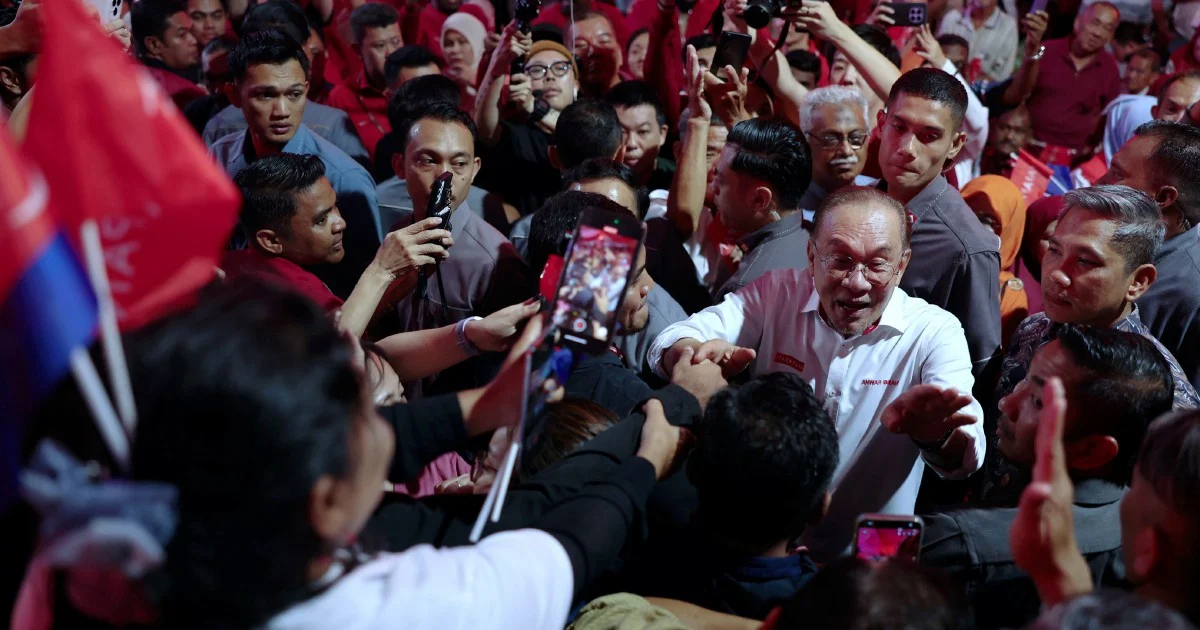
Pakatan Harapan has formally unveiled its complete roster of 56 candidates for the Johor state assembly election scheduled for July 11, a move that signals the opposition coalition's serious bid to capture one of Malaysia's most politically significant states. The announcement, made by coalition chairman Datuk Seri Anwar Ibrahim in Tangkak, represents a crucial moment in PH's electoral strategy as it seeks to reverse decades of Barisan Nasional dominance in Johor, a state long considered a stronghold of the ruling coalition and home to considerable Umno influence.
The formal declaration of candidates represents the culmination of weeks of negotiations and discussions among PH's component parties—PKr, DAP, and Amanah—as well as allied partners who sought representation in what has been framed as a decisive contest for the state. The coalition's ability to present a united slate across all contested seats demonstrates the degree to which the opposition has consolidated its messaging around Johor, where demographic shifts and economic grievances have begun to shift the electoral landscape. The timing of the announcement, coming as national political discourse has become increasingly fragmented, underscores PH's confidence that it can translate grievances into electoral support in the southern state.
Johor's political significance extends beyond its 56 assembly seats and extends into the broader calculus of Malaysian federalism. The state generates substantial economic output and its agricultural, port, and manufacturing sectors make it a barometer for national economic sentiment. A PH victory would signal that even the heartland of traditional Malay-Muslim politics is susceptible to the opposition's multi-ethnic, reform-focused messaging. Conversely, a Barisan Nasional consolidation would suggest that rural and semi-urban consolidation remains the ruling coalition's enduring strength, particularly among conservative voters in the peninsula's less urbanised areas.
The composition of the candidate slate itself carries strategic implications. PH has had to balance internal demands from its three main parties while ensuring the lineup appeals to Johor's diverse electorate, which encompasses urban professionals in Johor Bahru and Iskandar Puteri, rural agricultural communities, and industrial workers in towns like Kluang and Batu Pahat. The distribution of seats across PKR, DAP, and Amanah reflects both the partnership dynamics within the coalition and strategic assessments of which party's messaging resonates most effectively in particular constituencies. DAP's presence in urban centres, PKR's broader multiracial base, and Amanah's cultivation of conservative Muslim voter support create overlapping campaign narratives that PH hopes will appeal across demographic divides.
Anwar Ibrahim's personal role in unveiling the candidates emphasises PH's top-down commitment to the Johor campaign. As Prime Minister, Anwar carries both resources and symbolic weight, though his elevated position also exposes him to criticism should the Johor results disappoint opposition supporters. His presence signals that the coalition views this election not merely as a state-level contest but as a test of the central government's mandate and its capacity to implement policies that resonate with voters beyond the urban centres where PH has traditionally performed strongly.
The election on July 11 follows a pattern of state-level contests that have become increasingly competitive since the 2022 general election. Johor notably did not face elections during the recent Selangor and Penang contests, meaning voters will be casting ballots for the first time since GE15. This extended gap between elections creates uncertainty about whether the national political dynamics—which saw PH emerge as the single largest bloc in parliament—will translate into state-level gains. Johor voters may view state and federal politics through distinct lenses, with local issues around infrastructure, education, and land development potentially outweighing national considerations around governance reform and economic management.
The opposition's candidate strategy in Johor also reflects efforts to court Bumiputera and conservative voters who have historically gravitated toward Umno and its coalition partners. The inclusion of candidates with strong grassroots credentials, Islamic credentials, or business backgrounds signals PH's attempt to broaden its appeal beyond the urban, educated, Chinese-majority voter base that has formed its core support in previous elections. This diversification of PH's electoral appeal is essential if the coalition is to translate its parliamentary plurality into meaningful control of state governments, particularly in states where Malay-Muslim voters constitute majorities or significant pluralities.
Beyond Johor itself, this election carries implications for Malaysia's broader political balance. A strong PH performance would reinforce the legitimacy of Anwar's government and potentially provide renewed momentum for the federal administration's policy agenda. Such a result would also complicate the positioning of PAS, which governs Kelantan and Terengganu and represents a substantial Islamic conservative alternative to both PH and Barisan Nasional. Conversely, a Barisan Nasional consolidation in Johor would suggest that despite parliamentary weakness at the federal level, the traditional ruling coalition retains sufficient ground organisation and voter loyalty to defend its strongholds effectively.
The campaign period leading up to July 11 will likely witness intensive efforts from all parties to mobilise voters and frame the contest's significance. PH will emphasise themes of good governance, economic opportunity, and inclusive development, while Barisan Nasional will stress stability, experience, and its historical stewardship of Johor's progress. The outcome will provide the first clear electoral verdict on how national political dynamics translate into state-level performance, offering valuable indicators for both PH and the traditional ruling coalition as they prepare for future contests.

