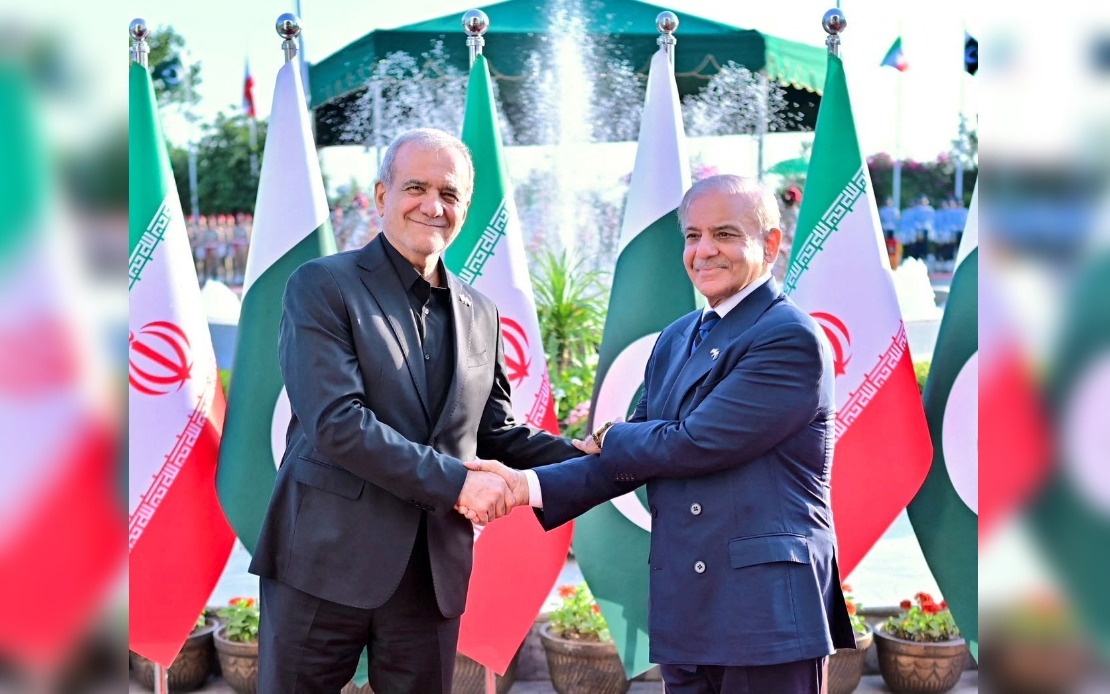
Pakistan's Prime Minister Shehbaz Sharif has unequivocally backed Iran's right to develop and maintain ballistic missiles, positioning Islamabad as a steadfast ally of Tehran during high-level bilateral talks on Tuesday. The statement came as Iranian President Masoud Pezeshkian and his delegation visited Islamabad, underscoring Pakistan's deepening engagement with its neighbour amid broader regional geopolitical tensions. Sharif's public endorsement of Iran's military capabilities represents a significant diplomatic gesture that reinforces Pakistan's role as a bridge between Tehran and Western powers, a position it has cultivated through recent mediation efforts.
The core of Sharif's argument centres on the claim that ballistic missiles were conspicuously absent from negotiations between Iran and the United States that culminated in a memorandum of understanding signed on June 17. He emphasised that the Iranian delegation itself deliberately refrained from raising missile-related matters during those discussions, effectively removing the issue from the bilateral arrangement. This framing provides Tehran with diplomatic cover while simultaneously justifying Pakistan's support for Iranian military modernisation on the grounds that it lies outside the bounds of any negotiated limitations. For Malaysian and Southeast Asian observers, this distinction highlights how regional powers navigate between accommodating Western concerns and maintaining strategic autonomy.
Sharif's criticism of selective standards regarding military capabilities directly challenged what he characterised as unfair treatment of Iran. He argued that permitting certain nations to possess ballistic missiles whilst denying Iran equivalent capabilities represents a double standard inconsistent with principles of international equality and sovereignty. This argument resonates within developing nations that have long chafed at restrictions imposed by major powers, making it particularly significant for countries in Southeast Asia that similarly seek to develop defence capabilities without external interference. The Pakistan prime minister's willingness to articulate this grievance openly suggests Islamabad views the issue as fundamental to maintaining credibility with Tehran.
Iran's strategic rationale for maintaining advanced missile systems stems from its assessment of existential security threats. Tehran regards its ballistic arsenal as essential deterrence following military strikes launched by Israel and the United States on February 28, operations that demonstrated the vulnerability of nations without comparable strike capabilities. Iranian President Pezeshkian reiterated this position during the joint press conference, explicitly stating that without defensive missile capacity, Iran would face the same catastrophic fate as Gaza. This framing transforms the missile question from a proliferation concern into a matter of national survival, fundamentally altering how the issue should be analysed within regional security contexts.
Pakistan's mediation achievements over recent months have positioned it as an indispensable diplomatic actor in managing US-Iran tensions. Beyond the June memorandum, Islamabad had previously facilitated a temporary ceasefire between the two nations in April, demonstrating sustained commitment to de-escalation. Deputy Prime Minister and Foreign Minister Ishaq Dar and Field Marshal Syed Asim Munir, the Chief of Army Staff, both played instrumental roles in these diplomatic initiatives. Sharif's expressions of gratitude toward Iranian leadership for trusting Pakistan's mediation underscores the personal investment Pakistani officials have made in brokering understanding, with the prime minister framing Pakistan's reliability as fundamental to future cooperation.
However, Sharif acknowledged significant obstacles to consolidating these diplomatic gains. He warned of international "spoilers" seeking to derail the US-Iran agreement, a reference widely understood to encompass Israel and potentially other regional actors opposed to rapprochement between Tehran and Washington. The Pakistan prime minister's identification of spoilers reflects a growing strategic concern that hard-won diplomatic breakthroughs remain fragile and vulnerable to sabotage by parties perceiving the arrangement as contrary to their interests. For the broader region, this acknowledgment highlights how peace initiatives in West Asia remain hostage to entrenched conflicts and competing visions of regional order.
Israel's military actions in Lebanon and occupied Palestine feature prominently in Pakistan's assessment of obstacles to peace. Sharif implicitly blamed Israeli aggression for creating conditions hostile to diplomatic resolution, a positioning that aligns Pakistan with Iran and broader anti-Western sentiment in parts of the Islamic world. This rhetoric, whilst diplomatically calibrated, nevertheless represents a clear choice regarding which regional actors Islamabad views as constructive forces. For Southeast Asian nations attempting to maintain balanced relationships across dividing lines, Pakistan's clarity on this issue demonstrates how even nominally non-aligned countries increasingly stake positions within broader civilisational conflicts.
US President Donald Trump's recent concession that Iran should possess ballistic missiles provided unexpected validation for the position Sharif articulated. During remarks in Paris on June 17, Trump acknowledged the inequity of denying Iran capabilities available to other nations, suggesting potential evolution in American thinking on proliferation constraints. Trump's admission that "if other countries have them, it is a little bit unfair for them not to have some" effectively concedes the double-standards argument that had previously been confined to developing-nation discourse. This shift, however modest, potentially creates diplomatic space for Iran to advance its military programme without immediate American intervention, though questions remain about Trump's commitment to this position under different circumstances.
Pezeshkian's visit to Islamabad included ceremonial elements befitting a head of state of a strategically important nation. Six Pakistan Air Force fighter jets escorted the Iranian president's aircraft, whilst President Asif Ali Zardari received him alongside Sharif. A 21-gun salute honoured Pezeshkian's arrival, ceremonial gestures that communicate respect and equivalence within diplomatic protocol. These rituals, beyond their symbolic significance, underscore that Pakistan views Iran as a peer of sufficient importance to warrant the highest-level diplomatic courtesies. Such displays matter particularly for states seeking to consolidate partnerships within multipolar environments where visible recognition carries weight in international relations.
The convergence of Pakistan's diplomatic mediation role, its public support for Iranian military capabilities, and its ceremonial reception of the Iranian president collectively signal a significant realignment in South Asian strategic positioning. Islamabad has effectively chosen to champion Iran's security interests within international forums whilst simultaneously maintaining working relationships with the United States. This balancing act, though challenging, reflects Pakistan's historical preference for hedging between major powers rather than committing irreversibly to any single alignment. However, the clarity of Sharif's statement suggests Pakistan may be moving toward a more definitively pro-Iran posture, at least regarding military modernisation questions that touch upon national sovereignty.
For Malaysia and other Southeast Asian nations monitoring developments in West Asia, Pakistan's diplomatic conduct offers instructive lessons about managing relationships between regional powers and external actors. The question of whether smaller states can successfully mediate between competing great powers remains contested, yet Pakistan's recent successes suggest opportunities exist for states willing to invest political capital in dialogue. Simultaneously, the persistence of military tensions and the acknowledged presence of spoilers suggest that diplomatic breakthroughs in West Asia remain extraordinarily fragile, vulnerable to reversal if underlying security calculations shift. These dynamics merit close attention from Southeast Asian policymakers navigating their own complex regional relationships.
The longer-term implications of Pakistan's backing for Iran's missile programme extend beyond immediate bilateral relations. By publicly rejecting restrictions on Iranian military capabilities, Sharif has effectively signalled opposition to Western-led non-proliferation regimes that many developing nations view as instruments of hegemonic control. This positioning potentially embeds Pakistan more deeply within networks of states challenging the post-Cold War security architecture, a trajectory with consequences for global governance and regional stability. Whether this represents a permanent shift in Pakistani strategic orientation or a temporary alignment driven by immediate diplomatic circumstances remains uncertain, but the public nature of Sharif's commitment suggests some durability to the position he has staked.

