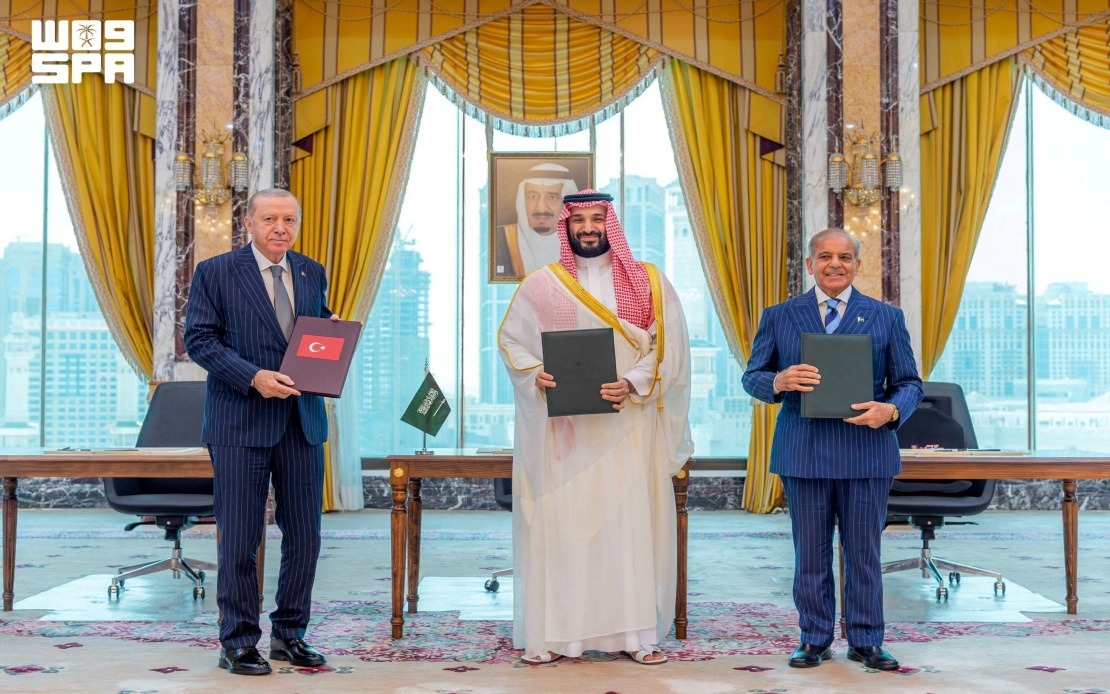
Three major Muslim-majority powers have formalised a defence alliance that signals a significant realignment of security interests in the broader Middle East and South Asian regions. Pakistan's Prime Minister Shehbaz Sharif, Saudi Arabia's Crown Prince Mohammed bin Salman bin Abdulaziz Al Saud, and Turkish President Recep Tayyip Erdogan inked the Joint Defence Agreement on Friday during a summit convened at Al Safa Palace in Makkah, creating a framework that obligates mutual military support should any member face external aggression.
The agreement represents a strategic consolidation among three nations with considerable geopolitical influence and military capacity. Pakistan possesses nuclear weapons and maintains one of Asia's largest standing armies. Saudi Arabia commands substantial economic resources and regional influence through its energy wealth and leadership in the Gulf Cooperation Council. Türkiye, bridging Europe and Asia, wields significant military capabilities and strategic positioning as NATO's only Muslim-majority member. The convergence of these three powers around a formal defence mechanism carries implications that extend well beyond their bilateral relationships, potentially reshaping security architectures across multiple regions.
Central to the pact is a mutual defence clause stipulating that any armed assault targeting one signatory automatically constitutes aggression against all three. This language echoes collective security arrangements seen in NATO and other regional alliances, establishing a deterrent threshold intended to discourage potential adversaries. The agreement extends beyond this headline provision to encompass broader cooperation frameworks, including collaborative defence capability development, strategic deterrence enhancement, and coordinated readiness measures. These provisions suggest the three nations intend to move beyond declarative statements toward substantive military and operational integration.
Official messaging from the Saudi government emphasises the agreement's defensive posture rather than any aggressive intent. Rayed Krimly, Saudi Arabia's deputy public diplomacy minister, stated the pact enables the three countries to develop joint defence capabilities and strengthen strategic deterrence while enhancing their collective ability to address threats to their security. He pointedly underscored that the arrangement poses no threat to regional neighbours and should not be interpreted as an escalation mechanism between any two states. Such careful framing suggests awareness that the pact's creation may trigger scrutiny from other regional and international actors.
The trilateral framework builds upon established bilateral relationships between the signatories. Pakistan and Saudi Arabia's defence ties have deepened considerably in recent years, culminating in a bilateral defence agreement signed in September of the previous year that similarly obligated mutual assistance against external aggression. Pakistan and Türkiye have maintained historically robust defence cooperation spanning decades, encompassing military training, equipment transfers, and strategic consultation. The new three-way arrangement essentially elevates and formalises these existing partnerships into a more institutionalised collective framework.
For Malaysian policymakers and regional observers, the pact warrants close monitoring as it reflects broader trends toward security clustering among non-Western powers. The agreement demonstrates how nations are organising into alternative security arrangements that operate outside Western-dominated frameworks, particularly as geopolitical competition intensifies between established powers and rising challengers. The emphasis on South-North and East-West balance, mutual sovereignty, and non-interference principles embedded in the signatories' joint statement reflects values increasingly articulated by nations seeking to preserve strategic autonomy.
The timing of the agreement also merits consideration. It comes amid evolving Middle Eastern dynamics following the normalisation of several Arab-Israeli relationships, ongoing tensions in the Persian Gulf, and broader competition for regional influence among external powers. Pakistan's participation introduces a South Asian dimension to what might otherwise appear primarily as Middle Eastern diplomacy, suggesting these three nations view their collective interests as transcending traditional regional boundaries. The inclusion of Pakistan particularly broadens the alliance's strategic depth and adds nuclear-armed military capacity to the arrangement.
The agreement's emphasis on developing integrated defence capabilities indicates the signatories contemplate operational coordination beyond theoretical mutual assistance commitments. Joint exercises, standardised equipment procurement, shared intelligence mechanisms, and coordinated strategic planning likely constitute components of implementation. Such integration requires substantial bureaucratic alignment, military-to-military relationship building, and investment in compatible systems and procedures. The success of these arrangements will depend heavily on how effectively the three nations navigate cultural, operational, and strategic differences.
Regional context proves essential for understanding this pact's implications. The Middle East remains volatile with unresolved conflicts in Yemen, Syria, and Iraq, alongside ongoing Palestinian-Israeli tensions and Persian Gulf security concerns. Pakistan faces persistent terrorism threats alongside contested borders with Afghanistan and India. Türkiye navigates complex relationships with Kurdish movements, Syria, and Iraq while managing NATO commitments. The mutual defence agreement may provide political cover for each nation to pursue security interests while operating within a collective framework that prevents individual action from being perceived as destabilising.
The agreement's impact on broader international relations remains uncertain. Western powers monitoring regional developments will assess whether the pact represents merely a formalisation of existing cooperation or signals a more cohesive bloc willing to challenge Western-led international order. The emphasis that the pact threatens no other country suggests the signatories wish to avoid unnecessarily provoking external reactions, yet the very act of formal collective defence arrangements naturally alters regional power calculations.
For Southeast Asia specifically, developments among these three powers deserve attention as they influence global energy security, international trade patterns, and the diplomatic weight these nations carry in multilateral forums. Pakistan, Saudi Arabia, and Türkiye all maintain significant economic and political relationships across Southeast Asia. Their growing alignment could influence their positions on issues ranging from religious governance to energy security to maritime disputes that affect regional stability.
The broader significance of this agreement lies in its reflection of how major non-Western powers increasingly construct security arrangements through their own agency and values rather than seeking security guarantees from Western-led structures. Whether this particular alliance achieves its stated goals of strengthened deterrence and enhanced defence cooperation will depend on sustained commitment, effective implementation, and the ability of these three quite different states to manage divergent interests within a collective framework. The months and years ahead will reveal whether this pact becomes a cornerstone of a new regional security architecture or remains primarily a symbolic statement of shared strategic interests.

