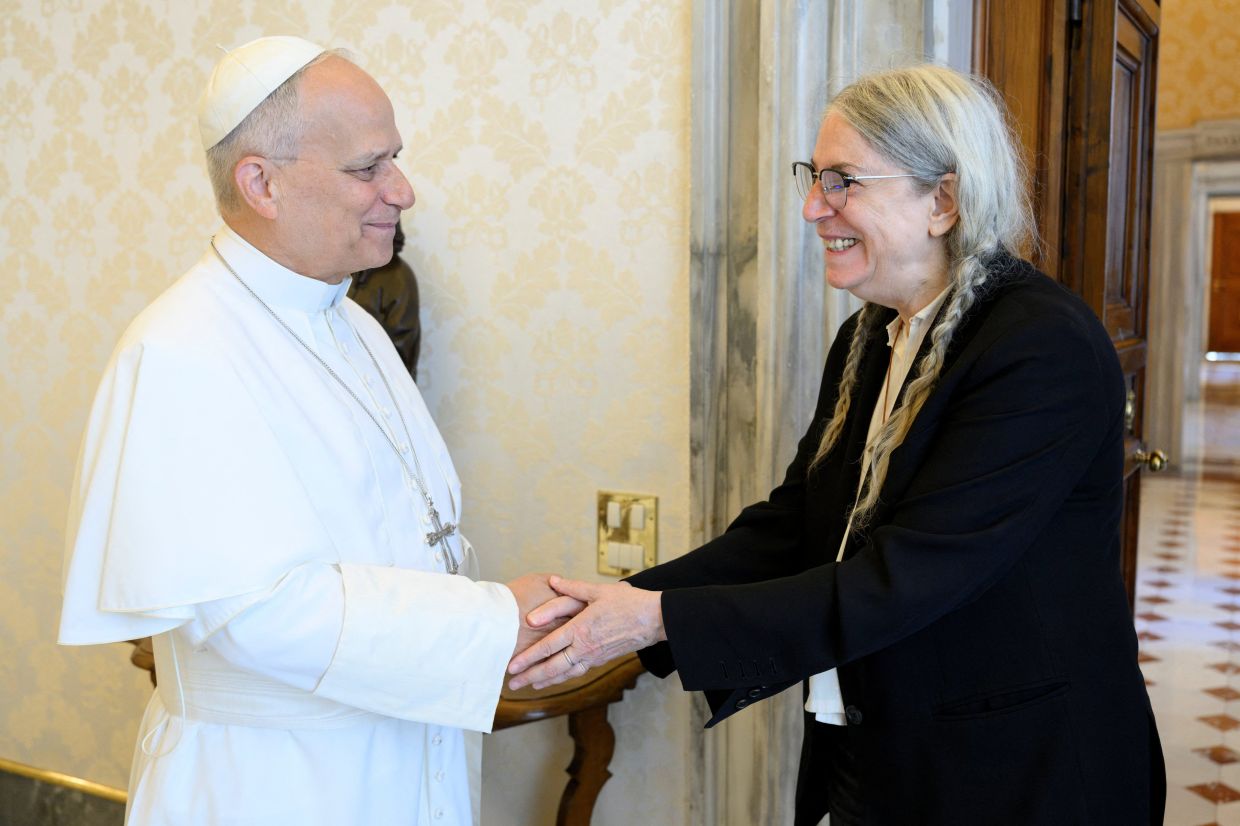
American rock icon Patti Smith encountered Pope Leo XIV on Friday at the Apostolic Palace, a meeting that left the legendary musician visibly moved and unusually restrained in expression. The Private audience marked another chapter in Smith's evolving relationship with the Vatican, a connection forged through her admiration for the institution's artistic and humanitarian values rather than formal religious affiliation.
Smith, dressed in her characteristic braided hairstyle and wearing a crucifix necklace, kept her initial greeting to the pontiff deliberately simple. As she took her seat across from Leo at his desk, she offered a soft "Hi"—a moment of uncharacteristic brevity from someone typically known for her eloquent and poetic communication style. The understated greeting belied the significance of the encounter for the 78-year-old artist, who has long championed spiritual and humanistic themes through her music and writing.
The musician's access to Vatican circles owes much to her friendship with Rev Antonio Spadaro, undersecretary in the Vatican's culture ministry. Through this relationship, Smith has transformed from an occasional visitor into an increasingly integral presence within the Holy See's cultural orbit. Her integration into Vatican circles represents a notable development in how the contemporary Catholic Church engages with secular artists and cultural figures, particularly those whose work explores themes of spirituality and human connection.
Smith has been explicit about her spiritual motivations without embracing formal Catholic doctrine. She has explained that her attraction to recent papal leadership stems not from theological conversion but from profound admiration for what she perceives as Pope Francis's distinctive approach to spiritual leadership. She articulated her appreciation for Francis's "gentle, open, and steadfast sense of humanity," qualities she found emblematic of a progressive Catholic vision focused on compassion and inclusion. This philosophical alignment, rather than doctrinal agreement, appears to anchor her Vatican involvement.
Her history with the papacy extends further back than her connection to Francis. Smith's 1979 song became a point of recognition during her Friday audience, with Pope Leo XIV indicating familiarity with the composition. When the pontiff remarked that the work "was marvelous," he demonstrated knowledge of Smith's artistic catalogue, suggesting preparation for the encounter that transcended ceremonial obligation. This acknowledgment of her creative output reflected a mutual appreciation that seemed to shape the tone of their private meeting.
Smith's profile at the Vatican has risen steadily through her participation in significant cultural events. Most recently, she performed during the May 8 inauguration of the Holy See's pavilion at the Venice Biennale, a prestigious contemporary art fair. The timing proved symbolically resonant, coinciding with the anniversary of Pope Leo's election. Her presence at such an event underscores the Vatican's strategic use of contemporary cultural figures to project an image of artistic sophistication and relevance to modern audiences.
Rev Spadaro's account of the meeting provides insight into the quality of the exchange between Smith and Leo. According to Spadaro, the 40-minute private audience transcended typical papal protocol, functioning instead as genuine dialogue between two individuals discovering unexpected commonality. His description of the encounter as a conversation between "two people discovering they were old friends, sharing memories woven from words and music, dreams, visions, and hopes—both from yesterday and for today" suggests that the interaction operated on a plane of shared understanding that moved beyond formality. This characterization hints at a chemistry rooted in their mutual Chicago heritage, a connection Spadaro himself facilitated by joining the audience.
Smith's emotional investment in the papacy was profoundly demonstrated following Pope Francis's death on April 21, 2025. Rather than conventional expressions of condolence, Smith composed a poem that she shared on social media, employing characteristically poetic imagery to process her loss. She likened Francis to a dandelion—"humble yet strong"—and lamented that "Nature and poetry and the suffering shall miss their champion." This deeply personal tribute revealed the depth of her connection to Francis's vision, transforming what might have been a distant admiration into something approaching spiritual kinship.
The Friday audience with Pope Leo XIV thus carries added weight in the context of Francis's passing. Smith's continued engagement with the Vatican under Leo's leadership suggests continuity of purpose rather than a relationship tied solely to Francis's papacy. Whether Leo represents a similar vision for progressive Catholicism that appealed to Smith remains an open question, though the positive tenor of their meeting and his demonstrated familiarity with her work suggest receptiveness to continued dialogue.
Pope Leo XIV has shown himself disposed toward engagement with prominent cultural figures beyond Smith. Just three days before Smith's audience, on Wednesday July 29, Leo attended a concert organised in his honour by renowned tenor Andrea Bocelli. This pattern of papal involvement in high-profile musical events reflects a deliberate cultivation of relationships with the world's artistic elite, positioning the contemporary papacy as an institution comfortable with secular culture and invested in meaningful exchanges across traditional boundaries.
Smith's presence at the Vatican represents a broader phenomenon in contemporary Catholic strategy: the cultivation of cultural icons whose work resonates with spiritual and existential questions, even when those figures operate outside formal Church structures. As Southeast Asian societies increasingly engage with global cultural movements and seek meaning through art and music, Smith's model of maintaining spiritual questioning without doctrinal commitment may offer instructive parallels for how religious institutions adapt to pluralistic modern contexts. Her Vatican friendship thus extends beyond biographical curiosity to touch on deeper questions about faith, art, and institutional evolution in the twenty-first century.

