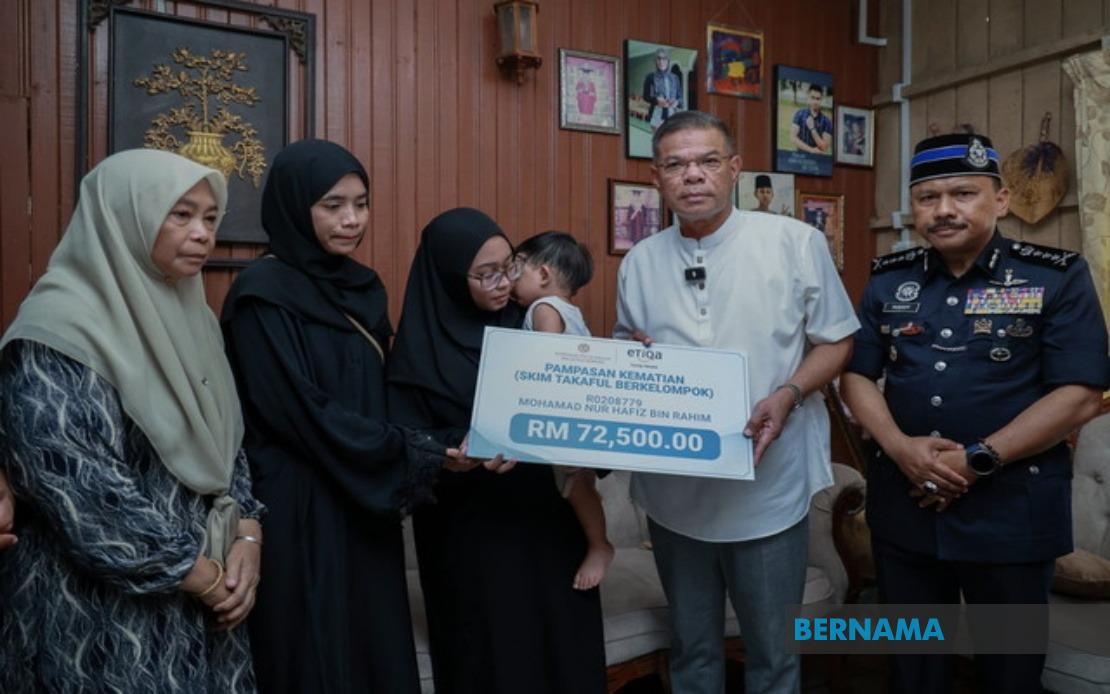
Home Minister Datuk Seri Saifuddin Nasution Ismail has pledged to accelerate the distribution of financial assistance and welfare support to the families of three Royal Malaysia Police officers who were killed in an electric shock incident at Beaufort, Sabah last Thursday. The commitment underscores the government's recognition of the sacrifices made by frontline law enforcement personnel and signals a departure from standard bureaucratic procedures to provide faster relief to bereaved families facing immediate hardship. Corporal Mohamad Nur Hafiz Rahim, 29, Corporal Chiu Teck Siong, 40, and Constable Muhammad Raimi Ismarubee, 26, died at approximately 5.50 pm on August 6 after sustaining electric shocks while repositioning a metal pole outside Weston Police Station in Beaufort.
The tragic incident has prompted a high-level response from Malaysia's police leadership, with Saifuddin personally visiting the bereaved families in both Kelantan and Terengganu to convey the institution's condolences and present immediate financial relief. During his visit to the home of Corporal Mohamad Nur Hafiz Rahim's family in Kampung Hutan Pasir, Ketereh, the Home Minister emphasized that the loss of any police officer, regardless of rank, represents a significant blow to the entire force. Accompanying him were Bukit Aman Management director Datuk Seri Abdul Aziz Abdul Majid, Kelantan police chief Datuk Mohd Yusoff Mamat, and Sabah deputy police commissioner Datuk Mohd Azhar Hamin, demonstrating the institutional weight being placed behind the support effort.
The immediate financial assistance extended to Corporal Mohamad Nur Hafiz Rahim's family reflects the multi-layered welfare mechanisms available within the police force. Contributions totaling more than RM200,000 were presented, comprising aid from both the Sabah and Kelantan Police Contingents, combined with takaful insurance payouts from the deceased's membership in the Police Cooperative scheme. The financial arrangements have been structured to provide ongoing income security, with his widow, Fatimah Shahira, designated as the beneficiary of the deceased's monthly pension, while his mother has also been accorded pension recipient status. These provisions ensure that the primary caregivers—his young family—will receive sustained financial support during the immediate crisis period and beyond.
Recognizing the potential for bureaucratic delays to compound the family's difficulties, Saifuddin issued explicit instructions to expedite all outstanding payments without subjecting them to standard administrative procedures. This directive carries significant weight in the Malaysian context, where government processes are often marked by lengthy timelines and multiple approval stages. By personally assuring the widow that the normal procedural framework would be bypassed, the Home Minister has signaled that the urgency of the family's circumstances supersedes routine administrative protocols. Additionally, Saifuddin advised the widow that the Sabah contingent of the Police Force stands ready to provide further assistance regarding her young son's welfare and the broader needs of her household.
Constable Muhammad Raimi Ismarubee's family in Felda Kerteh 2, Terengganu also received a separate visit from the Home Minister, reflecting the distributed nature of the tragedy's impact across Malaysia's peninsula. During a thirty-minute visit to the family home, Saifuddin presented death compensation of RM72,500 under the Royal Malaysia Police Cooperative Group Takaful Scheme, RM1,200 from the PDRM Welfare Fund, and a personal contribution from himself. The young officer, who was unmarried and the second of three children, had only recently been posted to Weston Police Station at the beginning of 2024. A larger delegation accompanied the Home Minister to Terengganu, including Terengganu police chief Datuk Mohd Khairi Khairudin and Dungun police chief Supt Nik Ab Halim Nik Mat, further underscoring the significance attached to supporting the family during this difficult period.
The electric shock tragedy raises important questions about occupational safety standards and risk management within police operations. The incident, which claimed three lives in a matter of seconds while officers were performing what appears to be routine maintenance work, suggests potential gaps in hazard awareness or preventive protocols. While the immediate focus has rightly centered on supporting the bereaved families, such incidents typically prompt internal investigations into whether adequate safety training, equipment inspection, and environmental risk assessments were in place. The fact that three officers were conducting the same task simultaneously, without apparent protective measures, indicates that this may represent a systemic concern within operational practices that warrants examination and remediation to prevent similar tragedies.
From a broader perspective, the government's swift and personal response to this incident reflects an understanding that police officers and their families require visible institutional support during personal crises. The Home Ministry's willingness to bypass standard procedures and provide accelerated financial relief acknowledges the precarious financial position many officers' families face, particularly when the primary earner is suddenly lost. For families in rural or semi-rural areas like Felda Kerteh 2 or Kampung Hutan Pasir, where alternative income opportunities may be limited, the immediate availability of substantial financial assistance can be transformative in preventing families from slipping into financial desperation during their period of acute grief.
The welfare provisions made available through the various mechanisms—including police contingent contributions, cooperative takaful schemes, and welfare funds—demonstrate that Malaysia's police institution has accumulated resources specifically designed to support officers and their dependents in times of hardship. However, the speed with which these mechanisms can be activated remains variable depending on the nature of the claim and the bureaucratic pathways involved. By emphasizing the need to expedite payments and bypass standard procedures, Saifuddin has effectively highlighted that rigid adherence to administrative timelines may be counterproductive when families face immediate needs for shelter, food, and childcare support.
For Southeast Asian observers, the incident and official response illustrate broader themes regarding occupational safety, worker protection, and institutional accountability within law enforcement agencies. Malaysia's police force, like many regional counterparts, operates in an environment where resources are sometimes stretched and safety protocols compete for attention with immediate operational demands. The tragedy serves as a reminder that even routine tasks can pose significant hazards when proper precautions are not in place or when individual awareness of electrical dangers is insufficiently reinforced through training and institutional culture. The Home Minister's personal intervention, while providing immediate comfort to grieving families, should ideally catalyze a more comprehensive review of operational safety standards across the force.
The incident also underscores the vulnerability of young, unmarried officers and those with dependent families who lack established networks of financial security. Constable Muhammad Raimi Ismarubee, at 26 years old and unmarried, had parents who would typically have relied on him for future financial support; instead, they now receive pension payments as designated beneficiaries. Corporal Mohamad Nur Hafiz Rahim's wife faces the dual challenge of grief and single parenthood of a two-year-old child, at an age when career development opportunities for women returning to the workforce after caregiving breaks remain constrained in many sectors. The institutional response, while generous and timely, addresses symptoms rather than underlying vulnerabilities in Malaysia's social safety net that leave families dependent on employer-provided welfare schemes rather than universal protections.
Moving forward, the government's demonstrated capacity and willingness to mobilize resources for police families in crisis may set expectations for similar treatment of other workers in hazardous sectors—healthcare, military, fire services, and industrial workers—who face comparable risks. If PDRM can bypass bureaucracy to provide rapid relief, questions arise about why similar flexibility cannot be extended to other occupational categories facing comparable circumstances. The precedent established by this high-profile case may influence ongoing conversations about whether Malaysia's approach to worker protection and family welfare should be reformed to provide faster, more consistent access to benefits across all sectors, rather than maintaining disparate systems determined by employment category and institutional resources.

