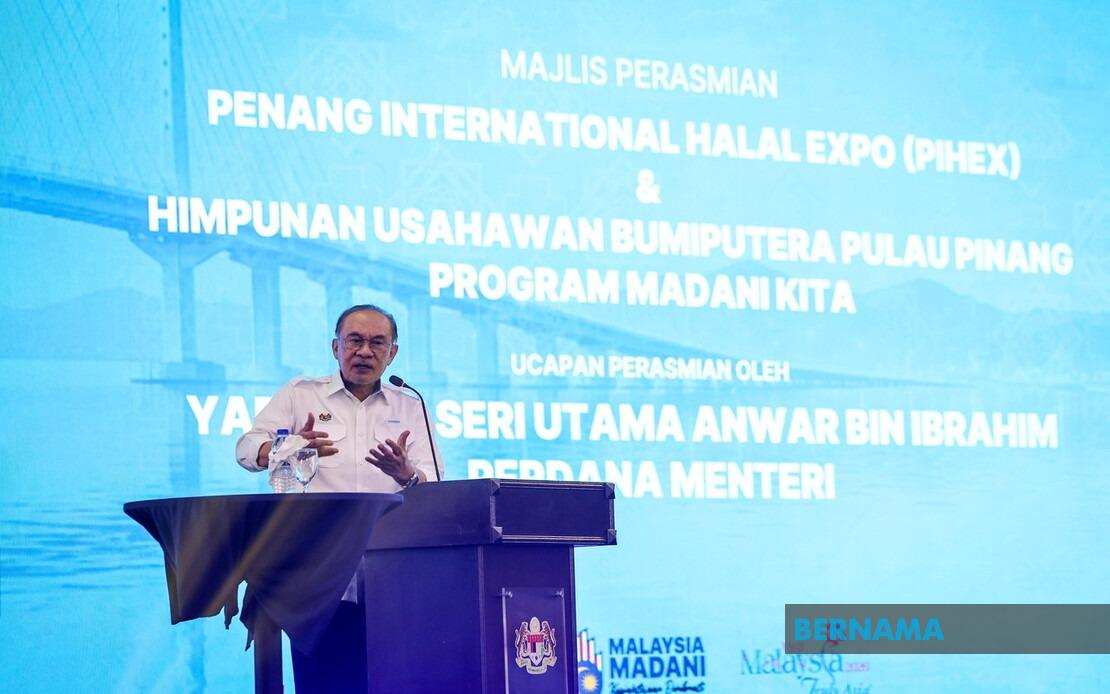
Prime Minister Datuk Seri Anwar Ibrahim has set an ambitious agenda for Penang to establish itself as a model state for Bumiputera economic participation, challenging what he describes as a widespread but inaccurate perception about the community's economic role in the state. Speaking at the Penang International Halal Trade Exhibition 2026 and the Penang Bumiputera Entrepreneurs Gathering at Seberang Perai Polytechnic in Permatang Pauh on July 25, Anwar emphasised that data contradicts the narrative of weak Bumiputera economic involvement in Penang compared to other states.
The prime minister's intervention addresses a longstanding misunderstanding about Bumiputera economic representation in Penang, a state often stereotyped as economically dominated by non-Bumiputera communities. According to Anwar, the empirical record demonstrates that overall Bumiputera economic participation in Penang actually outperforms most Malay-majority states on the peninsula. This assertion carries significant weight given Anwar's dual role as Prime Minister and Finance Minister, positioning him to influence resource allocation and policy direction across federal economic development initiatives.
Central to Anwar's strategy is the restructuring of how Bumiputera development agencies operate within Penang. Currently, these organisations function across multiple ministries and departments, often duplicating efforts or operating without coordinated objectives. Anwar has directed Penang Bumiputera Development Council chairman Tan Sri Khalid Ramli to consolidate all Bumiputera agencies under a unified strategic framework through the Bumiputera Economic Development Council. This consolidation mirrors broader public sector reform efforts emphasising efficiency and eliminating bureaucratic fragmentation.
The directive carries a clear timeline and accountability mechanism. Anwar indicated he expects a comprehensive progress report within weeks, signalling that this is not merely aspirational rhetoric but a monitored implementation agenda. Such specificity suggests the federal government views Penang as a test case for whether coordinated Bumiputera development strategies can yield measurable improvements in economic participation. Success in Penang could establish a template for replication in other states.
A particularly strategic dimension of Anwar's vision centres on the semiconductor industry, where Malaysia has developed significant competitive advantages. Penang, home to numerous semiconductor manufacturing facilities and clusters, represents the natural focal point for expanding Bumiputera participation in high-value supply chain activities. Rather than attempting to displace existing industry players, Anwar's approach seeks to create pathways enabling Bumiputera firms to become integrated suppliers and service providers within the semiconductor ecosystem. This positions Bumiputera enterprises as complementary participants rather than competitors in what remains a capital and technology-intensive sector.
To catalyse this expansion, Anwar announced a RM5 million allocation dedicated to the Bumiputera Semiconductor Action Plan. While modest in absolute terms, this funding signals federal commitment and provides seed capital for initiatives such as capacity building, technology transfer partnerships, and supply chain integration programmes. The investment reflects recognition that simply lowering regulatory barriers proves insufficient; Bumiputera enterprises require targeted support navigating the technical and commercial complexities of semiconductor supply chains.
The halal industry dimension, highlighted through the opening of PIHEX 2026, represents another avenue for Bumiputera economic expansion aligned with Malaysia's positioning as a global halal hub. Penang Deputy Chief Minister I and Penang Halal Industry Development Council chairman Datuk Dr Mohamad Abd Hamid reported tangible growth in Malaysian Halal Certification holders, increasing from 1,098 in 2024 to 1,191 in 2025, with 853 additional certificates recorded through mid-July this year. This trajectory demonstrates expanding halal certification activity in Penang, creating opportunities for Bumiputera entrepreneurs across production, distribution, and certification services.
The event's attendance reflected high-level federal commitment, with Communications Minister Datuk Seri Fahmi Fadzil and Malaysian Communications and Multimedia Commission chairman Tan Sri Mohamad Salim Fateh Din present. This ministerial participation underscores that Bumiputera economic development now features as a priority concern across multiple portfolio areas, from communications to economic planning. Such cross-ministerial engagement potentially facilitates integrated policy approaches addressing skills development, digital enablement, and market access simultaneously.
For Malaysia's broader regional context, Penang's development trajectory carries implications. As Southeast Asia's economies increasingly integrate through supply chains and trade partnerships, Bumiputera participation in high-technology sectors determines whether Malaysia's economic benefits distribute equitably and whether domestic enterprises can compete in sophisticated value chains. Penang's success or challenges in expanding Bumiputera semiconductor involvement will signal whether affirmative economic policies can coexist with competitive excellence in knowledge-intensive industries.
The emphasis on correcting perceptions about Bumiputera economic participation in Penang also addresses potential social cohesion concerns. When particular communities perceive themselves as economically marginalised despite factual evidence suggesting stronger performance, policy responses focusing on transparency and coordinated agency action become crucial for maintaining confidence in economic institutions. Anwar's explicit contradiction of negative narratives, backed by data claims, attempts to reset public understanding and build legitimacy for continued affirmative action policies.
Looking forward, the success of this Penang-focused initiative will likely influence federal approaches to other states. If consolidated Bumiputera agency coordination produces measurable improvements in economic participation, particularly in high-value sectors like semiconductors, this model could expand nationally. Conversely, implementation challenges or disappointing results might prompt recalibration of strategies around Bumiputera economic development more broadly.

