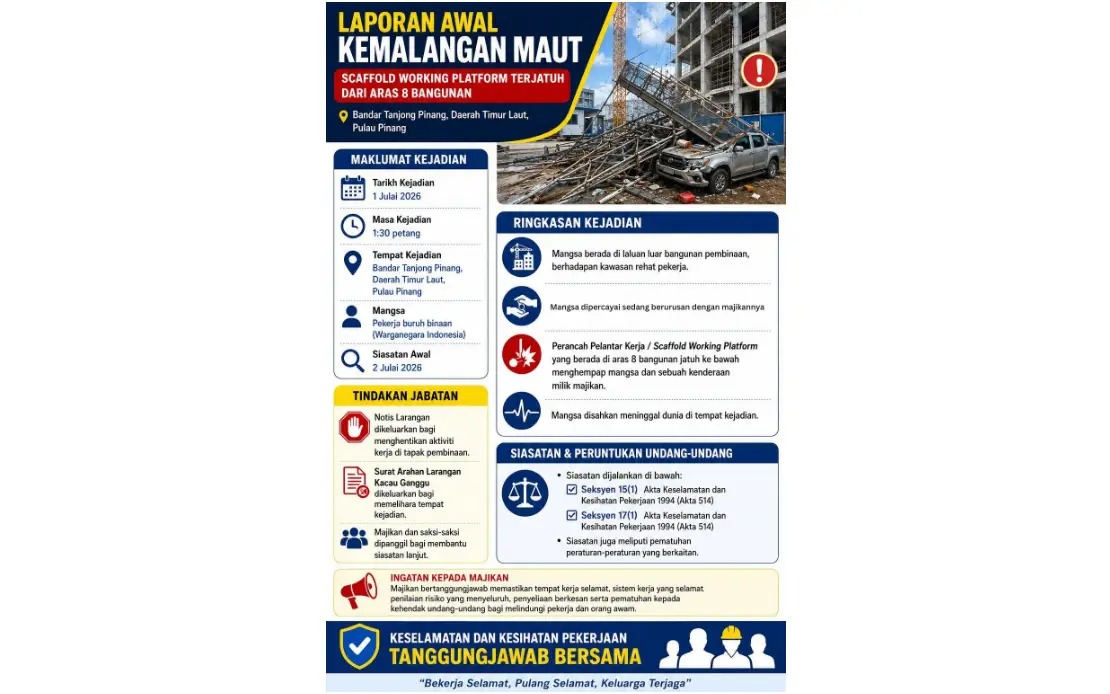
The Department of Occupational Safety and Health (DOSH) Penang branch has moved swiftly to enforce a prohibition notice halting all activities at a Bandar Tanjong Pinang construction site in the aftermath of a deadly workplace accident. The incident, which occurred on July 1 at 1.30 pm, resulted in the death of an Indonesian construction worker struck by a falling scaffolding platform from the eighth floor of the building. The regulatory action represents a serious response from authorities to what appears to be a significant breach of workplace safety protocols in the state's construction sector.
According to DOSH's preliminary assessment of the accident, the victim was positioned on an external walkway at a lower level of the building, situated in front of the workers' rest area, where he was engaged in discussion with his employer when the catastrophic failure occurred. The falling platform struck both the worker and a vehicle belonging to the employer, underscoring the unpredictable nature of the hazard and its widespread potential to cause harm. The violent nature of the incident and the involvement of multiple objects caught in the collapse have heightened concerns about structural integrity and safety measures at the site.
The prohibition notice issued by DOSH represents more than a routine suspension; it reflects the severity with which Malaysian authorities treat fatal workplace incidents. Accompanying the work halt is a non-disturbance order designed to preserve the accident scene in its original state, a crucial step that allows investigators to examine the physical evidence and reconstruction of events without alteration or contamination. This methodical approach to preserving evidence is essential for determining not only what happened, but why it happened and how such incidents can be prevented in future projects.
The ongoing investigation has widened its scope to examine whether the site's operators complied with their legal obligations under the Occupational Safety and Health Act 1994 (Act 514), specifically under Sections 15(1) and 17(1). These provisions establish the foundational duties that employers must fulfil to protect their workforce from foreseeable hazards. DOSH is systematically interviewing employers involved in the project as well as witnesses to the accident, gathering testimony that will help establish a timeline of events and identify any lapses in safety procedures or maintenance practices.
The implications of this incident extend beyond the immediate site and the affected family. Construction projects across Penang and the broader Malaysian construction industry should recognize this as a watershed moment regarding the adequacy of scaffolding safety measures. Temporary structures used during construction are subject to specific regulations and engineering standards, yet incidents involving their failure continue to occur, suggesting persistent gaps between regulatory requirements and actual practice on the ground. Questions about inspection frequency, load calculations, material degradation, and worker training protocols will likely feature prominently in the investigation's conclusions.
For Malaysian construction workers, particularly migrant workers from Indonesia and other neighbouring countries, this tragedy underscores the vulnerabilities faced by those employed in high-risk industries. Language barriers, relative unfamiliarity with local safety standards, and potential reluctance to voice safety concerns can compound the dangers inherent in construction work. The incident raises broader questions about whether current protections for foreign workers are sufficiently robust, and whether site operators consistently implement safety measures with equal rigour regardless of a worker's nationality or legal status.
Authorities have signalled that enforcement action will follow if the investigation reveals violations of statutory provisions. This potential prosecution represents both a deterrent and an accountability mechanism. In Malaysia's construction sector, where competition is fierce and profit margins often tight, some operators may be tempted to cut corners on safety investments. The threat of legal consequences serves to reset incentives, making robust safety compliance a competitive necessity rather than an optional expense.
The incident also carries implications for Penang's broader development trajectory. The state has positioned itself as an attractive destination for commercial and residential construction investment, particularly given its status as a major economic hub. High-profile workplace fatalities and regulatory crackdowns can dampen investor confidence, particularly among international firms accustomed to stringent occupational health and safety standards. However, robust enforcement—even when inconvenient for ongoing projects—ultimately strengthens the investment environment by reducing hidden risks and demonstrating competent governance.
DOSH's statement emphasizing that all workplace accidents, particularly those resulting in death, are treated with gravity, reflects a policy commitment to prioritizing worker protection over commercial convenience. The authority has explicitly reminded all stakeholders—employers, developers, main contractors, and subcontractors—that work activities must be comprehensively planned and executed safely. This advisory is not merely rhetorical; it establishes clear expectations that will inform future enforcement decisions and regulatory priorities.
The construction industry's complexity, with multiple layers of contractors and subcontractors, often creates ambiguity about responsibility for safety. This incident will likely clarify liability chains and accountability structures in ways that benefit worker protection going forward. Companies across the supply chain cannot assume that safety obligations rest with other parties; rather, each entity in the contractual hierarchy bears responsibility for aspects of the operation within their control or influence.
As the investigation progresses, the findings will be scrutinized not only by regulatory authorities but also by industry bodies, workers' representatives, and civil society organizations monitoring occupational safety performance. The public accounting that typically follows such investigations can catalyze broader industry improvements, prompting companies to voluntarily enhance their safety practices in anticipation of regulatory evolution or reputational considerations.
Ultimately, this incident serves as a stark reminder that construction safety is not negotiable. The loss of a worker's life is not merely a regulatory violation to be managed through administrative processes; it represents a profound failure of systems designed to protect human beings at work. The challenge for Malaysian authorities, industry stakeholders, and project developers is to translate this tragedy into concrete improvements in safety culture, design standards, inspection protocols, and worker empowerment mechanisms that prevent future loss of life.

