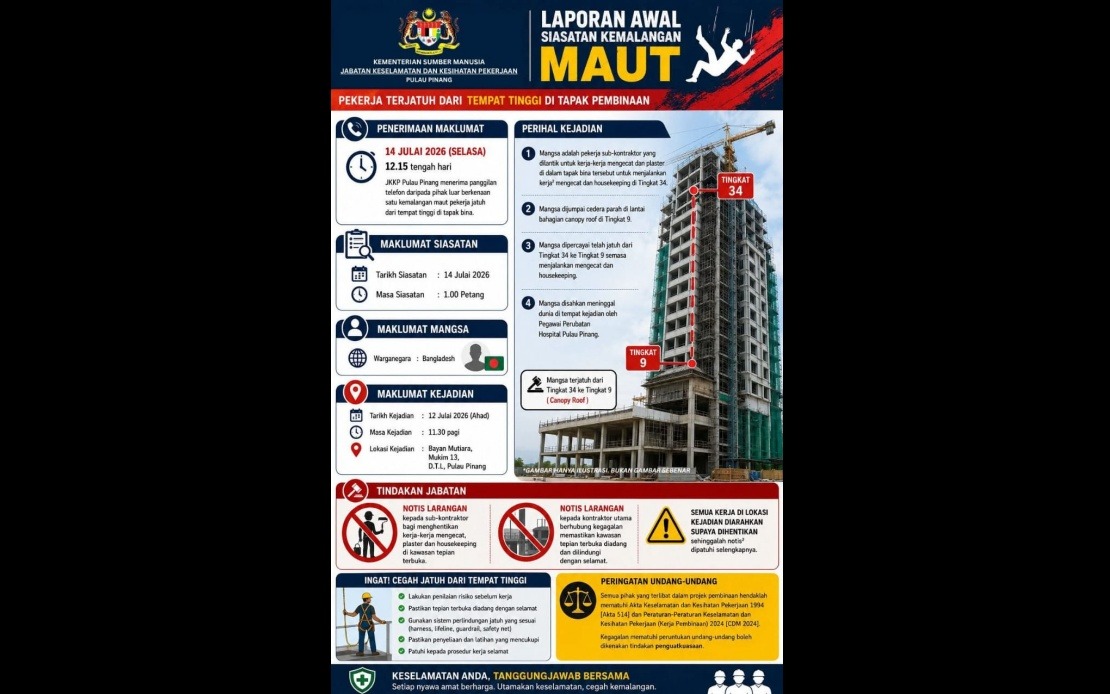
The Penang Department of Occupational Safety and Health is conducting a comprehensive investigation into the death of a Bangladeshi worker who died following a fall at a building construction project in Bayan Mutiara. The incident has prompted regulatory action against both the main contractor and subcontractor involved, underscoring the persistent challenges surrounding worker safety standards at high-rise construction sites across Malaysia.
According to Hairozie Asri, the director of Penang DOSH, the department was notified of the accident shortly after noon on July 15 through an external report. Investigators swiftly moved to the location to gather preliminary evidence and determine the sequence of events that led to the fatal outcome. The initial findings paint a troubling picture of the circumstances surrounding the worker's death and raise questions about safety protocols at the site.
The victim was engaged by a subcontractor specialising in finishing works including painting, plastering, and housekeeping services at the multi-storey development. Preliminary investigations indicate he was performing duties on the 34th floor when the incident occurred. The dramatic nature of the fall—from the 34th floor to a canopy roof structure at Level 9—suggests a significant failure in fall prevention measures. Medical personnel from Penang Hospital subsequently attended the scene and confirmed the worker had succumbed to his injuries at the location, with no opportunity for emergency medical intervention to alter the tragic outcome.
The regulatory response has been swift and decisive. DOSH has issued a prohibition notice specifically targeting the subcontractor, effectively halting all painting, plastering, and housekeeping work in areas with open edges where workers could be exposed to fall hazards. Additionally, a prohibition notice was directed at the main contractor overseeing the broader construction project. These orders represent a formal acknowledgement by authorities that existing safety measures proved inadequate to protect workers from preventable harm.
All construction activities connected to the accident site have been ordered to cease completely until both contractors fully satisfy the compliance requirements outlined in the prohibition notices. This suspension effectively grounds the project until management can demonstrate that comprehensive safety improvements have been implemented and certified. Such stoppages, while disruptive to development schedules and project timelines, serve as a critical mechanism for forcing contractors to reassess their occupational safety frameworks.
The incident highlights a persistent vulnerability in Malaysia's construction sector, where migrant workers from Bangladesh and other South Asian nations comprise a substantial portion of the workforce. These workers frequently labour in precarious conditions with limited protective equipment or proper training, often because cost considerations and competitive tendering processes incentivise corner-cutting on safety infrastructure. The reliance on subcontracting arrangements, as was the case here, can fragment responsibility and create gaps in safety oversight, particularly when main contractors fail to adequately supervise their subcontractors' compliance with regulations.
Fall-related fatalities remain among the leading causes of death in Malaysia's construction industry, accounting for a significant proportion of occupational mortality statistics. The prevalence of such accidents reflects insufficient investment in fall prevention systems, including adequate scaffolding, safety netting, personal protective equipment, and worker training programmes. High-rise projects in urban centres like Penang, where rapid development continues to drive construction activity, present particularly acute hazard profiles requiring stringent safety management.
The Penang DOSH investigation will likely examine multiple dimensions of the accident, including whether the worker received appropriate induction and safety training, whether necessary fall protection equipment was available and properly used, and whether site supervision was adequate. Investigators will also assess whether the subcontractor and main contractor had implemented documented safety systems and whether those systems were being enforced. The findings may reveal systemic failures that extend beyond this single incident.
For the broader construction industry in Malaysia and Southeast Asia, this tragedy underscores the importance of strengthened regulatory enforcement and contractor accountability mechanisms. Authorities must move beyond reactive investigations following fatalities to implement proactive workplace inspections and unannounced safety audits. Industry stakeholders should recognise that investment in genuine safety culture, rather than mere compliance paperwork, ultimately reduces both human suffering and project disruptions caused by accidents and regulatory action.
The incident also carries implications for migrant worker protection frameworks. Bangladesh, like several source nations for Malaysia's migrant workforce, has expressed concerns about the treatment and safety of its citizens working abroad. This death may prompt diplomatic engagement and calls for enhanced bilateral cooperation on occupational safety standards and worker compensation mechanisms. Malaysian authorities will need to ensure transparent investigation outcomes and appropriate accountability for any regulatory failures.

