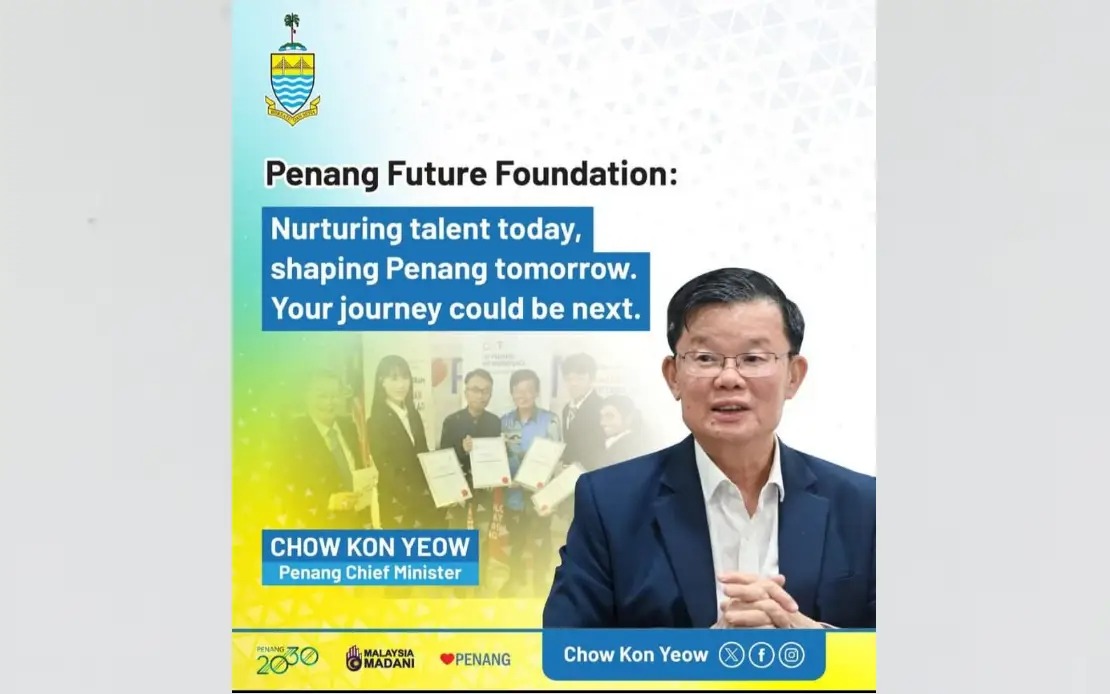
The Penang Future Foundation, established as a cornerstone initiative of the state government's talent development strategy in 2015, has now distributed approximately RM47.7 million across 863 scholarships to Malaysian students, marking a significant commitment to building human capital in critical fields. Chief Minister Chow Kon Yeow highlighted the programme's enduring importance as Penang enters its 11th year of operations, underscoring how strategic investment in education directly translates to economic competitiveness and industrial readiness.
The foundation operates on a hybrid financing model that draws resources from both government coffers and private sector partners, reflecting a collaborative approach to addressing Malaysia's persistent skills gap across multiple industries. This mixed-funding structure has enabled the foundation to expand its reach beyond what state resources alone could achieve, creating a sustainable platform for long-term scholarship provision that adapts to changing labour market demands.
During the most recent award cycle, the foundation distributed scholarships to 58 students representing diverse educational and socioeconomic backgrounds. These recipients specialised in Science, Technology, Engineering, Mathematics, Accountancy, and Finance—all sectors where Malaysia faces significant talent shortages and where regional competition for skilled professionals continues to intensify. The deliberate focus on these disciplines reflects strategic planning aligned with Penang's manufacturing, technology, and financial services industries.
Chow's statement reveals an underlying economic concern that resonates across Southeast Asia: the risk of brain drain and the challenge of retaining talented individuals within state boundaries. As Penang positions itself as an investment destination for the coming half-century, the foundation serves as a retention mechanism, attempting to bind scholarship recipients to the state through educational investment and career pathways. This approach recognises that sustainable economic growth requires not merely infrastructure and foreign direct investment, but a stable, skilled workforce developed from within.
The foundation operates two distinct scholarship tiers designed to accommodate varying academic standards while maintaining rigorous selection criteria. The PFF Penang Scholar programme targets high-achieving students with cumulative grade point averages of 3.67 and above, representing those in the upper echelon of academic performance. The PFF Mutiara Scholar track, positioned as the second tier, accepts applicants with GPAs ranging from 3.00 to 3.66, broadening access without sacrificing academic standards and acknowledging that merit comes in varied forms.
This tiered structure holds particular significance for Malaysian education policy discourse, as it balances excellence with inclusivity—a perpetual tension in higher education funding. By creating two pathways rather than a single highly restrictive programme, the foundation maximises the talent pool while still prioritising top performers, potentially capturing high-potential students who may have faced temporary academic setbacks or attended less-advantaged secondary institutions.
The 2026 application cycle will commence on July 15 and close on August 5, providing a six-week window for prospective applicants across Malaysia to submit documentation. This accelerated timeline, compared to some international scholarship processes, reflects the foundation's efficiency and suggests robust internal assessment infrastructure capable of processing large application volumes within compressed schedules.
The foundation's open-door policy, welcoming applications from anywhere within Malaysia rather than restricting awards to Penang residents, demonstrates strategic thinking about talent development at the national level. This approach positions Penang as a destination for Malaysia's brightest students regardless of origin, potentially creating networks and professional connections that benefit the state's economy indirectly through alumni networks and collaborative innovation.
For Southeast Asian readers monitoring scholarship opportunities, Penang Future Foundation's scale and accessibility merit attention. With nearly 900 scholarships distributed over a decade and a clearly articulated merit-based selection process, the foundation represents one of the region's more substantial state-level scholarship initiatives, rivalling some university-specific programmes in scope and demonstrating how subnational governments can shape talent markets.
The foundation's emphasis on STEM and professional fields aligns with broader Asian economic trends prioritising technology adoption and digital transformation. Countries across Southeast Asia face similar skills shortages in these areas, making Penang's approach—investing state resources to develop local expertise—a model worthy of examination by policymakers grappling with similar human capital challenges.
Prospective applicants can find detailed information through the foundation's official website at www.penangfuturefoundation.my, where periodic announcements and updates regarding the 2026 cycle will be published. This digital-first communication strategy reflects contemporary best practices in scholarship administration and ensures transparent, accessible information distribution to geographically dispersed applicants.
Looking forward, the foundation's trajectory suggests continued expansion as Penang pursues industrial diversification and higher-value economic activities. Whether scholarship numbers will increase or academic thresholds shift will largely depend on the foundation's success in tracking scholarship recipients' employment outcomes and contribution to state economic development—metrics that will ultimately determine whether this substantial public-private investment generates measurable returns in retained talent and strengthened competitiveness.

