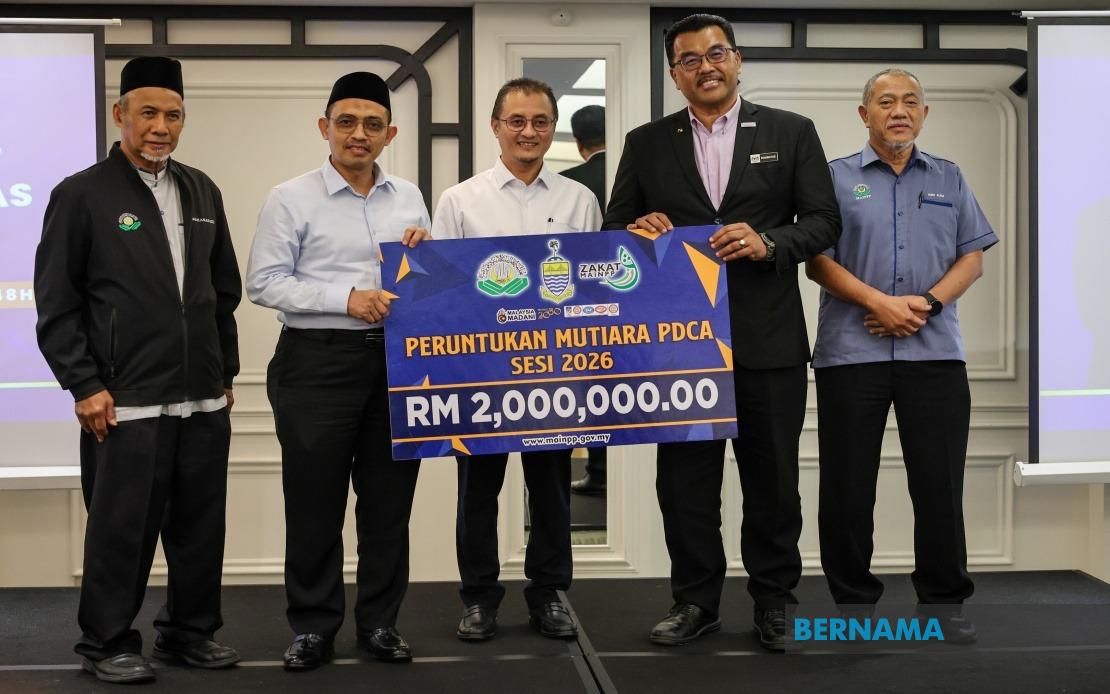
The Penang State Islamic Religious Council (MAINPP) is backing its educational mission for disadvantaged Bumiputera communities with a fresh RM2 million investment in 2026, extending a two-decade-old programme that has become central to the state's social mobility agenda. The allocation supports the Mutiara Didik Cemerlang Akademik (MPDCA) initiative, a collaborative venture spanning the state education authority, federal development coordination bodies, and regional planners, which will reach 7,403 pupils and students this year across primary and secondary institutions. The funding announcement signals MAINPP's sustained commitment to bridging educational gaps for Bumiputera children, particularly those from economically constrained backgrounds who lack access to private supplementary instruction.
Datak Dr Mohamad Abdul Hamid, Penang's Deputy Chief Minister and MAINPP president, underscored the programme's foundational role in the state's human capital development strategy during a coordinating teachers' briefing in Kepala Batas. The disbursement flows toward multiple educational interventions beyond basic tutoring: structured learning modules, academic seminars tailored to examination requirements, and specialist workshops focused on examination answering technique—approaches designed to systematically elevate student performance rather than relying solely on rote memorisation. The programme's scope reflects recognition that effective academic support requires multifaceted intervention, combining direct instruction with methodological training and confidence-building activities. MAINPP's broader educational portfolio, announced concurrently, includes RM22.36 million in higher education bursaries, RM6.3 million for tertiary admission support, and RM3 million each for early schooling and school uniform assistance, painting a comprehensive funding picture for Bumiputera advancement.
The operational footprint of MPDCA has expanded considerably within Penang's school system since its 2006 inception. The 2026 cohort engages 698 coordinating teachers distributed across 71 primary schools and 38 secondary schools, suggesting institutional entrenchment and systemic integration. For primary students, particularly those in Year Six facing crucial transition assessments, the programme concentrates on four foundational subjects: Bahasa Melayu, English, Mathematics and Science—domains universally recognised as critical for subsequent academic progression. The secondary track is substantially more ambitious, offering 13 subjects spanning languages, sciences, mathematics and humanities, including provisions for students pursuing the Sijil Pelajaran Malaysia (SPM) examination, the national university entry qualification. Additionally, the programme accommodates three integrated curricula specifically designed for government-aided religious schools, acknowledging the distinctive pedagogical pathways within Penang's diverse educational ecosystem and ensuring no segment of the Bumiputera student population remains unserved.
Evidence from participating educators suggests the programme delivers tangible academic gains rather than merely consuming budget allocations. Hartina Arjan, a Bahasa Melayu instructor at Sekolah Kebangsaan Permai Indah in Bukit Minyak, emphasised that systematically designed learning modules enhance student mastery of subject content while providing cost-free instruction to learners spanning the academic spectrum. Her observation that modules deliberately develop speaking, reading and writing competencies points to communication-focused pedagogy rather than test-preparation narrowness. The modules explicitly prepare students for Classroom-Based Assessment and formal examinations, suggesting alignment between supplementary instruction and official evaluation frameworks. Sadiah Roslan, teaching at Sekolah Rendah Islam Al-Masriyah Halimatun in Bukit Mertajam, articulated the programme's particular significance for low-income families unable to finance commercial tuition centres, addressing a equity gap that market-driven education inevitably creates. Her observation that interactive approaches and quiz-based activities have increased classroom engagement and academic performance indicators suggests psychological and pedagogical benefits beyond content transmission.
The 2006 launch of MPDCA coincided with Malaysia's intensifying focus on equitable outcomes within affirmative action frameworks, and subsequent performance data cited by state education authorities indicate sustained positive impact on participant achievement levels. This longitudinal track record provides justification for continued investment, though comparative data on participant outcomes versus control groups remains absent from public discourse. The partnership architecture involving MAINPP, the state education department, federal coordination mechanisms, and regional development authorities reflects multi-level governance engagement, a model increasingly common in Malaysian social policy but requiring sustained inter-agency coordination to maintain effectiveness. The 2026 allocation represents not merely financial commitment but institutional commitment, with infrastructure, personnel and systems already embedded across the state education system.
The programme's relevance extends beyond individual student advancement to regional considerations. Penang's demographic composition and economic structure create particular challenges: substantial populations of Malay-Muslim Bumiputera families, pockets of economic disadvantage despite the state's manufacturing prosperity, and educational aspiration-achievement gaps requiring systematic intervention. MPDCA addresses these realities through targeted support, reducing systemic barriers to academic progression for students whose family circumstances or prior educational experiences might otherwise constrain their potential. The programme's emphasis on state-level implementation contrasts with federal approaches, allowing tailoring to Penang's specific context while maintaining alignment with national curriculum standards and examination structures.
The allocation announced in July 2026 arrives amid broader Malaysian educational discussions concerning privatisation pressures, declining academic standards in public systems, and inequality in educational access. By maintaining substantial public investment in supplementary instruction, MAINPP implicitly rejects market-dependent models and affirms that equitable educational outcomes require sustained public expenditure. The RM2 million directed toward 7,403 students represents approximately RM270 per student annually, modest in absolute terms but substantial when aggregated across a programme requiring coordination, teacher deployment, module development and ongoing quality assurance. This per-pupil allocation suggests realistic expectations regarding service delivery—supplementary instruction rather than comprehensive replacement education, targeted interventions rather than universal provision.
The teacher testimonials incorporated in official announcements deserve scrutiny as indicators of programme health. Educators highlighted pedagogical innovations—interactive learning, updated modules, quiz-based activities—suggesting the programme remains dynamic rather than ossified into rote routines. The explicit mention of improved Classroom-Based Assessment performance, Malaysia's continuous evaluation mechanism replacing pure examination dependence, indicates alignment with contemporary pedagogical philosophy. Teacher participation and coordination across 109 schools implies professional development opportunities and community-of-practice engagement, factors known to sustain programme quality over extended periods. The identification of particular teachers and schools in public announcements, while customary in Malaysian government communications, also serves accountability functions, associating institutional prestige with programme participation.
Looking toward implications for comparable systems across Southeast Asia, MAINPP's model demonstrates how religious and state institutions can coordinate around educational equity objectives. Many Southeast Asian societies harbour comparable Bumiputera-equivalent populations requiring targeted support, and Malaysia's institutional architecture—combining religious councils, education ministries, and development authorities—offers templates for replication. The longevity of MPDCA (spanning 20 years through multiple electoral cycles and policy shifts) suggests resilience and cross-party political acceptance, factors increasing likelihood of sustained funding and institutional support. The programme's focus on academic subjects rather than vocational pathways reflects continued emphasis on university-directed trajectories, though this remains subject to ongoing debate regarding skills-focused alternatives.
Financial sustainability questions inevitably arise when examining long-term educational commitments within constrained fiscal environments. MAINPP's annual allocations across education bursaries, entrance assistance, and material support total approximately RM34.66 million in announced allocations, concentrating substantial resources within a single state and particular demographic segment. This concentration reflects MAINPP's specific religious constituency and state-level responsibility, but raises questions regarding comparative investment levels across Malaysia's 13 states and the degree to which similarly situated Bumiputera populations in other jurisdictions receive equivalent support. Whether MPDCA-equivalent programmes exist uniformly nationwide or remain concentrated in particular states represents an important equity consideration extending beyond Penang's borders.
The 2026 MPDCA allocation ultimately reflects institutional maturity and demonstrated commitment rather than experimental pilot programming. The specificity of numbers—698 coordinating teachers, 109 schools, 7,403 students, 13 SPM subjects—indicates established systems rather than nascent initiatives. The participation of senior political leadership in programme implementation ceremonies and funding disbursements signals political valorisation and protective institutional positioning. For Malaysian and Southeast Asian policymakers examining educational equity mechanisms, MPDCA demonstrates that supplementary academic support, when systematically deployed through existing institutional structures, can address performance disparities without requiring wholesale system transformation. Whether such mechanisms sufficiently address underlying inequities or merely provide marginal assistance at educational margins remains a more profound question extending beyond programme administration into foundational questions regarding educational access and social mobility in Malaysia.

