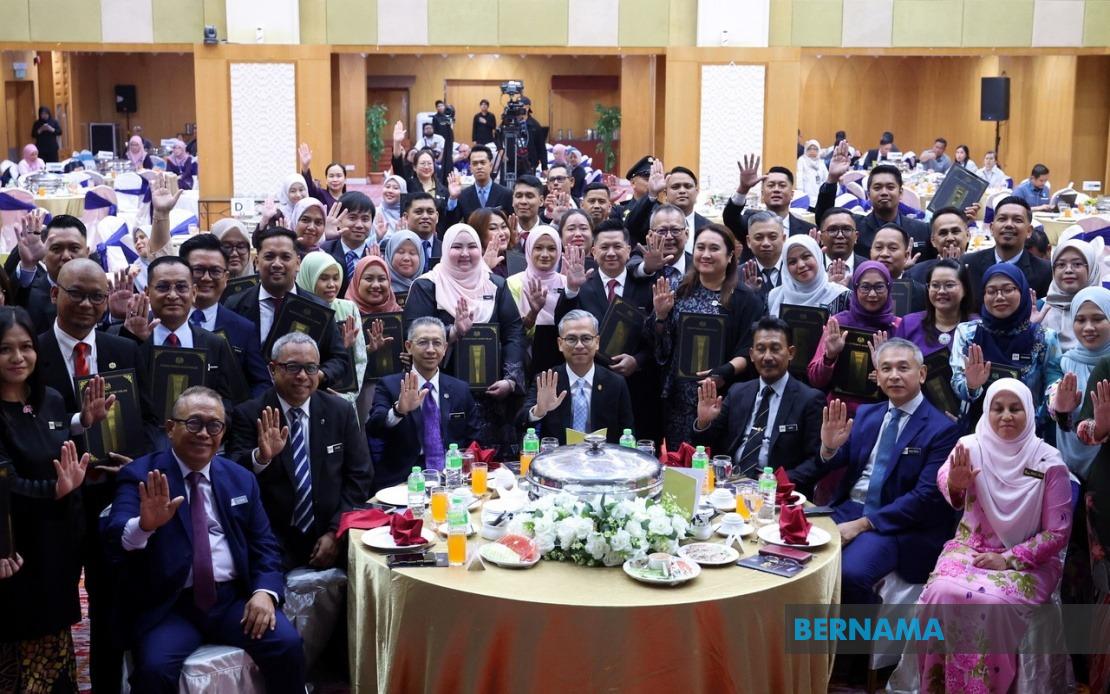
The MADANI Government is determined to anchor its economic agenda on direct benefits for all Malaysians, Communications Minister Datuk Seri Fahmi Fadzil declared in Kota Kinabalu this week. Speaking at a service excellence awards ceremony for the Communications Ministry's Sabah and Labuan operations, Fahmi stressed that impressive macroeconomic statistics only matter if they improve the lived experiences of ordinary citizens across the country.
While national and state-level economic indicators have performed respectably—with growing investment, rising revenues, strengthened reserves, expanding gross domestic product, and robust trade flows—Fahmi contended that these figures represent merely the surface of governmental economic responsibility. The real test, he suggested, lies in whether such aggregate growth penetrates households, influences purchasing power, and eases the financial pressures facing millions of Malaysians navigating daily economic realities.
This philosophy underpins what the government terms the "people's economy," a concept Fahmi defined with deliberate simplicity: the economy as experienced by individuals in their own lives, rather than abstract national statistics. He illustrated this principle through the implementation of BUDI MADANI, the government's retargeted diesel subsidy programme, which exemplifies how policy design must account for local geography and circumstances. In states like Sabah and Sarawak, citizens frequently travel considerable distances between districts for work, commerce, and essential services, making fuel costs a material concern for household budgets in ways that may not register with urban policymakers.
The minister underscored that Prime Minister Datuk Seri Anwar Ibrahim and the Cabinet remain attentive to such ground-level realities. This attention reflects an understanding that macroeconomic success divorced from household welfare creates a credibility gap between government rhetoric and citizen experience. When citizens fail to perceive tangible improvements in their financial circumstances despite claims of national prosperity, scepticism about economic management naturally follows. Conversely, when policies demonstrably reduce costs and improve access to essentials, public confidence in government stewardship strengthens.
Fahmi's emphasis on translating national performance into individual benefit carries particular significance for Malaysia's regional competitiveness and social cohesion. As the country competes regionally for investment and talent, economic credibility depends partly on whether prosperity reaches beyond urban centres and corporate boardrooms to encompass rural communities, peripheral regions, and ordinary wage-earners. Sabah and Sarawak, constituting Malaysia's eastern anchor, warrant particular focus given their geographical remoteness, infrastructure constraints, and economic integration challenges.
The government's commitment to targeted subsidies, as opposed to blanket approaches, reflects pragmatic recognition that one-size-fits-all policies generate inefficiencies and inequities. In remote Sabahan and Sarawakian localities, fuel subsidy retargeting acknowledges that transport costs consume significantly larger portions of household income than in densely populated areas. This granular policy design, properly implemented, prevents subsidy leakage while maximising impact where need is greatest. However, such complexity also creates communication challenges that Fahmi identified as ministerial responsibility.
Government agencies must shoulder the burden of explaining policy rationale, mechanisms, and impacts with clarity and comprehensiveness, Fahmi insisted. Without effective communication, well-intentioned policies risk misinterpretation or public confusion, undermining their effectiveness and generating unnecessary political friction. This imperative extends beyond simple announcements to encompass sustained dialogue with affected communities, addressing concerns, and demonstrating responsiveness to feedback. In Sabah and Sarawak particularly, where information distribution faces geographical obstacles and trust in federal initiatives may not be universally assumed, this communication responsibility intensifies.
The ceremonial context—honouring service excellence within the Communications Ministry—reinforces the interconnection between government communication and economic policy implementation. The ministry's Sabah and Labuan zone staff serve as frontline representatives of federal government presence and commitment to these regions. Their demonstrated excellence in service delivery projects governmental competence and shapes public perception of broader MADANI initiatives. This cascading effect means that routine administrative interactions contribute meaningfully to whether citizens believe the government genuinely prioritises their economic wellbeing.
Malaysia's economic sustainability depends fundamentally on inclusive growth that strengthens public confidence across demographic and geographic segments. Fahmi's articulation of the "people's economy" as governing framework suggests the current administration recognises that contemporary Malaysian politics increasingly demands tangible household-level improvements rather than aggregate performance metrics. This shift reflects both genuine commitment and pragmatic political calculation—voters evaluate governments through personal economic experience rather than abstract statistics.
For Southeast Asian observers, Malaysia's emphasis on inclusive economic translation offers instructive lessons regarding legitimacy in maturing economies. As regional peer nations pursue growth strategies, the Malaysian experience demonstrates that distributional outcomes matter as much as aggregate expansion. The MADANI Government's willingness to spotlight this principle publicly, through ministerial statements and policy examples, indicates recognition that future political stability rests upon demonstrable benefits reaching ordinary citizens throughout the federation, from Johor to Sabah and Sarawak.

