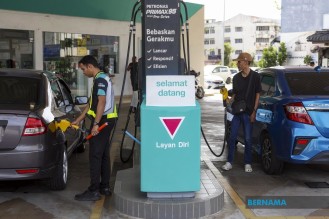
Malaysia's fuel supply situation remains on an even keel, with government assurances that the nationwide Petronas petrol station network will maintain adequate fuel stocks through August. Datuk Seri Azalina Othman Said, the Minister in the Prime Minister's Department (Law and Institutional Reform), delivered this reassurance during the National Economic Action Council's weekly session, drawing on official information furnished directly by Petronas. The statement addresses broader concerns about energy security in Southeast Asia's largest economy, particularly given volatile global markets and geopolitical tensions affecting crude oil flows.
Petrolas Dagangan Bhd, the publicly listed subsidiary that operates the bulk of Malaysia's retail fuel distribution, supplies roughly half of the nation's total domestic fuel consumption through its extensive station network. This commanding market position underscores the critical importance of maintaining smooth operations across the Petronas system, as disruptions would ripple across the Malaysian economy and affect millions of daily commuters, commercial operators, and industrial users. The company's ability to sustain supply through the middle of the year provides a crucial buffer, though questions remain about what happens beyond that timeline and how external shocks might compress that window.
The government's confidence in fuel availability stems partly from active management mechanisms now in place. A Crisis Management Task Force, established under the National Economic Action Council, has assumed responsibility for monitoring Malaysia's fuel, petroleum, and energy situation in real time. This task force represents a coordinated approach to what officials characterise as a global energy crisis triggered by conflict in West Asia—a euphemism for broader Middle Eastern instability that has already rattled energy markets and prompted strategic stockpiling across Asia. By centralising oversight, the government hopes to respond quickly to supply bottlenecks or price pressures before they cascade through the economy.
Beyond domestic coordination, Malaysia is actively diversifying its crude oil procurement strategy to reduce dependence on traditional Middle Eastern suppliers. Officials confirmed ongoing efforts to secure crude oil from alternative exporters in West Africa and the Americas, negotiations that reflect a pragmatic shift toward energy independence. However, such diversification involves complex considerations beyond simple availability. Crude oil from different regions carries distinct characteristics—varying viscosity, sulphur content, and other chemical properties—that affect refinery operations and product yields. Commercial terms, including pricing, shipping logistics, and contract flexibility, must align with Petronas' operational and financial requirements. This complexity means that expanding the supplier base, while strategically sound, requires months of technical evaluation and commercial negotiation.
The establishment of this task force also signals government intent to tackle secondary threats to fuel security beyond simple supply availability. Smuggling of subsidised Malaysian fuel across borders, particularly to Thailand and Brunei, represents a chronic drain on domestic reserves and distorts market pricing. By folding anti-smuggling operations into the crisis management framework, authorities are treating fuel security as a holistic challenge requiring interventions across procurement, distribution, pricing, and enforcement. This integrated approach mirrors successful models used by other energy-dependent nations managing subsidy systems under budget pressure.
Price control remains another pillar of the government's energy strategy, mentioned explicitly in the minister's remarks. Malaysia maintains a managed fuel pricing mechanism rather than allowing pure market forces to determine pump prices. This approach, while politically attractive and economically populist, creates structural challenges during periods of global price volatility. When international crude prices spike, the gap between government-controlled domestic prices and production costs widens, pressuring state finances and creating incentives for smuggling and hoarding. The task force's price-control mandate suggests officials intend to maintain affordable fuel access while managing fiscal impact, a balancing act that becomes increasingly difficult as global energy markets tighten.
The question posed by opposition legislator Khairil Nizam Khirudin addressed a discrepancy in public messaging. Petronas had previously stated that fuel supply guarantees extended only to the end of June 2026, yet the minister's response pushed the horizon to August. This apparent extension reflects either updated assessments or clarifications about supply security timeframes. The distinction matters because it signals whether the government has gained additional procurement flexibility, negotiated longer-term contracts, or simply refined how it communicates uncertainty to the public. For Malaysian businesses and consumers, the answer determines how urgently contingency plans require activation.
The broader geopolitical context intensifies scrutiny of Malaysia's fuel security. The region has experienced supply shocks before, most notably during the 1970s oil embargo and the various Middle Eastern conflicts that disrupted shipping lanes and production. Contemporary threats include potential escalation of tensions in the Strait of Hormuz, through which vast quantities of global crude oil transit daily. Should that waterway face disruption, prices would spike worldwide and availability would tighten dramatically across Asia. Malaysia, as both an energy consumer and a nation dependent on freedom of navigation for trade, faces compounded risks that go beyond direct crude supply concerns.
For Malaysian businesses relying on stable energy costs, these assurances provide limited comfort beyond the August timeframe. Freight operators, manufacturers, and service providers cannot simply suspend operations when fuel supplies become uncertain. The task force's work therefore carries high stakes for economic planning and competitiveness. Securing alternative suppliers and maintaining price stability through volatility will determine whether Malaysia can sustain growth and employment during energy-stressed periods. This challenge tests not only Petronas' operational excellence but the government's ability to make strategic energy decisions amid competing demands.
Looking ahead, Malaysia must balance immediate supply assurance against longer-term structural adaptation. The existence of the Crisis Management Task Force, while prudent, essentially acknowledges that energy security cannot be taken for granted. Southeast Asia's economic dynamism depends on reliable, affordable energy. Malaysia's response—diversifying suppliers, tightening smuggling controls, managing prices, and maintaining strategic coordination—represents competent crisis management. However, the underlying vulnerabilities to global energy shocks persist, suggesting that even with improved planning, the region remains exposed to forces largely beyond its control.

