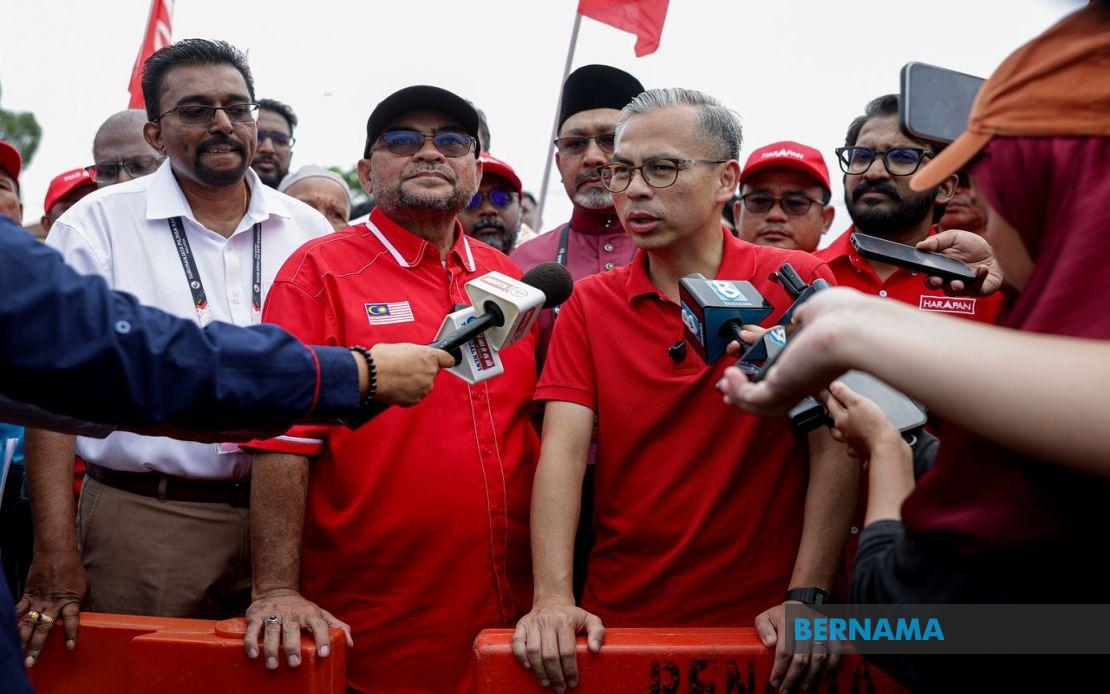
Pakatan Harapan's approach to the upcoming Negeri Sembilan state election will revolve around defending the incumbent administration's record and convincing voters that political continuity represents the safest path forward for the state's economic future. Speaking after the completion of candidate nominations in Jempol, PH Communications director Datuk Seri Fahmi Fadzil articulated a campaign strategy rooted in the tangible achievements delivered by Menteri Besar Datuk Seri Aminuddin Harun since assuming office in 2018. The coalition intends to position itself as the guardian of proven governance rather than a force promoting radical change, a messaging approach that reflects broader confidence in the incumbent's stewardship.
The foundation of PH's electoral pitch rests on a series of economic indicators that party officials argue demonstrate effective state administration. According to Fahmi, the Aminuddin-led government has achieved measurable increases in zakat collections—a significant metric in Malaysia's Islamic governance context—alongside improved revenue generation for the state treasury. Beyond these conventional fiscal measures, PH highlights sustained foreign investment inflows into Negeri Sembilan, culminating in the development of a new port facility that carries considerable strategic and commercial importance for regional trade corridors. These achievements, the party contends, serve as empirical evidence that the current leadership possesses the competence to manage state resources and attract economic opportunities.
The emphasis on administrative continuity reflects a deliberate political calculation. Having governed Negeri Sembilan since 2018, PH recognises that electoral victory hinges on persuading voters that disrupting the current administration would jeopardise the economic momentum the state has built. This message carries particular resonance in states where voters have witnessed visible infrastructure development and business expansion. However, the strategy also implies a certain defensive posture—by focusing primarily on past performance rather than forward-looking initiatives, PH may struggle to energise younger voters seeking transformative policies or address emerging concerns that economic growth has not translated into tangible improvements in their personal circumstances.
The four-cornered contest for the Jeram Padang seat exemplifies how PH is adapting its messaging to specific constituency dynamics. The party's candidate, G. Manivannan—a lawyer serving as political secretary to Prime Minister Datuk Seri Anwar Ibrahim—will prioritise employment and economic opportunity messaging, issues that consistently dominate conversations among younger voters in the district. By deploying a candidate with both legal credentials and proximity to federal leadership, PH signals that it can bridge local concerns with national decision-making architecture. Manivannan's positioning against incumbent Datuk Mohd Zaidy Abdul Kadir of Barisan Nasional, R. Sri Sanjeevan representing Bersatu, and Dayana Dal of Asli—notable as the sole Orang Asli candidate in these contests—reveals a fragmented opposition that may work to PH's advantage.
The nomination process itself proceeded without incident across the four Jempol parliamentary seats under contention. Serting will feature a three-cornered fight between PH's Yaacob Mahmood, Perikatan Nasional incumbent Mohd Fairuz Mohd Isa, and Bersatu's Muhammad Noraffendy Mohd Salleh, signalling continued factional divisions within Malay-Muslim politics that historically benefit the coalition capturing the centre ground. In Palong, a separate three-cornered contest pits PH's Muhammad Zahin Zinal Abidin against Barisan Nasional incumbent Datuk Mustapha Nagoor and Bersatu's Rebin Birham. The Bahau seat, by contrast, presents a cleaner two-way battle between DAP's incumbent Teo Kok Seong and MCA's Chong Fui Ming, eliminating the vote-splitting dynamics that plague other constituencies.
Fahmi's emphasis on responsible campaigning and adherence to the three Rs—Religion, Race, and Rulers—reflects mounting concern about electoral conduct across Malaysia's political landscape. As Communications Minister, his dual role grants him formal authority to shape media narratives whilst simultaneously requiring him to project impartiality in governance. By explicitly warning against fake news and slander whilst pledging to monitor media welfare, Fahmi attempts to preempt accusations that PH might exploit state machinery or friendly media outlets for partisan advantage. This posture, however, also suggests anxiety about opposition tactics, particularly from increasingly aggressive social media campaigns that have characterised recent Malaysian elections.
The timing of the election—with voting scheduled for August 1 following early voting on July 28—compresses the campaign window into two weeks, a constraint that rewards parties with established infrastructure and media access. PH's control of both state government machinery and federal communications apparatus provides measurable organisational advantages. Opposition parties must compensate through grassroots mobilisation and social media saturation, though Bersatu's participation in multiple seats and Barisan Nasional's continued presence complicate the opposition's ability to consolidate anti-PH sentiment around unified candidates. The fragmentation of the opposition across three broad camps—BN, PN/Bersatu, and Asli—mirrors national political fragmentation that has created opportunities for the coalition.
For Malaysian readers, the Negeri Sembilan election carries implications extending beyond state politics. The election functions as a bellwether for voter sentiment regarding federal PH leadership, with results potentially influencing assessments of Anwar Ibrahim's administration's popularity and electoral viability. Economic messaging will prove decisive; if voters perceive that state-level prosperity has translated into improved living standards, PH gains validation for its governance model. Conversely, if economic indicators fail to convert into household-level improvements—particularly concerning employment, housing affordability, and consumer prices—PH risks losing ground to opposition narratives centred on cost-of-living grievances. The deployment of Anwar's political secretary in Jeram Padang signals federal leadership's investment in state outcomes.
The geographical concentration of these four seats within the Jempol parliamentary constituency means that the campaign will intensify around a defined region, potentially creating localised political effects that ripple outward. Jempol's demographics, economic profile, and historical voting patterns will shape both the intensity of competition and the salience of particular issues. PH's emphasis on port development and foreign investment resonates most strongly in constituencies with significant business communities and trading populations, though rural areas within these constituencies may respond more strongly to agricultural subsidies, infrastructure projects, and social welfare messaging.
Moreover, the presence of Asli's sole Orang Asli candidate, Dayana Dal, in the Jeram Padang contest introduces a distinctive dimension reflecting growing political consciousness among indigenous communities. While Asli has historically occupied a marginal position in Malaysian electoral politics, increased indigenous political mobilisation could fragment votes in ways that disadvantage parties competing for the Malay-Muslim centre. The emergence of Asli candidates, however limited in number, suggests that indigenous communities increasingly view electoral participation as a mechanism for asserting distinctive interests rather than defaulting to establishment parties.
As the campaign unfolds, PH's reliance on administrative continuity as the primary electoral message will face stress-testing from opposition parties offering different visions. Barisan Nasional will attempt to regain lost ground through traditional BN networks and patronage advantages, whilst Perikatan Nasional's participation reflects the ongoing insurgency of Malay-Muslim centric politics challenging PH's multiethnic coalition model. The next two weeks will reveal whether voters prioritise macroeconomic achievements and political stability or whether rising cost-of-living pressures and employment anxieties override satisfaction with top-line economic metrics. For Southeast Asian observers, the Negeri Sembilan election offers a case study in how incumbent coalitions in democratic systems balance defensive positioning grounded in past performance against the imperative to articulate compelling visions of future progress.

