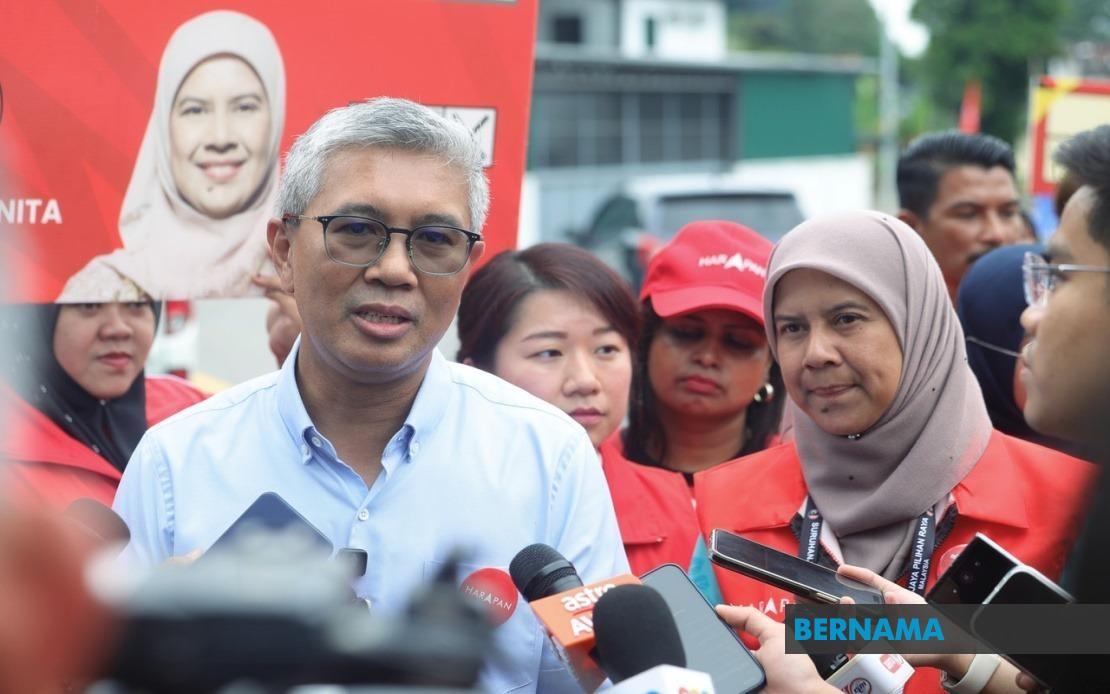
The Pakatan Harapan coalition is banking on momentum in the Pilah state constituency, where grassroots surveys indicate voters have responded positively to the incumbent administration's development agenda and service delivery record. Senior Political Advisor to the Prime Minister Tengku Datuk Seri Zafrul Tengku Abdul Aziz visited the Kuala Pilah area on the campaign trail, where he assessed that public receptivity towards the coalition's candidate remains notably high. The sentiment, he explained, reflects appreciation among constituents for the work undertaken by incumbent state assemblyman Datuk Noorzunita Begum Mohd Ibrahim during her tenure in office.
Tengku Zafrul's assessment comes as the 16th Negeri Sembilan State Election enters its second week, with polling scheduled for August 1 and early voting commencing July 28. The Pilah constituency, one of five state seats within the larger Kuala Pilah parliamentary division, represents a closely watched contest that may signal broader voter sentiment across the state. However, the PM's advisor cautioned against complacency, emphasizing that sustained campaign momentum and continuous engagement with residents remain essential to securing victory, particularly as the coalition faces a straight fight against the Barisan Nasional candidate S. Leza Md Yasin.
Economic fundamentals appear to underscore PH's confidence in retaining the seat. Tengku Zafrul highlighted that Negeri Sembilan's economy has demonstrated resilience under Menteri Besar Datuk Seri Aminuddin Harun's administration, with cumulative investments reaching RM19 billion and state reserves surpassing RM1 billion. These metrics, he argued, validate the effectiveness of the coalition's governance model and the political stability it has provided since taking power. For voters in Pilah, the narrative centers on translating macroeconomic gains into tangible livelihood improvements at the constituency level.
A significant focal point of PH's campaign strategy in Pilah is addressing the aspirations of younger residents, particularly Generation Z. Tengku Zafrul underscored the importance of creating quality professional employment opportunities that allow youth to build sustainable careers without necessitating migration to major urban centers or abroad. This emphasis on localized economic opportunity reflects broader concerns within Malaysian society about brain drain and the concentration of high-skilled jobs in Kuala Lumpur and other metropolitan areas. For a state constituency like Pilah, situated between Seremban and Bahau in central Negeri Sembilan, the challenge of retaining talent and fostering local economic dynamism remains acute.
The government's MADANI agenda frames these employment and development initiatives within a larger commitment to reducing economic disparities between urban and rural regions. Tengku Zafrul acknowledged that while Kuala Pilah possesses considerable economic potential, spillover effects from growth in adjacent areas have been uneven. Consequently, the administration is actively pursuing strategies to attract fresh investments and expand economic activity more widely across the state, rather than allowing concentration in traditional commercial hubs. This position appeals to constituencies that have historically felt sidelined in development planning and reflects a recognition that political sustainability increasingly depends on inclusive growth narratives.
Noorzunita Begum's campaign machinery has adopted a methodical approach, having reached most residential areas by the eighth day of campaigning. The incumbent plans to intensify efforts in traditional villages during the campaign's final stretch, ensuring that diverse community segments encounter the coalition's development vision and policy platform. This granular engagement strategy recognizes that traditional villages, often home to older voters and those with stronger ties to community institutions, require sustained relationship-building rather than one-off campaign events.
Demographic data for the Pilah constituency reveals an electorate of 18,034 registered voters, distributed nearly equally between genders: 8,925 male voters (49.49 percent) and 9,109 female voters (50.51 percent). This gender parity is notable for electoral analysis, as research increasingly shows that women voters can constitute decisive voting blocs in tightly contested state elections. The voter roll also includes 259 police personnel and spouses, a segment that may respond to specific campaign messaging around public sector support and security sector interests. The nearly equal male-female distribution suggests that campaign messages addressing family welfare, education, and senior citizen support—issues Noorzunita Begum highlighted—could prove strategically significant.
Feedback gathered during campaign walkabouts has surfaced employment and economic opportunity as top concerns among local youth, aligning with PH's messaging around professional job creation. This convergence between constituent priorities and campaign messaging provides an opening for the coalition to present itself as responsive to grassroots concerns rather than imposing a top-down agenda. However, the presence of organized BN opposition in a straight fight means that Noorzunita Begum cannot assume victory based on sentiment alone; the outcome will ultimately depend on voter turnout and the effectiveness of ground organization on polling day.
The Pilah contest carries implications beyond the state level. As one of five constituencies feeding into the Kuala Pilah parliamentary seat, electoral performance here can influence perceptions of coalition strength heading into potential federal realignments. A strong performance would reinforce PH's narrative of political stabilization and economic competence, while a setback could invite questions about whether the coalition's appeal has plateaued among state-level voters. For Negeri Sembilan specifically, retaining Pilah is essential to maintaining government control of the state assembly and ensuring continuity under Menteri Besar Aminuddin Harun's administration.
The early voting window of July 28 allows election officials to process votes from police and other security personnel ahead of the main August 1 poll. This staggered voting process, while administratively efficient, also means that campaign intensity remains high right up to the main polling date. Both PH and BN will be monitoring early voting patterns closely for signals about turnout and voter enthusiasm. For Malaysian political observers, the Pilah result will offer one of the first substantive tests of voter sentiment in a state election since national political dynamics shifted following the 2022 general election.

