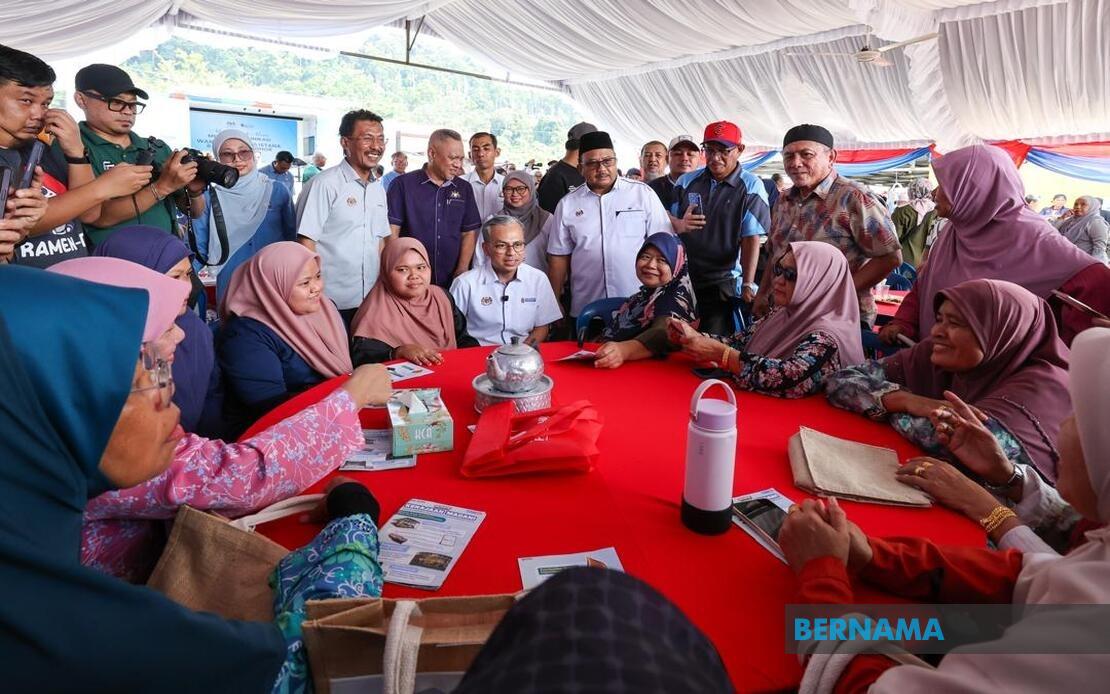
Pakatan Harapan's Communications director Datuk Fahmi Fadzil has pushed back against suggestions that the coalition's decision to delay releasing its election manifesto compromised its electoral prospects in Johor. Speaking during a public engagement in Batu Pahat on July 4, Fahmi, who simultaneously holds the position of Communications Minister, insisted that the 'Johor for All' blueprint was unveiled precisely when the campaign machinery required it, after comprehensive refinement and sign-off from the coalition's upper echelon.
The defence comes in response to remarks from Ong Kian Ming, the former Member of Parliament for Bangi who has expressed concerns that postponing the manifesto's publication could hobble PH's electoral momentum in the state ballot. Ong had cited multiple strategic shortcomings, including the coalition's refusal to publicly commit to a menteri besar candidate and the absence of heavyweight party figures from the candidate roster, as evidence that Barisan Nasional would achieve a decisive victory.
Fahmi's rebuttal frames the manifesto launch not as a retreat but as a calculated operational decision rooted in rigorous internal deliberation. He emphasised that PH released the document only after extensive vetting had confirmed both its substance and ideological coherence, with explicit approval from the coalition's leadership hierarchy, including Prime Minister Anwar Ibrahim. The timing of Friday's launch, he contended, aligned logically with campaign architecture—arriving at the threshold of the second campaign week, following the introduction of candidates, when both major contenders traditionally present their policy platforms.
The manifesto timing controversy reflects deeper anxieties within the coalition about whether its campaign narrative possesses sufficient clarity and momentum to overcome BN's inherent structural advantages in the state. Johor has been a Barisan stronghold for decades, and the absence of a publicly named menteri besar candidate signals a willingness to risk tactical ambiguity in pursuit of intra-coalition unity. This strategic trade-off, however, has evidently created openings for opposition critics to question whether PH has adequately prepared its ground game.
Fahmi's counterattack shifted focus to the opposition, redirecting criticism toward former UMNO Youth chief Khairy Jamaluddin, who dismissed the PH manifesto as derivative of BN's own policy commitments. Fahmi's response carried a subtle but pointed observation: Khairy has emerged as arguably the most visible campaigner in Johor's battle, outpacing in public prominence the sitting Menteri Besar Datuk Onn Hafiz Ghazi. The implication—that Khairy's energy and profile exceed those of BN's official state leader—inverts the conventional hierarchy of electoral contests and suggests internal dynamics within the ruling coalition that merit scrutiny.
His jest that Khairy's vigour should be "copied and pasted" to Onn Hafiz functioned as both criticism and a rhetorical parry, leveraging Khairy's own allegation of plagiarism to underscore what Fahmi presented as a leadership imbalance on the government side. This counteroffensive demonstrates PH's awareness that the campaign narrative extends beyond policy documents to encompass perceptions of dynamism, public engagement, and the credibility of frontline figures.
Internal tensions within the opposition coalition surfaced again when Fahmi was asked about allegations circulating on social media concerning a DAP leader's alleged willingness to support a pardon for former Prime Minister Datuk Seri Najib Tun Razak. These accusations gained public currency following a statement from Marina Ibrahim, a former Skudai assemblyman, who announced her retirement from politics citing disillusionment with what she characterised as DAP leadership dissembling on the pardon question. Such intra-party divisions, particularly involving DAP, represent precisely the organisational vulnerabilities that BN strategists hope to exploit.
Fahmi addressed these concerns by emphasising the robustness of grassroots mobilisation at PH events, claiming that public attendance and voter enthusiasm have remained consistently strong throughout the campaign period. He cited the fact that Ng Yak Howe, the coalition's Bentayan state seat candidate, is himself a DAP representative, suggesting that the party's electoral viability at the ground level has not been appreciably compromised by media-driven controversy. His reference to Marina Ibrahim's retirement as a peripheral concern, one without demonstrable impact on voter behaviour, reflected a confidence that internal party noise does not necessarily translate into electoral consequences.
The 16th Johor State Election represents a critical test for Pakatan Harapan's ability to penetrate BN's traditional strongholds. The contest encompasses 172 candidates vying for 56 state assembly seats, with polling scheduled for July 11 and advance voting opportunities available on July 7. The scale and intensity of this election have national ramifications, potentially reshaping the political equilibrium that emerged from the 2022 general election and the subsequent Anwar Ibrahim premiership.
Fahmi's insistence that manifesto timing posed no strategic disadvantage should be understood within the context of PH's broader challenge in Johor: assembling a sufficiently compelling and unified campaign narrative to dislodge entrenched BN structures. While the coalition has sought to frame the manifesto launch as methodical and principled, the timing controversy itself has inadvertently consumed campaign oxygen and afforded critics the opportunity to question PH's organisational coherence. Whether the 'Johor for All' blueprint, once in voters' hands, succeeds in catalysing electoral momentum will ultimately determine whether Fahmi's defence of the launch strategy was prescient or merely wishful reasoning.

