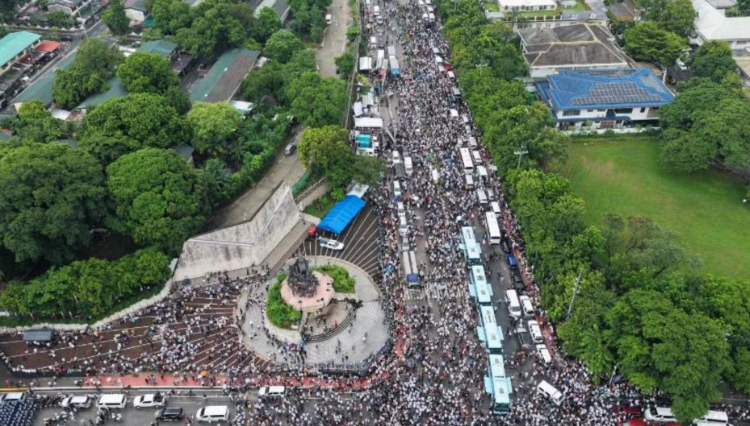
Religious and political tensions in the Philippines have collided spectacularly as the powerful Iglesia Ni Cristo mobilised tens of thousands of supporters to contest the prosecution of one of its members, exposing the deep fractured state of the country's leadership and the persistent influence of faith-based organisations in electoral politics. The demonstration, which clogged Manila's central business district on Tuesday, underscores how the Duterte political machinery continues to leverage its institutional allies even as its key figures face mounting legal jeopardy.
The rally centred on Senator Rodante Marcoleta, an INC member and firm Duterte loyalist, who faces graft prosecution for allegedly concealing approximately 75 million pesos in unaccounted election campaign funds. Government Ombudsman Jesus Remulla announced the charges just one day before the protest erupted, setting the stage for what organisers framed as a demonstration of solidarity rather than a direct intervention in judicial proceedings. The scale of the turnout—authorities estimated at least 8,000 participants early in the day with expectations of further growth—reflected the sect's capacity to mobilise its membership for politically sensitive causes.
The timing of the INC's mobilisation is hardly coincidental. Marcoleta's trial emerges precisely as Vice President Sara Duterte faces her own impeachment proceedings, which commence on July 6 with the Senate serving as the jury. With conviction requiring 16 votes from the 24-member chamber, every senator's position becomes strategically significant. Marcoleta, widely assumed to oppose Duterte's removal, represents a critical vote, and the INC's public show of strength appears designed to reinforce the political cost of proceeding against their ally while simultaneously pressuring other legislators.
The Iglesia Ni Cristo has historically functioned as one of Philippine politics' most formidable voting blocs, capable of delivering bloc votes and mobilising grassroots support with remarkable efficiency. The sect's historical alignment with the Duterte dynasty has proven mutually beneficial, with the INC gaining political access and protection while providing crucial electoral and parliamentary support. This relationship has deepened through multiple cycles of national politics, creating an entanglement that blurs the boundaries between religious conviction and partisan interest.
Manila's EDSA thoroughfare, one of the capital's primary traffic arteries, became partially impassable as demonstrators congregated, with only dedicated bus lanes remaining operational. The disruption to daily commerce and commuting patterns was substantial enough to prompt President Ferdinand Marcos to cancel a scheduled lunch with the foreign press corps, signalling the government's assessment of the situation's political sensitivity. The disruption itself functioned as a form of political messaging, demonstrating the organisers' capacity to impose tangible costs on the broader public to advance their agenda.
INC spokesman Edwil Zabala framed the protest in terms of institutional independence and fairness, declaring in a Facebook video that the church would continue demanding justice regardless of whether Marcoleta faced incarceration. The language of "selective justice" and the insistence that the organisation would not "remain silent" positioned the INC as defending principles of equality before the law, even as critics contend the demonstration itself exemplifies how organised religious groups can exercise disproportionate influence over judicial processes. The rhetoric of victimisation—suggesting that prosecution of a church member constitutes persecution—taps into the sect's historical narrative of standing apart from mainstream Philippine society.
The Marcoleta case arrives amid a broader pattern of legal vulnerability affecting Duterte allies. Senator Jose "Jinggoy" Estrada faces charges related to a corruption scandal involving bogus flood control projects, while Senator Ronald "Bato" Dela Rosa has fled to avoid arrest on International Criminal Court warrants connected to the drug war prosecuted by Sara Duterte's father, former President Rodrigo Duterte. These cascading prosecutions suggest a deliberate effort by the Marcos administration to systematically dismantle the Duterte political apparatus, though such efforts remain subject to the vagaries of institutional independence and the resilience of factional loyalties within the state machinery.
The INC's protest activity itself demonstrates the sect's capacity for sustained political engagement. In November, the organisation rallied hundreds of thousands demanding accountability for the same flood control scandal, with speakers directing blame toward President Marcos. In January 2025, the sect organised an enormous demonstration opposing Duterte's impeachment, revealing the breadth of the INC's mobilisation capacity. These successive mobilisations indicate an organisation willing to invest significant resources and member commitment in what it calculates as existentially important political contests.
For Southeast Asian observers, the Philippine situation illustrates the vulnerability of democracies to coordinated institutional action by organised minorities, particularly when those minorities command both material resources and organisational sophistication. The INC's activities suggest that electoral systems, even when formally democratic, can be substantially influenced by organisations capable of delivering bloc support and imposing immediate costs through large-scale demonstrations. The sect's interventions also highlight how religious institutions can become instrumentalised for partisan purposes, with the boundary between spiritual authority and political action becoming increasingly blurred.
The broader context involves a rupture between President Marcos and former President Duterte, once political allies who have become bitter rivals. The impeachment of Vice President Duterte represents a continuation of this conflict, with prosecutors and legislators loyal to Marcos seeking to remove a potential future rival. Marcoleta's prosecution, whether substantively justified or strategically motivated, has become entangled in this factional struggle, with the INC's intervention adding a destabilising religious dimension to what is fundamentally a political contest. The church's willingness to contest the legal process itself suggests confidence in its ability to impose political costs on prosecutors and legislators who proceed against its preferred outcomes.

