Vice President Sara Duterte's defence team mounted a vigorous challenge to the foundations of her impeachment trial on Wednesday, arguing that the accusations stemming from controversial statements she made in November 2024 fall short of the constitutional threshold required to remove a sitting vice president. The legal strategy, articulated during cross-examination of the prosecution's opening witness before the Senate impeachment court, centres on a fundamental constitutional distinction: that whatever threat her words may have conveyed, they do not constitute "other high crimes" as enumerated in Article XI, Section 2 of the 1987 Constitution.
The defence directly confronted the prosecution's investigative work, with counsel Mark Vinluan pointing to what he characterised as a critical evidentiary void. Specifically, the defence emphasised the prosecution's own admission that video recordings of Duterte's November 23 press briefing do not conclusively demonstrate that she contracted an assassin to harm President Ferdinand Marcos, his wife Liza Araneta-Marcos, or former House Speaker Martin Romualdez. This acknowledgment by prosecution counsel Amando Ligutan becomes pivotal: if the alleged victim statements themselves cannot establish an assassination contract, the defence argues, then charging someone with high crimes based on those statements alone becomes constitutionally deficient. Vinluan stressed that the term "assassin" itself appears to have been supplied by interpreters rather than explicitly uttered by Duterte, raising questions about whether the prosecution has conflated inference with direct evidence.
The defence team reframed the nature of Duterte's remarks by embedding them within a narrative of alleged government persecution. According to this account, Duterte was not speaking as Vice President addressing the nation, but rather as a distressed family member responding to what her team describes as systematic oppression. Central to this framing was the conduct of Zuleika Lopez, Duterte's chief of staff, who on the same day as the controversial briefing faced contempt citations and threatened transfer to the Correctional Institution for Women in Mandaluyong City. The defence presented video evidence showing Lopez's emotional distress, arguing that Duterte's subsequent statements were precipitated by her concern for a trusted aide's safety and wellbeing. This contextualisation strategy seeks to transform the trial narrative from one of governmental threat into one of a leader protecting her inner circle from what she perceived as unjust persecution.
The impeachment accusation itself hinges on Article IV of the complaint, which alleges that Duterte made grave threats during the November 23 online press briefing. However, the constitutional provision under which she faces potential removal requires proof of high crimes, a term of art with specific historical and legal meaning in impeachment jurisprudence. The defence contends that while Duterte's language may have been intemperate or unconventional, utterances alone—without demonstrable intent or capacity to execute a criminal conspiracy—cannot satisfy the constitutional bar. This distinction carries significant implications for impeachment proceedings across Southeast Asia, where presidents and vice presidents occupy positions of considerable rhetorical power and emotional volatility in governance is not uncommon.
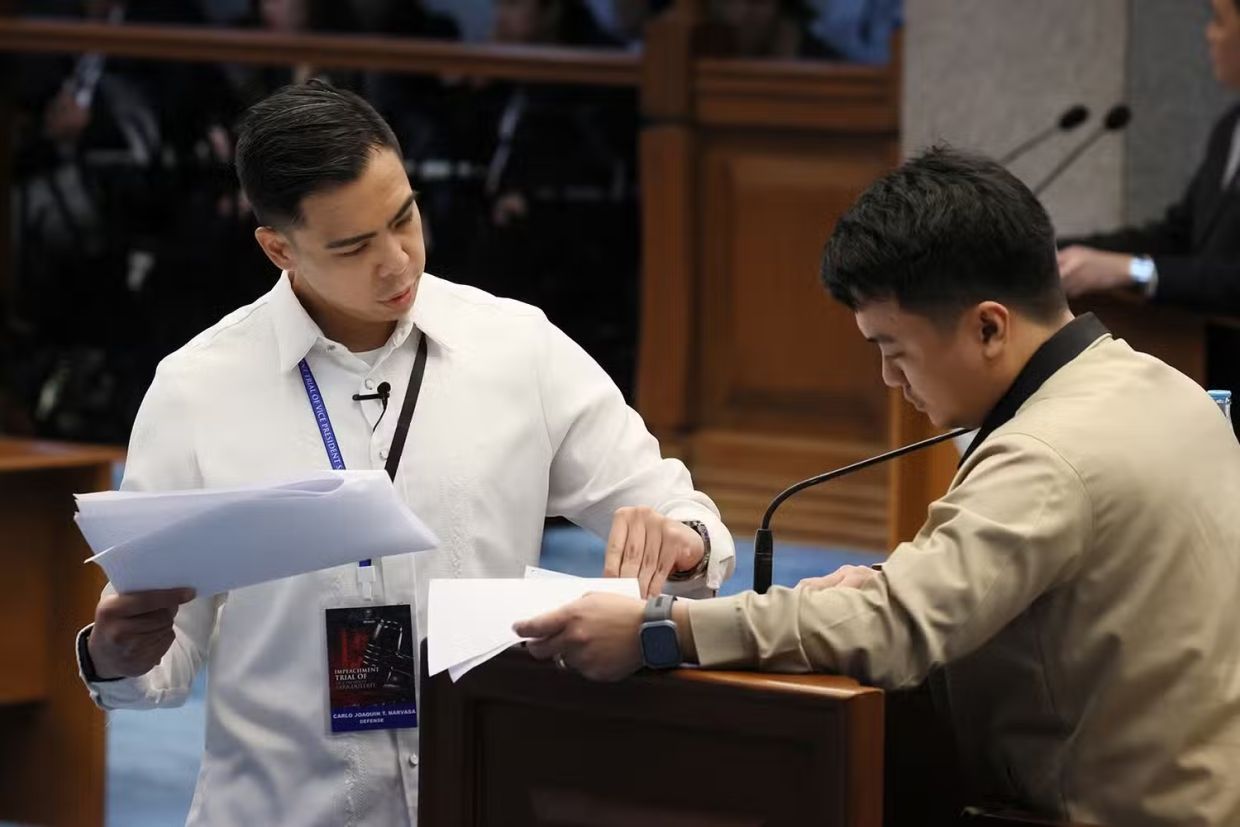
National Bureau of Investigation senior agent John Mark Calilung became the focal point of the defence's evidentiary assault. The defence highlighted that Calilung possessed no personal knowledge regarding whether Marcos, his wife, or Romualdez had filed formal criminal complaints with the bureau. More damaging still, none of the three alleged victims appeared before the NBI to provide sworn statements. This procedural irregularity proved significant: the NBI conducted its investigation motu proprio—independently and without a formal complainant—a methodology that defence counsel Carlo Narvasa challenged as fundamentally incomplete. The revised NBI affidavit dated February 10, 2025, notably excluded affidavits from the offended parties themselves or from journalists who attended the press briefing, gaps that the defence framed as undermining the entire investigative foundation.
Narvasa's cross-examination systematically dismantled the investigative methodology by questioning whether a genuine investigation had occurred at all. When he asked Calilung directly whether the NBI had "really investigated this case," the prosecution objected before the witness could respond, yet the question hung in the courtroom air as a rhetorical indictment. Instead of sworn statements from those ostensibly threatened, Calilung merely executed an affidavit attesting to minutes of investigators' interviews—a second-hand account rather than primary evidence. The NBI's reliance on Department of Justice certification of preliminary investigation sufficiency appears to the defence as procedural compliance without substantive investigative rigor.
The defence strategy incorporates an assertion that Duterte and her associates have endured what Narvasa termed "systematic oppression" originating from a House committee chaired by Representative Joel Chua, who now serves among the House prosecutors in the impeachment trial. This creates a structural conflict of interest argument: those pursuing impeachment allegedly also pursued the antecedent harassment that Duterte claims precipitated her statements. The removal of Duterte's trusted security personnel and the profiling of her residences in both Davao and Manila form part of the defence narrative of environmental threat. Whether these claims will resonate with senator-judges who must ultimately decide Duterte's fate remains uncertain, but they establish a counter-narrative suggesting political persecution rather than high crime.
Senator Risa Hontiveros's questioning during Tuesday's proceedings appears to have provided the defence with crucial ammunition. When she asked whether Duterte's recorded statements proved she actually hired an assassin, the prosecution's acknowledgment that they did not—only that they demonstrated intent—exposed the logical gap the defence now exploits. Intent to hire and actual hiring are distinct legal concepts, and the absence of evidence for the latter undermines charges predicated on the former. Defence counsel emphasised this distinction throughout their arguments, suggesting that even if one accepts the prosecution's theory of Duterte's subjective intent, proving that intent through recordings alone cannot satisfy the objective requirements of impeachment under constitutional law.
The trial has already begun to reveal procedural tensions regarding the scope of questioning permitted before the Senate impeachment court. When Hontiveros pressed whether grave threats could ever be justified by legitimate underlying reasons, presiding officer Senator Francis Escudero intervened, noting that such legal conclusions should await closing arguments rather than emerge through examination. This ruling may constrain the prosecution's ability to build broader contextual arguments about the seriousness of Duterte's remarks. For Malaysian observers and other Southeast Asian readers following this proceeding, the trial illustrates how impeachment jurisprudence develops through procedural engagement and how definitions of high crime shape the limits of executive accountability.
The fundamental clash emerging from these early trial days concerns constitutional interpretation. The prosecution contends that threats against the President and sitting political figures constitute high crimes warranting removal; the defence argues that without proof of an actual conspiracy to commit violence, mere statements—however threatening—fall outside the impeachable offences enumerated in the Constitution. This represents not merely a factual dispute about what Duterte said, but a constitutional dispute about what the Constitution permits as grounds for removing a vice president. The outcome will likely depend on whether senator-judges view the trial through the lens of protecting institutional dignity and leadership security, or through the lens of requiring objective evidence of criminal conspiracy before invoking the extraordinary remedy of impeachment.

