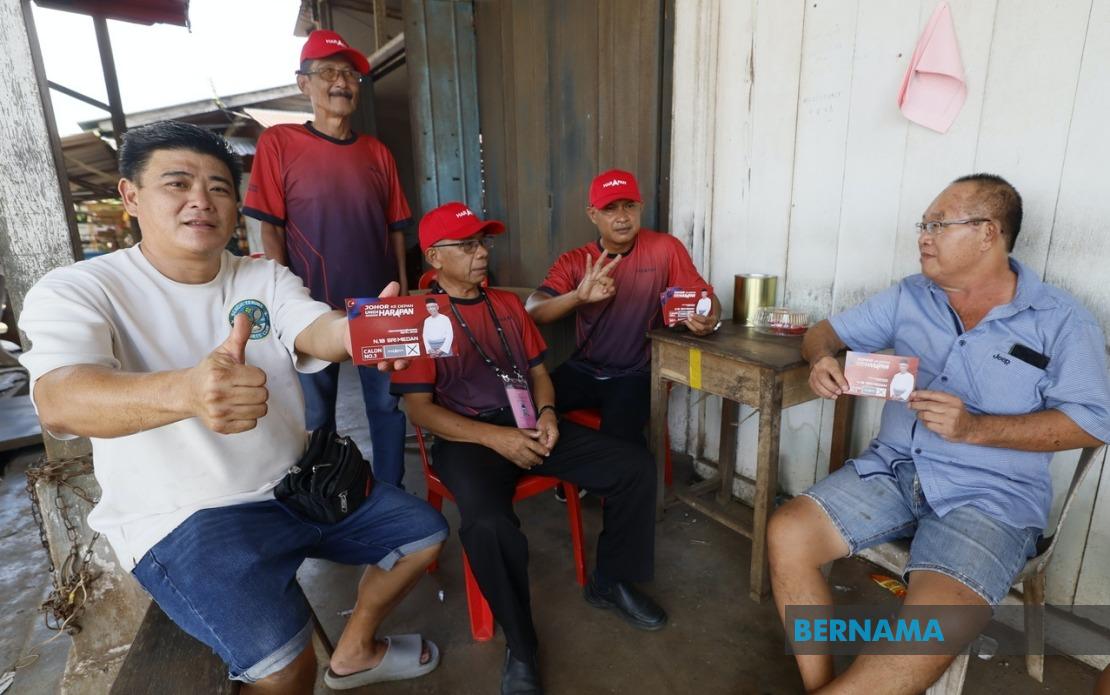
Johor's Sri Medan constituency is witnessing a fresh challenger in the form of Pakatan Harapan candidate Hishamudin @ Misrin Ishak, a former mathematics teacher who is adopting a distinctly grassroots approach to his campaign for the 16th Johor State Election. Known informally as "Cikgu Misrin" among those who know him, the PH contender is positioning himself as an accessible, listening leader who places constituent concerns at the heart of his political agenda. His demeanour during campaign walkabouts—remaining engaged and attentive as residents voice their priorities—reflects a deliberate strategy of accessibility that contrasts with more traditional, top-down political engagement.
At the core of Ishak's campaign platform lies a commitment to address the chronic flooding that has plagued Sri Medan residents for years, a persistent local grievance that previous administrations have struggled to resolve comprehensively. Rather than making grandiose promises, he emphasises a principle of "work first, talk later," suggesting a preference for tangible results over rhetorical flourish. This measured approach reflects his background in education and community administration, fields where outcomes matter more than announcements. He argues that infrastructure development must be equitably distributed across urban, semi-urban, and rural pockets of the constituency, ensuring that development gains do not concentrate in commercially attractive areas while peripheral communities languish.
Ishak's vision for economic opportunity reveals particular attention to youth employment and skills development. He proposes expanding Technical and Vocational Education and Training (TVET) programmes within the constituency, recognising that not all young Malaysians follow traditional university pathways and that practical skills remain undervalued in many communities. Complementing this is a focus on digital literacy, acknowledging that technological competency has become essential for economic participation in contemporary Malaysia. These priorities resonate beyond Sri Medan, reflecting broader anxieties across Johor and the nation about whether education systems adequately prepare youth for actual labour market demands.
Small and medium enterprises represent another pillar of his platform, with particular emphasis on helping local business owners expand beyond dependence on domestic markets. This reflects understanding that many Malaysian SMEs plateau precisely because they lack market access infrastructure and export capabilities. By positioning himself as a facilitator rather than a provider, Ishak suggests a collaborative approach where government enables rather than directs entrepreneurial activity. Such framing appeals to business communities that often feel constrained by bureaucratic complexity and inconsistent policy support across different administrative levels.
Ishak's positioning as a servant of all constituents regardless of political affiliation carries particular significance in Sri Medan, traditionally regarded as a Barisan Nasional stronghold. This rhetorical move attempts to depoliticise his candidacy, presenting him as motivated by administrative effectiveness rather than partisan loyalty. His prior experience as a village head, while modest in scope, provides tangible evidence of community service credentials that newer political entrants often lack. This administrative background distinguishes him from candidates lacking demonstrable governance experience, addressing a common criticism levelled at politicians who transition directly from party work into elected office.
The challenge confronting Ishak should not be underestimated. Sri Medan's historical loyalty to BN, embodied in the incumbency of Datuk Zulkurnain Kamisan, represents formidable structural advantage including established administrative networks, constituent service infrastructure, and voter familiarity. The presence of Perikatan Nasional candidate Ahmad Rosdi Bahari further fragments the non-BN vote, potentially advantaging the ruling coalition. For a PH candidate to prevail in such territory requires not merely a compelling platform but also genuine grassroots mobilisation and persuasion of floating voters persuaded that change offers concrete improvements in their daily circumstances.
By the third day of his campaign, Ishak reported encouraging responses from constituents, a necessary but insufficient condition for electoral victory in competitive Malaysian politics. His self-described status as "a new candidate and a fresh face" represents both advantage and vulnerability—advantage insofar as he lacks baggage of prior electoral performance and carries no history of unfulfilled promises, but vulnerable because voters may question whether a newcomer possesses the political capital to deliver meaningful outcomes within government structures dominated by more established figures. His deliberate emphasis on maintaining positivity despite recognising the structural challenges suggests realistic expectations tempered by determined effort.
The timeframe for Ishak's campaign compresses significantly with polling day scheduled for July 11, and early voting taking place July 7. This compressed schedule means that whatever momentum he generates during field campaigning must rapidly translate into electoral mobilisation. For Malaysian voters observing this contest, the Sri Medan race offers insight into whether PH can successfully challenge BN in its traditional strongholds through combination of grassroots engagement, targeted policy messaging, and credible local candidates. The outcome will carry implications not only for Johor's political balance but also for broader 16th state election results across the peninsula.
The Johor election itself occurs within Malaysia's evolving political landscape, where party coalitions remain fluid and voter preferences increasingly driven by local performance and personality rather than solely by national partisan alignments. Sri Medan's contest exemplifies this shift, with three candidates each representing distinct political forces and offering different visions of local governance. For observers tracking Malaysian electoral trends, Ishak's campaign provides a microcosm of how opposition coalitions navigate traditional BN territory, what messaging resonates with rural and semi-rural constituencies, and whether service-delivery focused platforms can penetrate voter preferences shaped by decades of incumbent administration.

