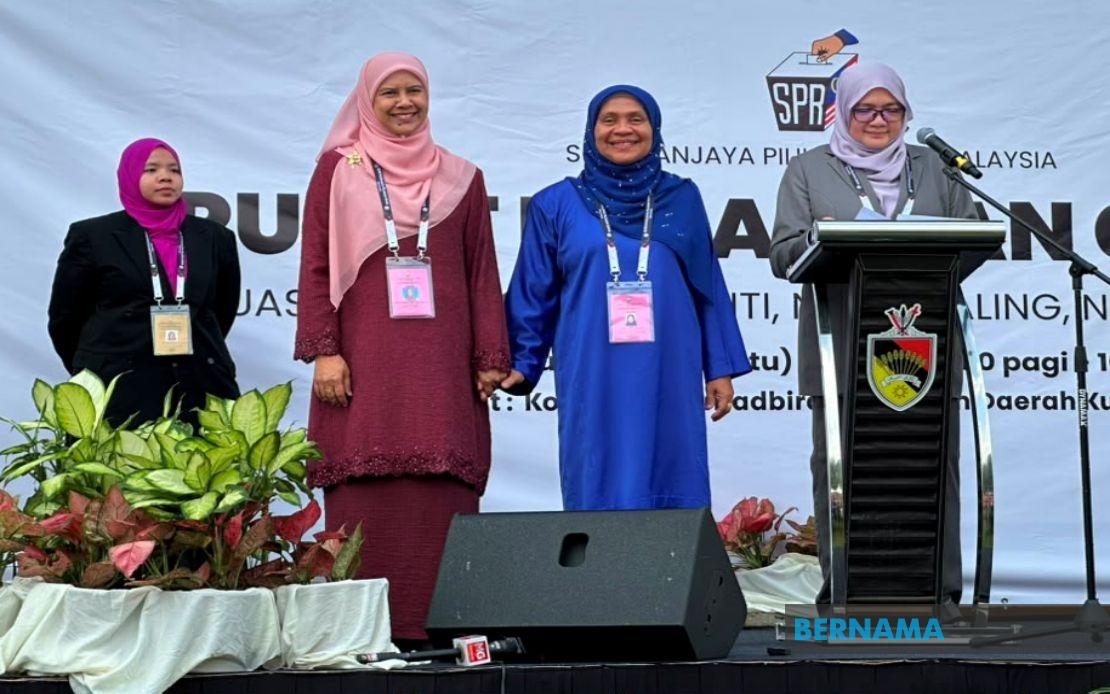
The Pilah state seat in Negeri Sembilan will feature a direct contest between two female candidates in the 16th state election, marking a notable moment in the electoral landscape of the state. Incumbent Datuk Noorzunita Begum Mohd Ibrahim, representing Pakatan Harapan, will face Barisan Nasional's S. Leza Md Yasin after both candidates successfully filed their nomination papers on July 18. The announcement was made by Kuala Pilah returning officer Nawal Mohammed Amin following the close of the nomination period at the District and Land Office, with Noorzunita Begum submitting her papers at 9.03 am and S. Leza following just six minutes later at 9.09 am.
The all-women battle in Pilah reflects broader patterns emerging across the Negeri Sembilan electoral arena, where several seats have attracted multiple challengers, creating a varied competitive landscape. Beyond Pilah's two-way race, the state will host a series of three-cornered contests that add complexity to voters' choices and may fragment support bases in key constituencies. The mixture of straight fights and multi-sided contests suggests that the outcome of the election may hinge on tactical voting patterns and how effectively each party mobilizes its core supporters across diverse demographic zones.
Juasseh presents one of the more crowded battlefields, with three candidates vying for the seat. Mohd Aidil Abdullah represents Pakatan Harapan's bid to wrest the seat away from Barisan Nasional's incumbent Datuk Ismail Lasim, while Bersatu's Mohd Zuhami Md Yusof introduces a third force that could splinter votes. This configuration mirrors patterns seen in other Malaysian elections where the presence of a viable third contender has reshaped outcomes by drawing support away from traditional powerhouses, particularly in constituencies where dissatisfaction with establishment parties runs deep.
The Seri Menanti seat features another three-way contest involving Pakatan Harapan's Mohd Kamarul Arifin Mohd Wafa, who will challenge incumbent Muhammad Sufian Maradzi of Barisan Nasional and Bersatu's high-profile candidate Datuk Seri Megat D. Shahriman Zaharuddin. The involvement of a senior Bersatu figure in this seat suggests that the party is targeting Seri Menanti as a potential stronghold or is at minimum mounting a serious challenge to both traditional coalitions. Megat's presence could particularly complicate Barisan Nasional's ability to retain what has been a held seat, depending on whether Bersatu's appeal resonates with voters seeking an alternative to the long-established blocs.
Senaling will similarly witness a three-cornered contest between Mohd Hanis Mohd Alimin of Pakatan Harapan, Barisan Nasional's Mohamad Qayyum Abd Jalil, and Bersatu's Mohd Izzafi Khan. The proliferation of three-way races across multiple constituencies in Negeri Sembilan underscores the state's complex political terrain, where neither Pakatan Harapan nor Barisan Nasional can assume dominance without accounting for Bersatu's expanding footprint. For Malaysian observers, these contests represent critical tests of whether Bersatu can consolidate itself as a genuine third force or whether its candidacies will merely fracture opposition votes and benefit the established parties.
In contrast to these multi-sided battles, the Johol seat will see a more straightforward contest between Pakatan Harapan's Mohd Zailan Mohd Munawar and incumbent Datuk Saiful Yazan Sulaiman of Barisan Nasional. The straight fight format in Johol may offer clearer messaging to voters and potentially higher stakes for either coalition, without the complication of vote-splitting among three competing forces. Such contests often deliver decisive results and can serve as bellwethers for broader state-level sentiment.
The nominations were accompanied by high-level political representations from both coalitions. Pakatan Harapan's candidates received support from PKR Wanita chief Fadhlina Sidek, who also serves as Education Minister, alongside Angkatan Muda Keadilan vice-chief Dr Mohammed Taufiq Johari in his capacity as Youth and Sports Minister. The presence of these federal ministers during the nomination process underscores the centrality of the Negeri Sembilan state election to national coalition politics, signaling that both coalitions view the outcome as consequential for their broader political fortunes and federal positioning.
Barisan Nasional's nomination process was similarly elevated in profile, with Deputy Home Minister Datuk Seri Dr Shamsul Anuar Nasarah accompanying candidates alongside Perak Menteri Besar Datuk Seri Saarani Mohamad. The involvement of the Perak Menteri Besar in a neighboring state's election reflects the interconnected nature of state politics within the broader Malaysian federation and suggests that Barisan Nasional is treating the Negeri Sembilan contest as a test case for its organizational capacity and messaging resonance across similar constituencies throughout the peninsula.
The electoral timetable has been clearly demarcated by the Election Commission, with early voting scheduled for July 28 and the main polling day set for August 1. This compressed timeline between nominations and voting gives candidates approximately two weeks to campaign intensively within their respective constituencies. For voters, the schedule provides limited time for deliberation and information gathering, potentially advantaging established parties with existing machinery and name recognition over newer challengers seeking to build momentum from scratch.
The Negeri Sembilan state election carries implications beyond the state's borders. As a relatively evenly contested political arena where both Pakatan Harapan and Barisan Nasional maintain viable presences, the state often serves as a barometer for broader national sentiment. Electoral outcomes in Negeri Sembilan have historically correlated with shifts in federal political alignments, making the August 1 results potentially significant for assessing public confidence in the current federal administration and the viability of opposition coalitions heading into potential future elections.
For Malaysian political observers, the 16th Negeri Sembilan state election presents several dynamics worthy of close attention. The emergence of multiple three-cornered contests signals that the Malaysian political landscape continues to fragment beyond the traditional binary competition between Pakatan Harapan and Barisan Nasional. Bersatu's active participation across multiple seats indicates that the party intends to maintain relevance at the state level, even as its federal political positioning remains uncertain. The gender composition of the Pilah contest, featuring two women candidates, also reflects gradual shifts in political recruitment patterns, though such occurrences remain notable enough to warrant specific mention, suggesting that women candidates still represent a minority in Malaysian electoral contests despite incremental progress.
For Southeast Asian context, Negeri Sembilan's electoral patterns offer insights into how Malaysian federalism distributes political competition across state and federal levels. Unlike more centralized systems, Malaysia's constitutional structure permits meaningful state-level contests where parties can test strategies and build alternative power bases separate from federal administration. The willingness of candidates to contest across multiple coalitions, as seen with Bersatu's participation, demonstrates the fluidity within Malaysian politics where party switches and realignments occur with relative frequency, reflecting ongoing negotiations over resource distribution and policy influence within the federal system.

