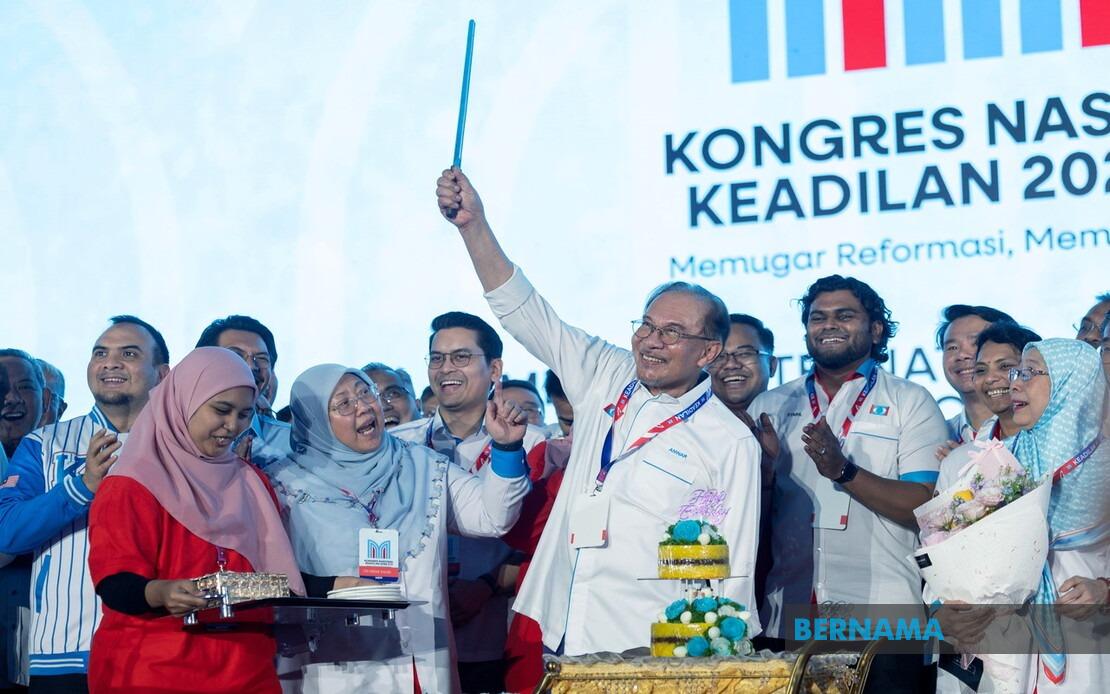
The PKR National Congress 2026 concluded in Melaka with the ruling party reiterating its resolve to uphold both political stability and its foundational reform principles, striking a careful balance between its role within the federal coalition and its identity as an agent of change. Datuk Seri Anwar Ibrahim, addressing the party faithful at the closing session, doubled down on the party's backing for the Unity Government arrangement, which he portrayed as essential to maintaining economic momentum and preventing the political volatility that had characterised Malaysia's recent history. His remarks underscored a central tension within PKR's positioning: how to remain a reformist force while governing alongside more establishment-oriented coalition partners.
As Prime Minister and PKR president, Anwar made clear that his personal commitment to the Unity Government framework would persist, though he acknowledged that its longevity depends fundamentally on decisions made by UMNO and Barisan Nasional leadership. This candid admission reflected the asymmetry in the coalition, where the larger UMNO effectively holds veto power. Anwar warned party members and coalition partners against taking destabilising actions that might jeopardise the arrangement, characterising the government's formation as rooted in pragmatic politics and national interest rather than personal animosity or zero-sum competition. For Malaysian observers accustomed to fractious coalition politics, this rhetoric represented an attempt to normalise what remains a historically unusual arrangement between PKR-led Pakatan Harapan and the historically dominant UMNO.
The tension between stability and reform emerged as the congress's defining theme, with PKR deputy president Nurul Izzah Anwar explicitly insisting that the party's transformative agenda must not wither simply because PKR now occupies ministerial seats. She argued that meaningful change within party structures, the civil administration, and policy frameworks remained not merely desirable but essential to preserving the ideals that motivated PKR's founding and growth. Drawing on concrete examples, she highlighted the repeal of the Universities and University Colleges Act (AUKU) 1971 as a tangible achievement demonstrating that government participation need not require abandoning reformist credentials. This framing attempted to forestall potential criticism from within PKR's base that the party had compromised its principles by entering coalition government.
On the sensitive matter of student activism and campus freedoms, Anwar provided reassurance that the government would not respond to the AUKU repeal by introducing replacement legislation that could reimpose restrictions on student organising and expression. Instead, he contended that existing criminal law provisions offered sufficient tools to address genuinely problematic student conduct, with university students subject to the same legal framework as any other citizens. This position, delivered at Cabinet level commitment, carries significance for Malaysia's academic institutions and youth movements, as it theoretically preserves expanded space for campus political activity and debate. The stance also reflects PKR's historical positioning as a champion of civil liberties and democratic participation, distinguishing it rhetorically from more security-focused approaches.
Education Minister and PKR Wanita chief Fadhlina Sidek used the congress platform to advocate for institutional shifts in how party and government leadership engage with criticism and feedback. She stressed that openness to scrutiny and willingness to acknowledge governance shortcomings represent essential characteristics of effective administration. Simultaneously, Fadhlina pressed for expanded opportunities for women in party leadership and governmental decision-making structures, linking gender inclusion to broader questions of democratic quality and representative governance. Her remarks reflected ongoing conversations within Malaysian political circles about diversifying power structures and ensuring that policy-making reflects constituent demographics.
Youth mobilisation, particularly regarding emerging economic realities and technological participation, featured prominently in congress discussions through the Angkatan Muda Keadilan (AMK) wing's contributions. AMK representatives outlined initiatives to enhance Bumiputera participation in high-growth technology sectors spanning artificial intelligence, semiconductor manufacturing, and biotechnology development. This focus acknowledges that young Malaysians, particularly those from Bumiputera backgrounds, risk exclusion from tomorrow's high-value economic opportunities without deliberate inclusion strategies. By positioning PKR as championing equitable technological access, the party attempted to appeal to forward-looking voters concerned about economic competitiveness and generational opportunity.
Beyond sectoral participation, AMK highlighted broader quality-of-life concerns animating Generation Z and early-career workers, including formal recognition and protection for gig economy participants who operate outside traditional employment relationships. This addresses a genuine policy gap in Malaysia, where ride-hailing drivers, food delivery workers, and other freelancers often lack statutory protections or benefits. The wing also raised mental health and psychological well-being among young people, reflecting international trends in youth political concerns and domestic Malaysian realities surrounding stress-related conditions. These interventions positioned PKR as attentive to contemporary youth priorities beyond conventional political messaging.
The congress's emphasis on organisational readiness absent any imminent parliamentary dissolution or election cycle announcement suggested PKR's leadership adopting a long-term perspective on political positioning. Rather than calibrating party structures purely around immediate electoral timetables, PKR signalled commitment to sustained institutional development and ideological coherence. This approach carries implications for how the party manages internal factional dynamics and maintains member engagement during periods when electoral competition appears distant. For coalition stability, it may also signal to UMNO and other BN component parties that PKR is not poised for opportunistic early withdrawal from the arrangement.
The congress outcomes reveal a party attempting to navigate genuinely competing imperatives: maintaining coalition governmental stability while preserving reformist identity, pursuing technocratic policy achievements while expanding democratic participation, and accommodating diverse constituency interests from students to young entrepreneurs. Whether PKR ultimately succeeds in this balancing act will substantially influence Malaysian coalition politics' trajectory. The party's ability to deliver on both stability and reform agenda promises will shape voter perceptions of whether meaningful change remains possible within established governmental frameworks or whether aspiring reformers must look beyond current coalition structures.

