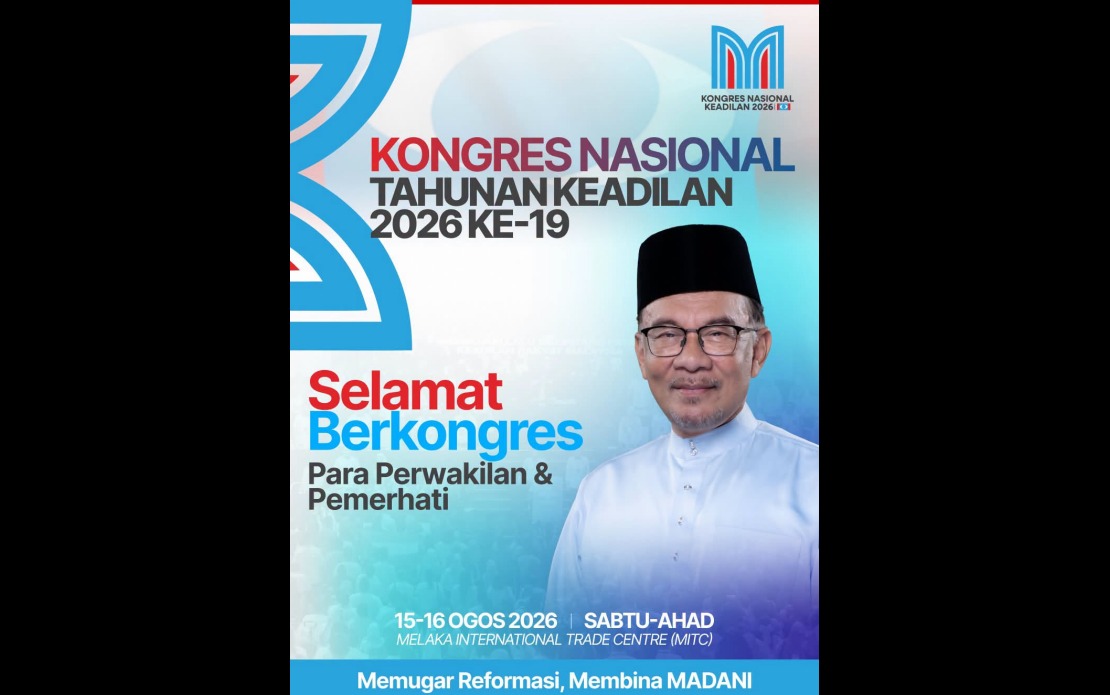
Parti Keadilan Rakyat must transcend its role as a mere electoral apparatus and instead function as a authentic mass movement anchored in principles of integrity, social justice, and unity, according to party president Datuk Seri Anwar Ibrahim. Speaking ahead of the PKR National Congress 2026, the Prime Minister emphasised that these foundational values are essential to PKR's mission of constructing a Malaysia that is more dignified, prosperous, and equitable for its citizens. The distinction Anwar draws between a genuine mass movement and a purely electoral vehicle reflects ongoing internal debates within Malaysia's political landscape about the nature and purpose of political parties in serving the public interest.
Anwar conveyed his message through a Facebook post directed at delegates preparing to attend the two-day gathering commencing tomorrow at the Melaka International Trade Centre in Ayer Keroh. His framing suggests a deliberate effort to refocus the party's identity and strategic priorities as it navigates complex internal and external political pressures. The timing of this intervention—just as the congress convenes—signals that PKR leadership remains preoccupied with reinforcing party discipline and ideological coherence among its membership.
The congress itself carries significant symbolic weight within PKR's institutional calendar. Occurring under the thematic banner "Memugar Reformasi, Membina MADANI" (Revitalising Reformasi, Building MADANI), the gathering serves multiple functions simultaneously. Most visibly, it provides a platform for the party to evaluate its performance, recalibrate its strategic direction, and energise the reformasi movement that constituted PKR's original raison d'être when the party was established in the late 1990s. For observers of Malaysian politics, the congress represents a critical juncture where the party leadership can assess whether PKR has maintained fidelity to its founding principles or whether it has drifted towards the opportunism that frequently afflicts ruling coalitions.
Anwar's emphasis on introspection and self-assessment suggests that PKR faces questions about its trajectory and identity. The party emerged from the reformasi movement, a mass mobilisation that transcended conventional elite-dominated political structures and incorporated civil society actors, youth movements, and grassroots organisers. However, PKR's evolution into a governing coalition partner and its participation in Malaysia's ruling administrations has created potential tensions between its historical identity as a reform-oriented challenger and its contemporary role as a custodian of state power. Anwar's intervention appears designed to bridge this gap by insisting that PKR can and should maintain its reform credentials even while holding governmental office.
The concept of remaining faithful to the reformasi agenda while building MADANI—the government's aspiration framework—encapsulates an ambition to synthesise PKR's oppositional heritage with its current governmental responsibilities. MADANI, an acronym representing Malaysian values of prosperity, unity, and dignity, has emerged as the governing coalition's overarching narrative. By explicitly linking reformasi to MADANI, Anwar attempts to position PKR not as having abandoned its principles but as having successfully transitioned them into a governing programme that delivers tangible benefits to the Malaysian public.
For Malaysian readers and regional observers, the congress carries implications extending beyond PKR's internal functioning. As the dominant component within the broader Pakatan Harapan coalition, PKR's strategic direction influences the stability and direction of the entire government. A party that successfully maintains mass movement characteristics while governing effectively could demonstrate an alternative model to the centralised, elite-dominated structures that have historically characterised Malaysian political parties. Conversely, if PKR succumbs to the same factionalisation and opportunism that has compromised other parties, its failure would reinforce pessimistic assessments about the capacity for institutional reform within Malaysia's political system.
Anwar's scheduled address to the congress—where he will deliver the keynote policy speech—represents the culmination of these preparatory messaging efforts. The speech is anticipated to articulate PKR's strategic priorities and provide clearer definition of the party's intended trajectory over the coming political period. Given the Prime Minister's prominence as PKR president and his dominant position within the governing coalition, his intervention carries substantial weight in shaping party discourse and direction.
The emphasis on trust—both as a value to be upheld and as a commodity that political parties must earn from their constituencies—resonates particularly within Malaysia's contemporary political context. Multiple scandals involving political parties, corruption allegations, and perceived elite disconnection from grassroots concerns have eroded public confidence in political institutions. By explicitly positioning PKR as a trustee of people's aspirations rather than merely a vehicle for elite advancement, Anwar articulates a response to widespread cynicism about political motives and party loyalty.
The congress occurs at a moment when Malaysian politics confronts substantive challenges regarding democratic participation, institutional accountability, and the alignment between elite governance and popular expectations. PKR's success or failure in maintaining its identity as a mass movement will therefore carry ramifications extending well beyond party internal dynamics, potentially signalling broader trends about the capacity for political parties to maintain grassroots accountability while wielding state power.
The invocation of religious blessing—"May Allah SWT bless all our efforts for our beloved homeland, Insya-Allah"—concludes Anwar's address with a rhetorical gesture connecting national aspiration to spiritual purpose, a characteristic framing within Malaysian political discourse that attempts to elevate particular political projects above narrow partisan competition.

