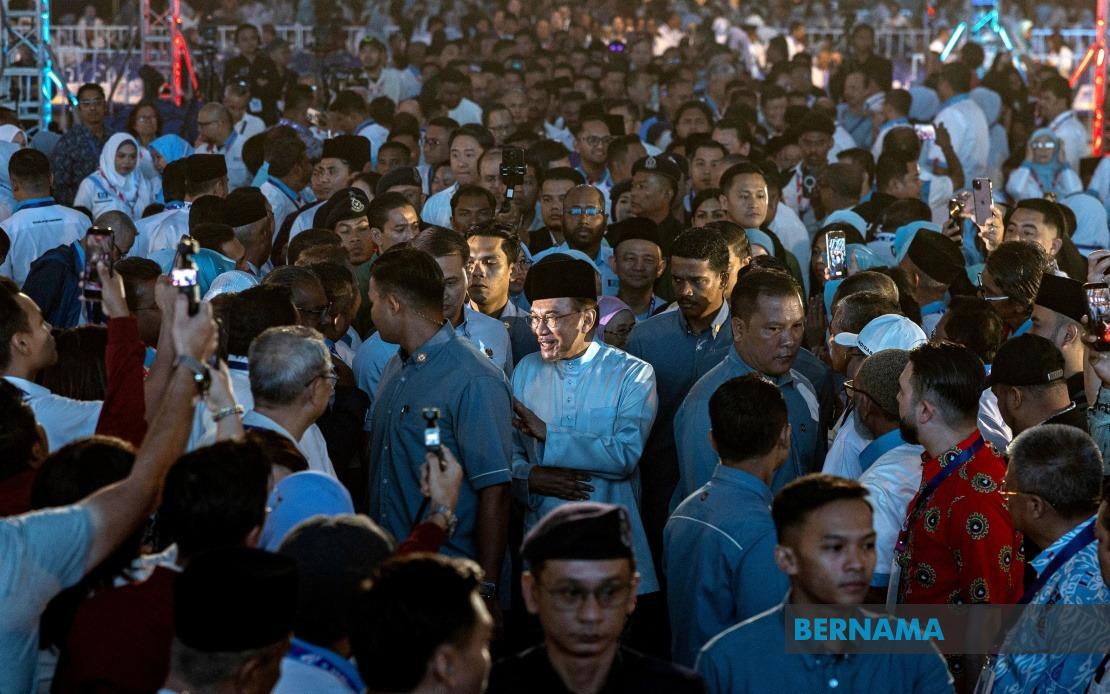
The 2026 PKR National Congress represents a critical moment for the party to regroup and rebuild public confidence, according to Tengku Datuk Seri Zafrul Tengku Abdul Aziz, who serves as the Prime Minister's senior political adviser and an ex-officio member of PKR's Political Bureau. Speaking in Melaka, he outlined a vision where the congress functions as more than a ceremonial gathering—instead positioning it as a platform for genuine institutional renewal and collective commitment to party strengthening.
Tengku Zafrul's remarks carry particular weight given his dual role bridging the Prime Minister's office and PKR's higher councils. His intervention suggests concern at senior levels about the party's trajectory, particularly following disappointing results in recent state elections. Rather than deflecting responsibility onto coalition partners or external factors, his message directs PKR members' attention inward, emphasising that the party controls only its own destiny and performance.
The adviser called for comprehensive organisational assessment across all levels of PKR's structure, from grassroots divisions through to the central leadership. This comprehensive approach acknowledges that weakness at any structural level undermines the entire party apparatus. He stressed that the party machinery must operate with greater effectiveness, implying that current systems may be inefficient or outdated. Such operational improvements would address not just morale but practical capacity to implement policy and mobilise supporters during elections.
Central to Tengku Zafrul's appeal is the concept of honest self-reflection. He recognised that recent electoral outcomes may have disappointed party members and voters alike, but he reframed disappointment not as cause for defensiveness but as motivation for introspection. This framing is significant in Malaysian political culture, where public admission of shortcomings can be perceived as weakness. By positioning self-criticism as strength, he aims to model the kind of institutional accountability that might restore public confidence in political leadership more broadly.
Regarding the Unity Government coalition, Tengku Zafrul acknowledged that PKR members may harbour frustrations with partner parties' performance or strategy. However, he steered the conversation away from inter-coalition blame, arguing that such focus is counterproductive. Instead, he argued that PKR should concentrate entirely on perfecting its own house, recognising that the party can influence coalition outcomes more effectively by strengthening itself than by criticising allies. This pragmatic approach reflects understanding that Malaysian voters hold PKR accountable for its own decisions and performance regardless of coalition membership.
A significant dimension of Tengku Zafrul's message addresses the communication gap between government initiatives and public perception. He suggested that even where PKR and the government have implemented substantial programmes or achieved meaningful results, these accomplishments may not have effectively reached voters or convinced them of the government's commitment to their welfare. This reflects a broader challenge facing the Anwar Ibrahim administration: translating policy achievements into improved public sentiment.
He emphasised that improving communication must become a party priority, but framed it not merely as better public relations or messaging strategy. Instead, he suggested that clearer communication flows from genuine delivery on commitments. The implication is that marketing cannot substitute for actual results, though better articulation of existing achievements could help close the perception gap that currently undermines the government's standing.
Tengku Zafrul introduced another critical element in his call for PKR members to listen genuinely to public grievances. He distinguished between listening and mere responding, suggesting that party members often become so focused on defending positions or delivering prepared talking points that they fail to truly understand constituent concerns. This approach reflects emerging thinking within PKR's leadership that the party has lost touch with ground-level sentiment and voter priorities.
The three-step framework he proposed—listen, acknowledge, then deliver—appears deceptively simple but carries substantial implications for how PKR engages with constituents. Listening without acknowledgement can be dismissed as performative. Acknowledgement without action breeds cynicism. The sequence emphasises that genuine engagement requires all three elements in order, and that any shortfall at any stage undermines the entire process.
For Malaysian politics more broadly, Tengku Zafrul's intervention signals that PKR recognises a legitimacy crisis requiring more than cosmetic change. The recent state election results evidently triggered serious concern within government circles about the coalition's capacity to retain voter confidence heading toward general elections. His emphasis on party strengthening, organisational effectiveness, and authentic engagement with voters suggests that PKR's leadership understands the need for substantive institutional improvement rather than blame-shifting.
The timing of these remarks ahead of the 2026 congress sets expectations that the gathering will focus on structural reform and accountability mechanisms rather than serving primarily as a loyalty-building exercise or showcase for leadership. This implicit commitment to meaningful party renewal will test whether PKR can translate leadership rhetoric into actual institutional change, particularly at grassroots levels where disconnects with voter sentiment often originate.
For Southeast Asian observers watching Malaysia's political evolution, Tengku Zafrul's message reflects broader regional trends of incumbent coalitions recognising voter fatigue and attempting course correction. Whether PKR can successfully execute the internal renewal he advocates while maintaining coalition stability will significantly influence Malaysian politics through 2026 and beyond, with implications for regional perceptions of governance capacity in Southeast Asia's third-largest economy.

