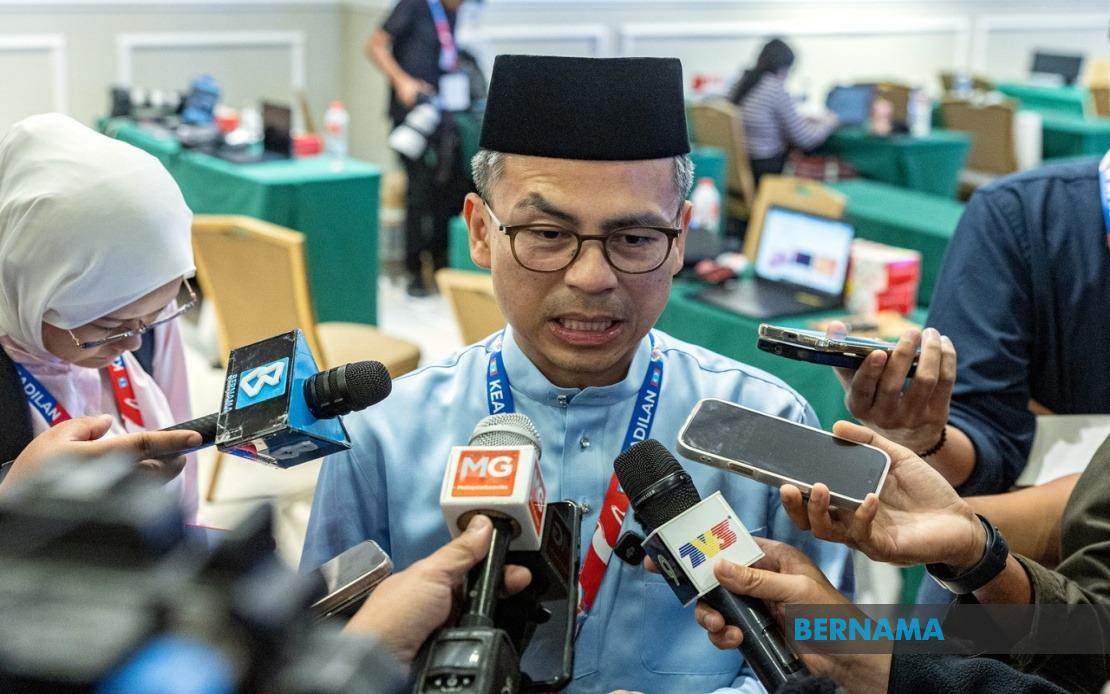
Parti Keadilan Rakyat is moving to revamp its information dissemination framework, recognising that the coalition government's economic credentials have failed to translate into tangible messaging that resonates with ordinary households across the country. The decision emerged during the PKR National Congress 2026 held at the Melaka International Trade and Exhibition Centre in Ayer Keroh, where party delegates formally raised the communication challenge as a strategic priority requiring immediate institutional attention.
Datuk Seri Fahmi Fadzil, who holds the dual portfolios of Communications Minister and PKR Information Chief, acknowledged the core concern articulated by grassroots party members. Despite the government implementing various initiatives and recording measurable macroeconomic improvements, these developments have not successfully filtered down to create visible, tangible benefits that working Malaysians can clearly perceive in their daily economic lives. This perception gap represents one of the most pressing political vulnerabilities facing the current administration, as it suggests that technical policy success and public sentiment remain fundamentally misaligned.
The minister framed the communication overhaul as essential not only for PKR internally but for Pakatan Harapan more broadly, signalling that the three-party coalition recognises this as an existential challenge to its political sustainability. Fahmi indicated that delegates proposed concrete structural reforms to how information flows between parliamentary representatives, party leadership in Putrajaya, and local branch organisations tasked with community engagement. The implication is clear: the current communication apparatus has proven insufficiently nimble to translate policy announcements into grassroots political narratives.
Fahmi revealed that the party's Central Leadership Council has adopted a notably receptive posture toward the delegates' proposals, with senior figures committed to demonstrating transformation beginning with the party's own internal structures and leadership practices. This approach suggests an acknowledgment that PKR must model effective communication internally before attempting to reshape how public-facing government messaging operates. The implicit logic is that visible internal reform will generate credibility for any new public communication initiatives the party subsequently launches.
Crucially, Fahmi emphasised that whilst informal channels for information distribution have historically existed within PKR's organisational ecosystem, delegates are advocating for more formalised mechanisms. This distinction carries significant weight, as it indicates recognition that ad-hoc communication approaches have been overtaken by events and that the scale of the public engagement challenge demands systematic institutional redesign. The proposal appears to contemplate establishing structured protocols whereby parliamentary members can escalate localised concerns and community feedback to party headquarters in Putrajaya, enabling more responsive policy articulation.
The communication deficit acknowledged at the congress reflects a broader phenomenon affecting ruling coalitions across Asia-Pacific democracies, where technical policy implementation often outpaces the political narrative infrastructure required to build public ownership of those achievements. In Malaysia's context, this gap becomes particularly acute given the country's economically diverse population and the significant variations in how macroeconomic improvements distribute across different regions and income categories. What registers as genuine progress in aggregate statistics may appear abstract or irrelevant to households experiencing stagnant wages, rising living costs, or sector-specific economic decline.
The timing of this strategic reorientation matters substantially. With electoral cycles approaching and competing political narratives already intensifying, PKR appears determined to consolidate its communication capabilities before opposition parties further exploit the perceived gap between government claims and citizen experience. The party's willingness to grant delegates substantive voice in reshaping communications strategy also serves an important function in renewing engagement with grassroots activists who might otherwise drift toward political apathy or defection.
Fahmi's openness to branch-level proposals and his emphasis on appreciating the commitment of local leaders to disseminate information more effectively suggests a deliberate strategic choice to rebuild bottom-up political momentum. Rather than imposing communication directives from Putrajaya downward, PKR appears to be attempting collaborative redesign that invests local leaders with greater agency and resources. This approach could prove particularly valuable in secondary urban centres and rural areas where party presence has historically been weaker than in major metropolitan regions.
The proposed changes will be formally presented during the congress winding-up session, transforming what might otherwise remain abstract delegate sentiment into concrete policy amendments. This procedural step signals that the communication challenge has achieved sufficient salience within PKR's hierarchy to warrant formal institutional codification, moving beyond rhetorical acknowledgment toward structural commitment. Malaysian political observers will closely monitor whether these promised reforms translate into genuinely enhanced communication effectiveness or remain largely symbolic gestures intended to satisfy activist constituencies.
Looking forward, the success of PKR's communication revamp will significantly influence not only the coalition's electoral prospects but also its fundamental capacity to govern effectively. Governments that cannot successfully explain their achievements or connect policy outcomes to citizen welfare face mounting legitimacy challenges regardless of objective performance metrics. For Malaysia's currently complex political environment, where multiple parties compete aggressively for voter attention and public trust in institutions remains contested, communication capability has become as strategically important as policy competence itself.

