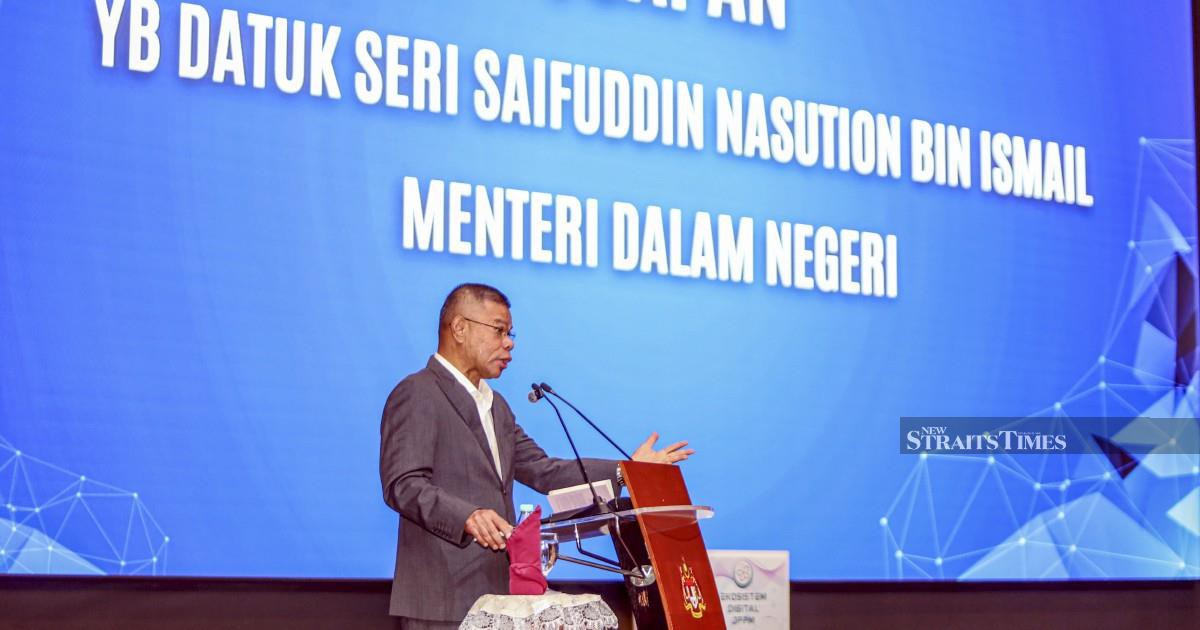
PKR has drawn a clear line in the nation's political sand, signalling it will not participate in what party leaders view as a counterproductive competition over ethnic and religious identity. The party's strategic repositioning marks a significant shift in how opposition and coalition players are framing political legitimacy in Malaysia, moving away from claims centred on defending Malay-Muslim interests and towards performance-based accountability.
Saifuddin's declaration reflects a broader recognition within PKR that attempting to outbid rivals on appeals to Malay nationalism or Islamic credentials would be both futile and strategically unwise. Umno has spent seven decades cultivating its brand as the guardian of Malay-Muslim rights, while Bersatu, despite being a newer entrant, has positioned itself as carrying forward that legacy. Similarly, Pas has entrenched its standing as Malaysia's foremost Islamic party through decades of religious discourse and mobilisation. For PKR to attempt competing on these grounds would mean fighting opponents on terrain where they hold institutional advantage and historical credibility.
Instead, PKR's approach suggests the party intends to redirect public discourse toward measurable outcomes: infrastructure delivery, economic management, service quality, and institutional effectiveness. This pivot carries implications beyond PKR itself. It suggests at least some segments of Malaysia's political establishment recognise that escalating identity-based appeals may have diminishing electoral returns and could be fracturing the broader coalition required to govern. The party is essentially arguing that voters should evaluate all contenders—whether from Umno, Bersatu, Pas, or PKR—based on what they have accomplished for ordinary Malaysians rather than whose interpretation of Malay or Islamic interests is most authentic.
The timing of this statement is instructive. Malaysia's political landscape has fractured across multiple fault lines over recent years. The 2022 return of Umno to power alongside Pas, coupled with Bersatu's role as kingmaker, has reshuffled traditional alignments. PKR, as the core of what remains of the Pakatan Harapan coalition, must articulate a distinct political identity that appeals beyond its traditional urban, multiethnic voter base if it is to remain competitive. By declining to contest on ethnic and religious grounds, Saifuddin is attempting to redefine what constitutes a legitimate political claim.
This strategy does carry risks. In a political environment where identity appeals retain considerable mobilising power, particularly in rural and semi-urban constituencies, appearing indifferent to Malay-Muslim concerns could be weaponised by opponents. Umno and Bersatu have demonstrated they can effectively use such framing to drive wedges between coalition partners and to consolidate their own voter bases. Pas, too, has weaponised questions of Islamic authenticity to expand beyond its traditional strongholds. PKR's statement therefore represents a calculated wager that the electorate is increasingly willing to prioritise practical governance over symbolic assertions of identity protection.
For Southeast Asia's broader context, PKR's positioning is noteworthy. Throughout the region, identity politics continues to play an outsized role in political competition. The Philippines, Thailand, and Indonesia all grapple with questions of religious authenticity and ethnic preference in electoral contests. Malaysia's experience—with a multiethnic, multireligious society structured around constitutional arrangements protecting Malay-Muslim interests—makes it a critical test case for whether identity-based politics can be superseded by performance-based evaluation. If PKR succeeds in shifting discourse in this direction, even partially, it could signal possibilities for political reorientation elsewhere in Southeast Asia.
Saifuddin's comments also reflect internal PKR dynamics. The party comprises diverse constituencies: Malay Muslims concerned with religious and communal issues, urban professionals focused on economic and institutional reform, and non-Malay voters seeking recognition of plural interests. Anchoring party identity to performance rather than ethnic or religious assertion allows PKR to accommodate these constituencies without forcing uncomfortable compromises on identity questions. It is, in effect, a deliberate deprioritisation of the zero-sum competition over who best represents Malay-Muslim interests.
The practical implications for Malaysian governance could be substantial. If mainstream parties begin emphasising performance metrics—employment creation, education outcomes, infrastructure development, anticorruption measures—over identity assertion, it creates space for technocratic evaluation of policy proposals. It also potentially creates avenues for cross-party cooperation on issues where identity is secondary to practical problem-solving. Water management, public transport, digital infrastructure, and healthcare delivery are domains where parties might collaborate based on expertise and effectiveness rather than ideological or identity-based positioning.
However, the sustainability of this approach remains uncertain. Identity politics has deep roots in Malaysian society, and political actors across the spectrum have structural incentives to mobilise such appeals when electoral competition intensifies. PKR's strategic choice to opt out of identity-based competition depends partly on whether other parties reciprocate with similar restraint. If Umno, Bersatu, and Pas continue aggressive identity mobilisation while PKR emphasises performance, voters in identity-sensitive segments may default to established players who speak directly to communal concerns. PKR's gambit therefore requires not just a change in how it presents itself, but a gradual recalibration of how Malaysian politics itself is structured and evaluated—a shift that extends far beyond any single party or leader.

