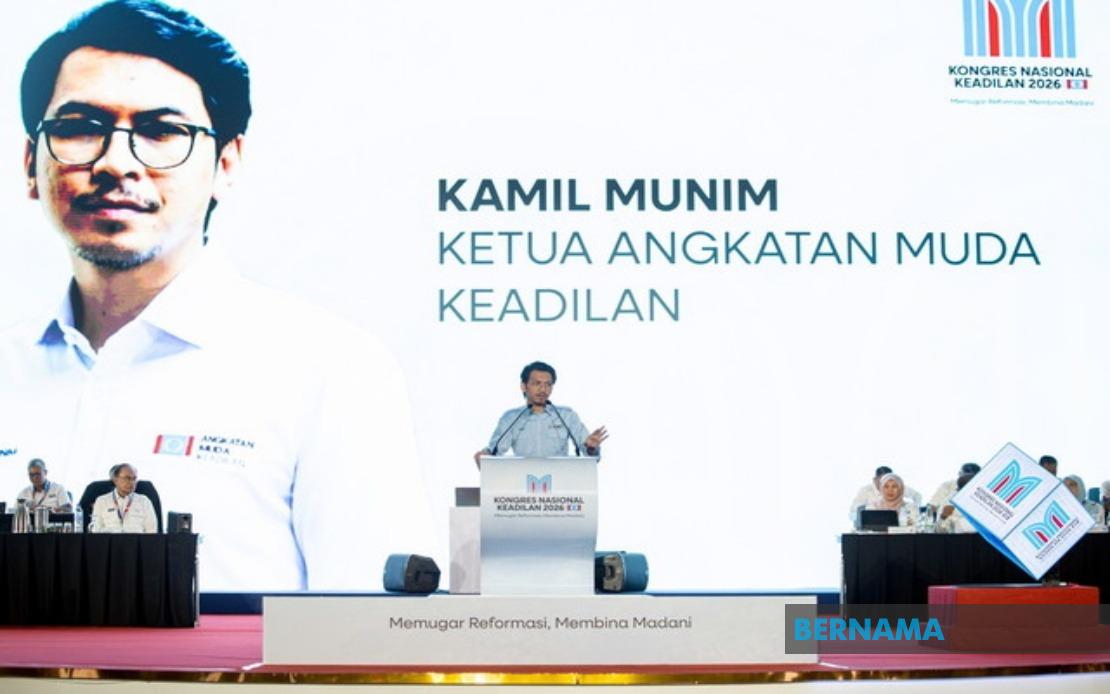
PKR Youth needs to fundamentally rethink its political approach to capture the support of Malaysia's younger voters, according to the party faction's leader Muhammad Kamil Abdul Munim. Speaking during his closing address at the PKR National Congress in Melaka on August 16, he emphasised that those aged 45 and below now constitute the single largest bloc on the country's electoral roll, making this demographic essential to any winning coalition. The call reflects growing recognition within the party that past strategies may not be translating into electoral success among this crucial age group.
The urgency behind Muhammad Kamil's message stems from disappointing results in consecutive state elections. Recent polls in Johor and Negeri Sembilan have prompted PKR leadership to conduct a thorough reassessment of both its tactical approach and underlying strengths as a political force. These results, while not necessarily disastrous, have exposed weaknesses that the party cannot afford to ignore as it prepares for what officials believe will be an imminent general election. The party is evidently wrestling with a credibility gap that extends beyond mere policy disagreements.
Muhammad Kamil's diagnosis centres on a familiar problem in Malaysian politics: the disconnect between party machinery and voter concerns. He directed criticism at grassroots leaders who have become too absorbed in administrative functions while neglecting genuine leadership development. This distinction is crucial—managing party structures differs fundamentally from the interpersonal work required to understand and address what ordinary Malaysians actually worry about. The PKR Youth chief suggested that without this shift, no amount of organisational restructuring will move the needle with younger voters who increasingly demand authenticity and responsiveness from political representatives.
Despite positive public reception of the MADANI Government's performance, according to internal PKR assessments, electoral results paint a more complicated picture. This gap between perceived governmental competence and actual voter behaviour suggests that performance alone is insufficient to maintain political support. Voters may appreciate specific policies while simultaneously harbouring reservations about the ruling coalition's broader direction or failing to see tangible improvements in their own circumstances. For younger Malaysians particularly, such disconnects often translate into alienation from established political structures.
The strategy Muhammad Kamil outlined emphasises direct community engagement, especially in rural areas where small population centres are often overlooked by mainstream campaign efforts. This grassroots-focused approach recognises that younger voters in peripheral regions may face distinctly different concerns from their urban counterparts—employment opportunities, infrastructure development, educational access, and agricultural viability all loom larger in these communities. By concentrating on these micro-level interactions rather than broad-brush messaging, PKR hopes to identify specific pain points that the party can address through concrete proposals.
Muhammad Kamil framed this as an opportunity for PKR to identify and fill perceived voids in the political market. The underlying assumption is that gaps exist between what voters want and what they are currently receiving from any political offering. By positioning itself as attentive to these overlooked concerns, PKR could theoretically appeal to disillusioned younger voters who feel neither the ruling coalition nor the opposition adequately represents their interests. This repositioning requires not just policy adjustments but a fundamental change in how the party leadership approaches community relations.
Historical perspective featured prominently in Muhammad Kamil's message, with references to PKR's capacity to generate electoral surprises. The party's performance in 2008, when it prevented Barisan Nasional from securing a two-thirds parliamentary majority, and its pivotal role in forming the Pakatan Harapan government in 2018, serve as reminders that PKR possesses the organisational capacity to shift electoral dynamics. Yet both examples occurred a decade apart, suggesting that the party's ability to generate significant electoral movement may follow a temporal pattern. The implied message to party faithful is that preparation and momentum-building must begin immediately if 2024 or later is to represent another breakthrough moment.
The reform agenda that Muhammad Kamil repeatedly invoked carries particular significance for younger voters who supported Pakatan Harapan in 2018 partly on the promise of systemic change. Six years later, perceptions of unfulfilled reform aspirations may be dampening youth enthusiasm for the coalition. Reframing and recommitting to transformative change—whether in governance structures, corruption fighting, institutional accountability, or policy innovation—could potentially reignite support among voters who were motivated by ideological concerns rather than simple partisan loyalty. This requires the entire party structure to demonstrate genuine commitment to reform rather than merely discussing it rhetorically.
Muhammad Kamil's call for preparation ahead of the next general election carries an implicit acknowledgment that PKR cannot take any electoral outcome for granted. Unlike established governing parties that can rely on institutional advantages and incumbent benefits, opposition-oriented or coalition parties must continuously mobilise active support. For PKR Youth specifically, whose members often serve as ground-level organisers and campaign activists, this translates into demanding more sophisticated political work: understanding local economies, mapping demographic changes, identifying emerging social issues, and crafting locally relevant responses rather than applying national talking points uniformly across diverse constituencies.
The broader Malaysian political context amplifies the significance of this internal PKR discussion. As the country navigates post-COVID economic uncertainty, generational political realignment, and evolving expectations around governance quality, younger voters' preferences will substantially influence electoral outcomes. Multiple parties are competing for this demographic's allegiance, and PKR's acknowledgment that it must refine its approach reflects the competitive intensity around this voting bloc. For regional observers, PKR's strategic repositioning offers insights into how established coalition partners attempt to maintain relevance when electoral trends suggest declining support.
Implementing Muhammad Kamil's strategic prescriptions will require substantial organisational effort and sustained resource commitment. Moving beyond administrative roles to develop sophisticated community engagement capabilities demands training, investment in grassroots infrastructure, and genuine empowerment of lower-level party structures. Whether PKR's leadership will allocate the necessary resources remains unclear, but the public articulation of these priorities signals that at least senior figures recognise the urgency of change. The coming months will reveal whether this represents genuine strategic reorientation or merely rhetorical acknowledgment of problems that internal politics proves too cumbersome to actually address.

