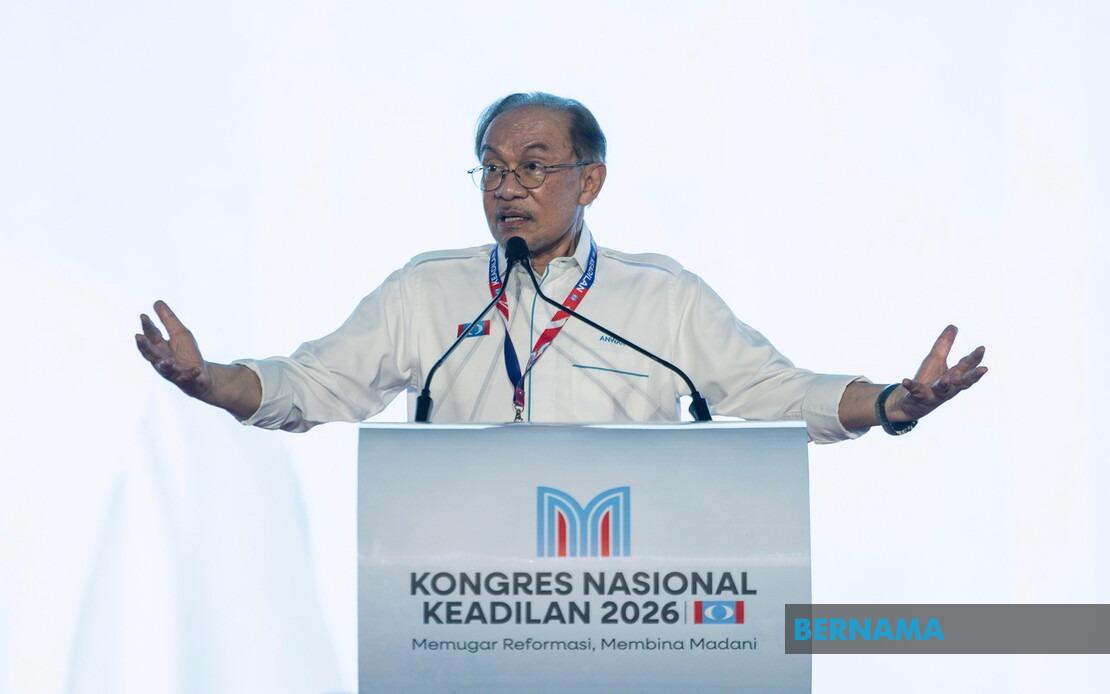
Prime Minister Datuk Seri Anwar Ibrahim has committed the federal government to providing an extra RM1 million annually to every parliamentary constituency across the nation, signalling a renewed emphasis on decentralised, community-focused governance. The allocation will bypass traditional administrative channels to reach communities more efficiently, addressing pressing welfare requirements, basic infrastructure, and social concerns that residents face at the grassroots level. Anwar made this announcement during his closing address at the 2026 PKR National Congress in Melaka, framing the initiative as evidence of the MADANI Government's unwavering commitment to strengthening support networks for ordinary Malaysians.
The Prime Minister stressed that the additional funding represents not a redirection of existing resources but rather a genuine expansion of the government's commitment to local constituencies. By emphasising that allocations have remained stable whilst new money is being injected into the system, Anwar sought to counter perceptions of budgetary constraints or shifting priorities. This approach suggests a strategic decision to channel resources closer to the point of need rather than consolidating funds at the federal or state level, potentially reducing the time required for communities to access assistance.
As both Prime Minister and Finance Minister, Anwar positioned this allocation within a broader fiscal strategy aimed at translating macroeconomic growth into tangible improvements in household living standards. He highlighted that the initiative complements existing welfare programmes, including the Sumbangan Tunai Rahmah and Sumbangan Asas Rahmah, which collectively represent RM16 billion in direct cash assistance. This layering of programmes suggests a comprehensive approach to poverty reduction and cost-of-living relief, acknowledging that no single initiative can address the multifaceted economic challenges facing Malaysian households.
The MADANI Government has pointed to the reduction of hardcore poverty to 0.09 per cent as validation of its economic strategy, though questions remain about whether rapid urbanisation and changing definitions of poverty adequately capture the financial stress experienced by middle-income and working-class families. The additional constituency allocation appears designed to address these gaps by placing decision-making authority closer to local representatives who may better understand their communities' specific vulnerabilities. Whether this devolution of fiscal discretion will improve targeting efficiency or create coordination challenges remains an open question for observers monitoring implementation.
Anwar emphasised that the government's social protection architecture deliberately avoids discriminating between income groups, extending support to both B40 (bottom 40 per cent) and M40 (middle 40 per cent) households. This inclusive framing reflects a political calculation that middle-income Malaysians, facing rising costs for education, housing, and transport, represent a crucial constituency requiring reassurance. The mention of school assistance, subsidised Rahmah sales, and housing financing support suggests an understanding that poverty alleviation must address not only income but also access to essential services and productive assets.
The timing of this announcement at a PKR party congress carries significant political weight. By using a prominent partisan platform to unveil the initiative, Anwar leveraged the occasion to energise party cadres ahead of the subsequent general election cycle. The address functioned simultaneously as a policy announcement and party mobilisation exercise, signalling that PKR-led constituencies would benefit from this new funding stream. For opposition-controlled areas, the political calculations become more complex, raising questions about whether the allocation mechanism will be applied uniformly regardless of parliamentary party affiliation.
Anwar explicitly called on party leaders and grassroots machinery to undertake extensive public communication campaigns explaining government initiatives and ensuring beneficiaries understand their eligibility for various programmes. This directive acknowledges a persistent governance challenge in Malaysia: the gap between programme availability and public awareness. Many government assistance schemes suffer from low uptake rates not because they are inadequately funded but because potential beneficiaries remain unaware of their existence or eligibility criteria. By tasking party machinery with this educational role, Anwar sought to transform political structures into implementation partners for social policy.
The emphasis on reducing bureaucratic impediments reflects broader administrative reform aspirations within the MADANI framework. Traditional government processes, involving multiple layers of approval and compliance requirements, often create delays that undermine the effectiveness of assistance during periods of acute need. By allocating funds directly to constituencies with simplified disbursement mechanisms, the government aims to demonstrate that fiscal efficiency and political responsiveness need not conflict. However, the success of this approach depends critically on the competence and integrity of local representatives managing these funds, introducing principal-agent concerns that will require careful oversight.
For Malaysian households, particularly those navigating the challenging economic environment of 2024-2025, this announcement represents a concrete policy response to sustained pressure regarding cost-of-living expenses. The allocation signals governmental acknowledgement that existing assistance levels remain insufficient for many families managing inflation-driven increases in food, transport, utilities, and accommodation costs. Whether RM1 million per constituency translates into meaningful individual relief depends on population size, local needs assessment accuracy, and competing priorities within each constituency. Larger urban constituencies serving hundreds of thousands of residents may find the allocation spread thinly, whilst smaller rural constituencies might deploy it more strategically.
The broader policy architecture revealed in Anwar's statement demonstrates an attempt to simultaneously maintain macroeconomic stability whilst directing increased resources toward distributive programmes. This balancing act reflects the inherent tension within the MADANI framework between pursuing fiscal consolidation and meeting rising social expectations. International investors and credit rating agencies monitor such policy choices carefully, and sustained large-scale expansions of discretionary spending allocations could eventually constrain the government's fiscal space if accompanied by insufficient revenue growth.
Regional implications deserve consideration as well. Malaysia's approach to decentralised social assistance, if effective, could offer lessons for other Southeast Asian governments wrestling with similar urbanisation patterns and rising inequality. The devolution of constituency-level allocation authority represents a middle ground between highly centralised federal welfare systems and fully decentralised arrangements, potentially combining local responsiveness with national consistency standards. Implementation outcomes over the coming months will determine whether this model provides a replicable template for governance innovation in the region or serves mainly as a tactical political manoeuvre for the ruling coalition.

