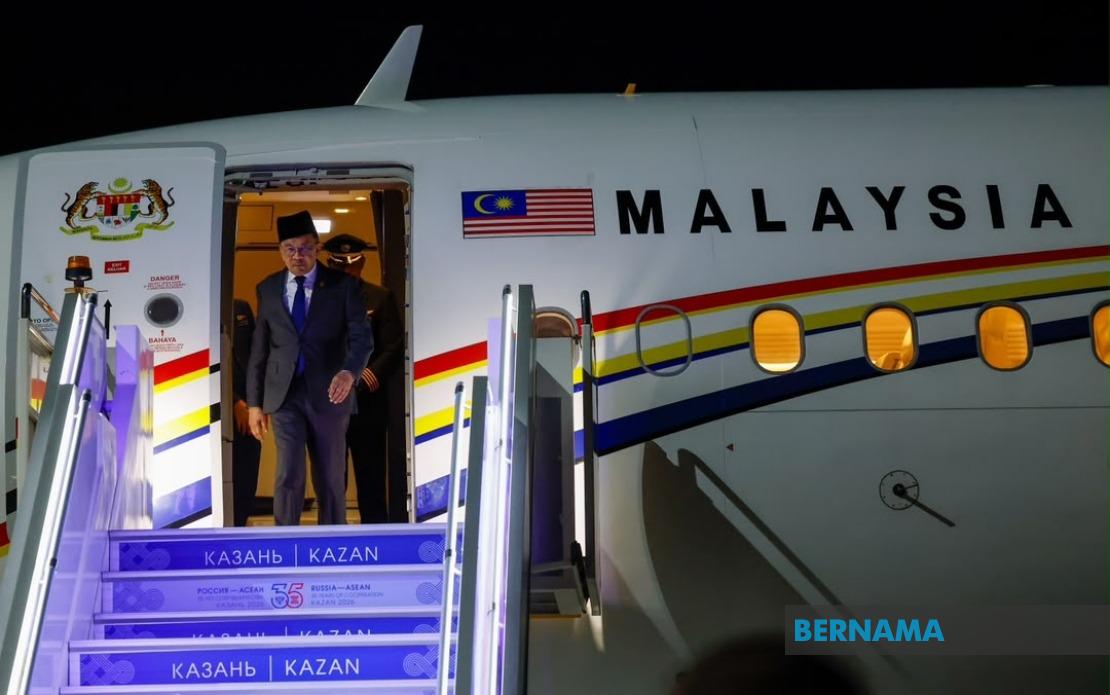
Prime Minister Datuk Seri Anwar Ibrahim landed at Kazan International Airport late Sunday evening to kick off a two-day working visit centred on the ASEAN-Russia Commemorative Summit scheduled for June 17-18. The aircraft bearing the Malaysian delegation arrived at 10:20 pm local time, bringing with it a high-level contingent comprising Minister of Investment, Trade and Industry Datuk Seri Johari Abdul Ghani, Minister of Economy Akmal Nasrullah Mohd Nasir, and representatives from both the Prime Minister's Office and the Foreign Ministry. Upon arrival, Malaysia's Ambassador to Russia Datuk Cheong Loon Lai extended official greetings, whilst the Russian side was represented by Tatarstan's Minister of Digital Development Ilya Nachvin, Kazan Mayor Ilsur Metshin, and state protocol officials.
The summit itself carries considerable symbolic weight, commemorating thirty-five years since ASEAN and Russia first established diplomatic ties in Kuala Lumpur during 1991. This milestone presents more than mere anniversary symbolism; it represents a critical juncture for both parties to assess the trajectory of their relationship and establish new frameworks for deepening cooperation across the coming half-decade. The gathering affords ASEAN member states an opportunity to collectively engage with Moscow on matters of mutual strategic interest whilst reinforcing the bloc's centrality in regional affairs—a principle increasingly important as geopolitical tensions reshape Asia-Pacific dynamics.
The substantive agenda encompasses an ambitious breadth of cooperation domains. Trade and investment feature prominently, reflecting broader efforts to diversify economic partnerships beyond traditional Western markets. Energy cooperation assumes particular urgency given volatile global commodity prices and Southeast Asia's energy security concerns. Food security discussions acknowledge the region's vulnerability to supply chain disruptions, a lesson sharpened by recent global crises. Digital economy and technology transfers respond to rapid technological change reshaping competitive advantage across the region. Cultural exchanges, educational partnerships, and tourism initiatives represent the people-to-people dimensions that embed strategic relationships within broader societal connections, fostering long-term stability beyond government-to-government arrangements.
Four landmark documents are anticipated to emerge from the proceedings. The Kazan Declaration itself celebrates the relationship's milestone whilst projecting forward. A dedicated Joint Statement on Energy Cooperation signals serious intent on oil, gas, and potentially renewable energy partnerships at a moment when traditional suppliers face geopolitical constraints. The Joint Statement on Cultural Cooperation acknowledges that soft power and cultural affinity represent underutilised tools for building mutual understanding. The Comprehensive Plan of Action for 2026-2030 provides the operational blueprint, translating high-level commitments into specific initiatives with timelines and deliverables. Together, these documents aim to anchor ASEAN-Russia relations within a more structured, resilient framework capable of weathering international turbulence.
For Malaysia specifically, this visit underscores the government's commitment to maintaining balanced external relations in an increasingly complex global environment. Anwar's participation demonstrates Malaysia's role as a constructive voice within ASEAN, bridging dialogue between the bloc and major powers whilst advocating for multilateralism and peaceful resolution of disputes. The presence of investment and economy ministers signals that this is no mere ceremonial affair but a working engagement with tangible commercial dimensions. Malaysia's consistent diplomatic engagement with Russia, despite international pressures, reflects a principled foreign policy stance prioritising dialogue and pragmatic cooperation over ideological alignment.
While in Kazan, Anwar is scheduled to engage directly with Russian President Vladimir Putin and the Rais of Tatarstan, discussions expected to address bilateral concerns and shared regional challenges. These bilateral encounters will likely explore opportunities for enhanced Malaysian-Russian cooperation in specific sectors, building upon previous conversations. The prime minister intends to stress several thematic priorities: championing dialogue and peaceful conflict resolution in an era of rising tensions; bolstering economic resilience against external shocks; advancing energy and food security through diversified partnerships; and deepening human connections through educational and cultural exchanges. These priorities reflect Malaysia's broader strategic interests and its vision for a region characterised by stability, prosperity, and respect for international law.
This Kazan visit marks Anwar's third engagement with Russia since his appointment in November 2022, illustrating consistent prioritisation of Russian relations within Malaysia's diplomatic calendar. His initial visit to Vladivostok in September 2024 for the Eastern Economic Forum provided an introduction to Russia's Far Eastern development agenda and economic potential. The subsequent official visit to Moscow in May 2025 represented a more formal, bilateral engagement during which detailed discussions covered trade, investment, agricultural cooperation, educational exchanges, aerospace partnership and energy collaboration. The current summit experience enriches this trajectory by situating bilateral ties within the broader ASEAN framework, amplifying Malaysia's voice and positioning the country as a bridge between regional bloc and major power.
The timing of this summit reflects shifting geopolitical realities. International sanctions against Russia have created space for alternative partnerships amongst non-aligned nations and regional blocs. ASEAN, as a bloc of significant geopolitical importance astride crucial sea lanes and home to over 600 million people, represents an attractive partner for Moscow seeking to diversify its international engagement. Conversely, ASEAN member states recognise the strategic value of maintaining constructive relations with all major powers, avoiding forced alignments whilst protecting national interests. This mutual recognition creates conditions for pragmatic cooperation that transcends ideological divisions.
Beyond Anwar's direct engagements, the summit provides Malaysia with opportunities to shape ASEAN's collective positioning on regional security, economic development, and global governance issues. Malaysia's voice within ASEAN carries weight given its economic development, experience in managing religious and ethnic diversity, and historical role as a bridge between different civilisations and worldviews. Malaysian proposals regarding energy security, digital cooperation, or educational exchanges can influence the collective ASEAN position, thereby amplifying the nation's strategic influence far beyond its individual capacity. This multiplier effect through ASEAN mechanisms remains one of Malaysia's most valuable diplomatic assets.
The summit's focus on energy cooperation carries particular salience for Southeast Asia. As renewable energy transitions accelerate and traditional fossil fuel markets face long-term structural headwinds, partnerships enabling technology transfer and investment become crucial. Russia, despite international challenges, retains significant expertise in energy infrastructure, particularly in Arctic and unconventional resources. Malaysian engagement with Russian energy expertise, channelled through ASEAN mechanisms, could accelerate the region's energy transition whilst building supply chain resilience. Similarly, agricultural cooperation assumes urgency given climate change pressures on crop yields and the region's role in global food systems.
The strategic partnership framework extending to 2030 reflects confidence that ASEAN-Russia relations will remain relevant across the coming five-year period. This timeframe encompasses significant potential shifts in global geopolitics, yet the commitment to sustained engagement suggests both parties view their relationship as fundamental rather than transactional. For Malaysia, being part of codifying this partnership demonstrates its commitment to maintaining ASEAN's strategic autonomy and relevance in great power calculations. The summit outcome documents will serve as reference points for bilateral engagement going forward, providing legitimacy and structure to initiatives that might otherwise face scepticism from Western partners concerned about Russia engagement.
Anwar's diplomatic efforts in Kazan must be understood within Malaysia's broader strategic positioning. The country navigates complex relationships with the United States, China, India, and other major powers whilst maintaining strong ASEAN solidarity. Engagement with Russia does not diminish Malaysia's Western relationships but rather reflects the reality that inclusive, dialogue-based diplomacy serves Malaysian interests better than polarised geopolitical blocs. This nuanced positioning requires skilful navigation and consistent messaging, capabilities demonstrated through Anwar's previous visits to Russia and current engagement at the summit. Malaysia's success in maintaining this balanced approach influences regional stability and preserves space for smaller nations to advance national interests through coalition-building and principled diplomacy rather than forced alignment with particular power centres.