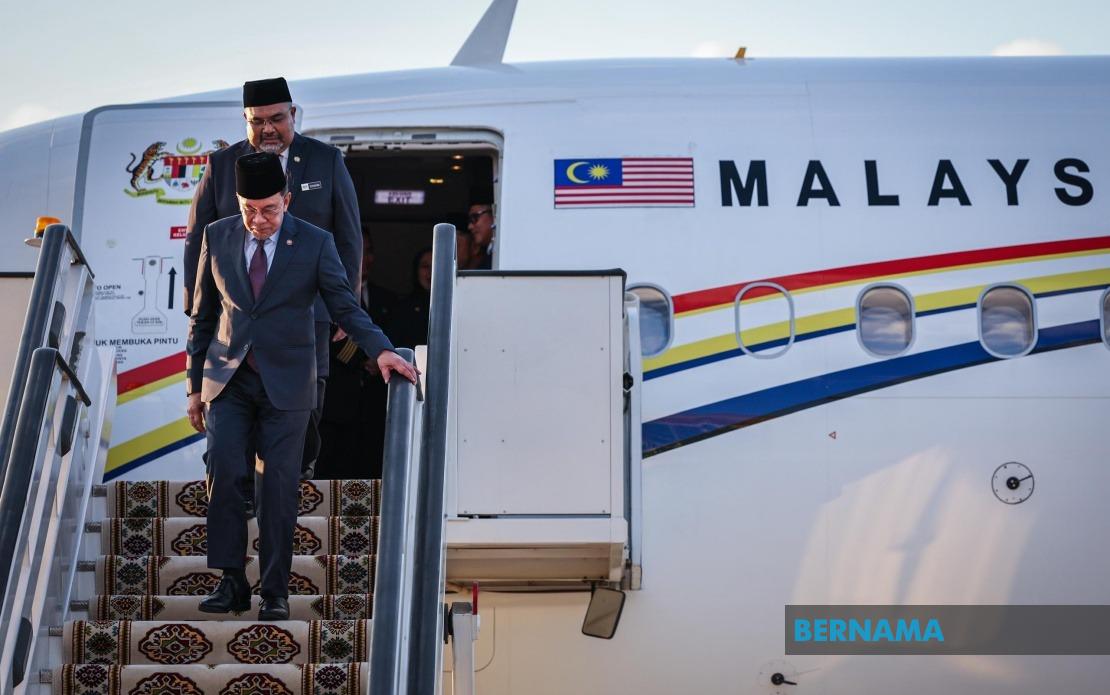
Prime Minister Datuk Seri Anwar Ibrahim touched down in Ashgabat on June 18 evening, transitioning smoothly from his working engagement in Kazan to advance Malaysia's diplomatic footprint across Central Asia. The aircraft arrived at Ashgabat International Airport at 8 pm local time, carrying the prime minister and a substantive delegation that underscores the significance Kuala Lumpur places on this visit. Accompanying Anwar were Minister of Investment, Trade and Industry Datuk Seri Johari Abdul Ghani and Minister of Economy Akmal Nasrullah Mohd Nasir, alongside supporting officials from the Prime Minister's Office and Ministry of Foreign Affairs, signalling that this is not merely a courtesy call but a working mission centred on commerce and institutional ties.
The visit comes at the explicit invitation of Turkmenistan President Serdar Berdimuhamedov and functions as a reciprocal gesture following the Turkmenistan leader's official trip to Malaysia in December 2024. This exchange underscores a pattern of sustained high-level engagement between the two countries. For Anwar, this represents his inaugural official visit to Turkmenistan, though it is the fifth such visit by a Malaysian prime minister to the Central Asian nation, reflecting a continuity of interest across successive administrations in Kuala Lumpur.
Upon arrival, Anwar was received by Malaysia's Ambassador to Turkmenistan Mohd Suhaimi Ahmad Tajuddin, while the Turkmenistan side fielded Deputy Chairman of the Cabinet of Ministers for Oil and Gas Guvanch Agajanov to greet the Malaysian contingent. This pairing is telling: the presence of Agajanov highlights Turkmenistan's prioritisation of energy sector engagement with Malaysia, a theme that runs through the bilateral relationship. The immediate diplomatic reception set the tone for a visit structured around both ceremonial obligations and substantive economic discussions.
The evening of June 18 featured a dinner reception with Malaysia's diaspora and friends of Malaysia, a customary element of diplomatic visits that allows the prime minister to engage with citizens and sympathetic voices within the host nation. Such occasions serve dual purposes: they provide direct channels for Anwar to hear grassroots perspectives and concerns, whilst simultaneously reinforcing Malaysia's cultural presence and people-to-people connections in Ashgabat.
June 19 promised a densely packed itinerary designed to maximise bilateral engagement. The day commenced with a formal welcoming ceremony at the Presidential Palace, where Berdimuhamedov hosted Anwar. This ceremonial segment was followed by bilateral talks between the two leaders—initially one-on-one, then expanded to include their respective delegations. These discussions were to culminate in the signing of a joint statement and the exchange of additional agreements and memoranda of understanding that had been negotiated previously by both governments, formalising areas of mutual interest and commitment.
The Prime Minister, who holds the concurrent portfolio of Finance Minister, was scheduled to attend an official luncheon hosted by Berdimuhamedov, providing an informal setting for continued dialogue. In the afternoon, Anwar was to perform Friday prayers at the Turkmenbashi Ruhy Mosque, also known as the Gypjak Mosque, an act that carries cultural resonance and demonstrates respect for local religious traditions whilst affirming the Islamic commonalities between Malaysia and Turkmenistan, both Muslim-majority nations.
The evening session featured what may be the most economically consequential element of the visit: the joint inauguration of the Malaysia-Turkmenistan Forum held at the Chamber of Commerce and Industry of Turkmenistan. This forum, to be jointly officiated by both leaders, serves as a structured platform for deepening commercial interactions and exploring expanded investment opportunities. The forum represents institutional machinery designed to move bilateral relations beyond diplomatic pleasantries into sustained business engagement, creating frameworks within which private sector actors from both nations can identify and pursue opportunities.
Turkmenistan's significance in Malaysia's regional economic strategy cannot be overstated. In 2025, it ranked as Malaysia's fourth-largest trading partner among Central Asian nations, reflecting the competitive landscape of Southeast Asian engagement with a region increasingly important for resource security and geopolitical positioning. Total bilateral trade reached RM75.80 million, with Malaysian exports constituting RM75.50 million of this figure—a commanding proportion that reflects Malaysia's role as an exporter of goods and services to Turkmenistan. This trade volume expanded by nine percent year-on-year, suggesting growing economic momentum between the partners.
Beyond conventional trade metrics, the relationship derives profound significance from Petronas' extensive operations in Turkmenistan. The national oil company has accumulated investments totalling RM52.73 billion since 1996, making it one of Malaysia's largest foreign direct investment endeavours. This half-century-spanning commitment reflects the hydrocarbon richness of Turkmenistan and Petronas' strategic importance as a reliable foreign investor and operator within the Central Asian energy sector. For Malaysia, Petronas' footprint in Turkmenistan represents crucial energy security infrastructure; for Turkmenistan, it represents capital inflow and technical expertise from a Southeast Asian partner viewed as stable and professional.
Anwar's visit thus operates on multiple levels simultaneously. Diplomatically, it reaffirms the bilateral commitment between two Muslim-majority nations separated by geography but connected through commerce, shared religious identity, and institutional ties. Economically, it provides political cover and high-level attention to Malaysia's substantial presence in Turkmenistan's energy sector whilst exploring new collaborative spaces in the Malaysia-Turkmenistan Forum. For the region, the visit exemplifies Malaysia's intensified engagement with Central Asia, a strategic pivot complementing its established relationships in Southeast Asia and reflecting recognition that Central Asian stability, resource availability, and geopolitical orientation matter increasingly to Malaysian interests. The press conference concluding the visit would likely emphasise these multifaceted dimensions of partnership, positioning the engagement as mutually beneficial and forward-looking.

