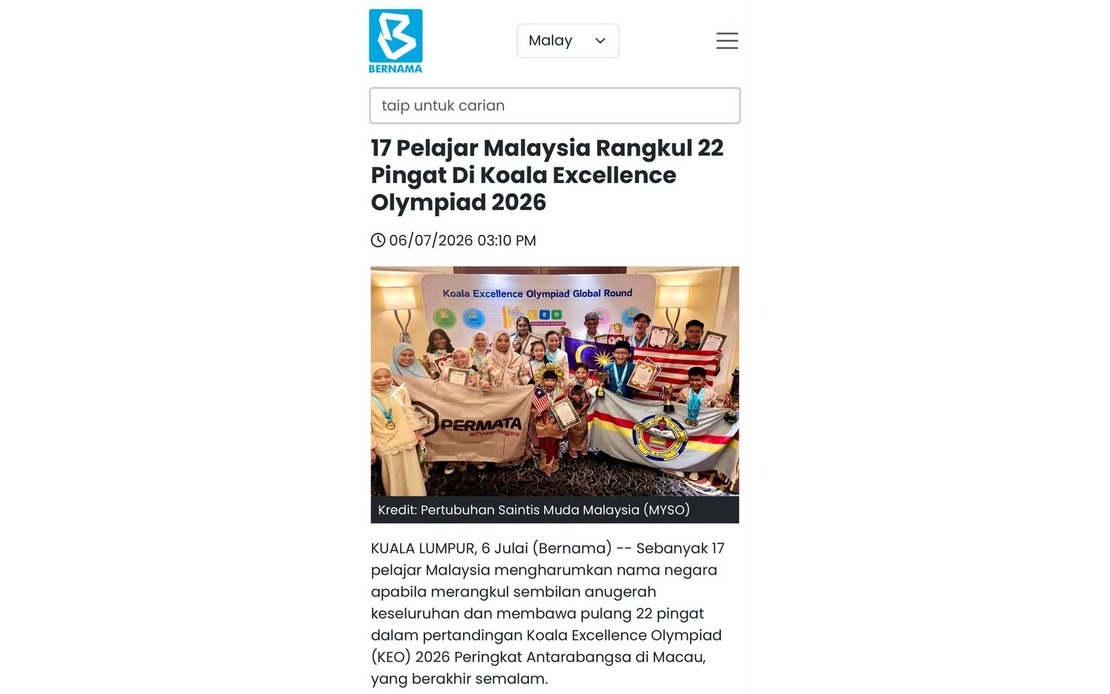
Prime Minister Datuk Seri Anwar Ibrahim has extended his congratulations to 17 Malaysian students who delivered a strong performance at the 2016 Koala Excellence Olympiad (KEO) Global Finals, held in Macau. The contingent returned home with an impressive haul of nine overall awards and 22 medals, underscoring Malaysia's growing competitive edge in international academic competitions. In a message posted on X, the Prime Minister urged the young achievers to maintain their drive for excellence and pursue even loftier goals in their future endeavours.
The Malaysian delegation's medal tally comprised five gold, six silver, and 11 bronze medals, according to Aidah Misran, who served as both the Malaysia Young Scientists Organisation (MYSO) coordinator and head of the Malaysian team dispatched to Macau for the competition. This breakdown reflects a balanced performance across the contest categories, with the team securing recognition at multiple levels of achievement. The results represent a meaningful contribution to Malaysia's international standing in youth academic competitions, particularly among English-speaking nations and regions.
The KEO competition is structured around four distinct academic disciplines—English, Mathematics, Science, and Arts—creating a comprehensive platform for testing students' knowledge and problem-solving capabilities across these core subjects. Established by a consortium of Australian educational experts and graduates, the Koala Excellence Olympiad has evolved into a truly global initiative, drawing participants from numerous countries to compete on an international stage. In Malaysia, the competition is coordinated by MYSO in partnership with Miss Man International Group and the KEO organising body, ensuring that local students have access to this prestigious opportunity.
The scale and scope of the KEO competition reflect broader trends in Southeast Asia regarding investment in youth educational development and international academic exposure. Nations across the region increasingly recognise that participation in global competitions serves multiple purposes: it benchmarks local student capabilities against international standards, identifies and nurtures exceptional talent, and enhances a country's reputation for educational excellence. Malaysia's consistent participation and respectable medal counts position the nation competitively within this ecosystem, signalling to the international community that Malaysian schools and students are producing high-calibre academic performers.
For Malaysian students, engagement with such competitions offers tangible benefits beyond the medals themselves. Exposure to international academic standards exposes local scholars to diverse teaching methodologies, problem-solving approaches, and peer perspectives from different educational systems. This cross-cultural academic exchange enriches their intellectual development and prepares them for increasingly globalised workforces where international competence and cross-cultural communication are highly valued. The experience gained through preparation and participation often proves instrumental in shaping student trajectories, influencing university choices, scholarship opportunities, and career pathways.
The Prime Minister's public endorsement of these students carries significance beyond mere ceremonial acknowledgment. By highlighting their achievements through an official channel, Anwar Ibrahim reinforces government commitment to nurturing academic excellence and supporting gifted young Malaysians. Such visible backing from the highest political level typically translates into increased institutional support, whether through funding for training programmes, enhanced school facilities, or competitive compensation packages for educators specialising in olympiad preparation. This creates a positive feedback loop that encourages more schools and students to participate seriously in such initiatives.
The MYSO's role as the national coordinating body underscores Malaysia's structured approach to identifying and developing academically gifted students. The organisation functions as a crucial bridge between local educational institutions and international platforms, ensuring that deserving students gain access to global opportunities regardless of geographical or socioeconomic constraints. Through such institutional frameworks, nations can democratise access to elite academic competitions, moving beyond elite private school dominance to include talented students from diverse school backgrounds across the country.
Looking forward, Malaysia's consistent performance at KEO and similar competitions positions the nation as a credible player in the global academic arena. The presence of regional competitors at these events—particularly from within Southeast Asia—creates natural rivalry that motivates participating nations to invest more seriously in talent identification and support systems. This competitive dynamic ultimately benefits all participants, as it drives systemic improvements in educational quality and student motivation. For Malaysia specifically, maintaining and improving on these results requires sustained investment in teacher professional development, access to advanced learning resources, and structured mentoring programmes that identify potential medallists early and provide targeted support throughout their secondary school years.
The achievement also reflects broader societal values regarding education and meritocracy. In a nation where academic success is culturally prised and where government policy increasingly emphasises STEM education and international competitiveness, the strong showing by Malaysian students at KEO validates these priorities and demonstrates tangible returns on educational investments. Parents and educators alike draw encouragement from such results, which reinforce the notion that Malaysian education, when combined with student dedication and strategic support, can produce results comparable to or exceeding those from more developed nations. This psychological and cultural dimension of such competitions often proves as consequential as the medals themselves in motivating systemic improvement across the education sector.
As Malaysia continues to develop its human capital in an increasingly knowledge-driven global economy, the contributions of institutions like MYSO and competitions like KEO become ever more crucial. These platforms serve as talent pipelines, feeding exceptional students into higher education and professional careers where they can contribute meaningfully to national development and regional advancement. The Prime Minister's recognition of the students' efforts, therefore, represents an investment in Malaysia's future—a celebration not merely of past achievement but of the potential these young minds represent for the nation's continued progress and prosperity.

