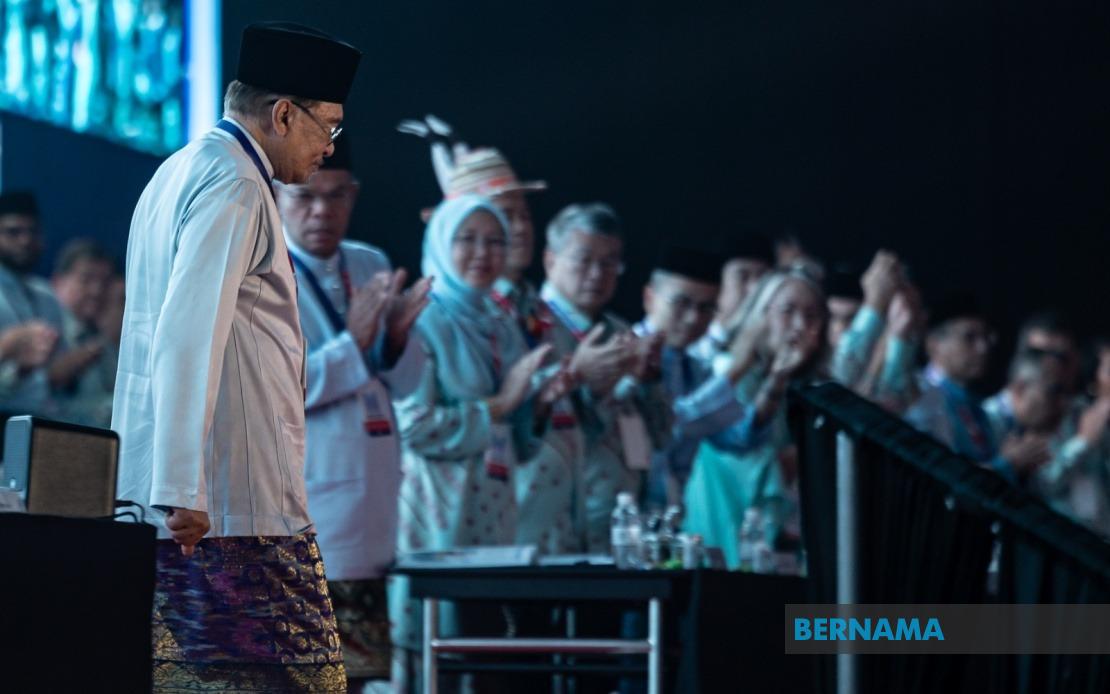
Prime Minister Datuk Seri Anwar Ibrahim has forcefully pushed back against allegations that the MADANI Government operates a two-tier system of state funding, insisting instead that his administration has substantially increased allocations to all regions according to their specific development needs. Speaking at the 2026 PKR National Congress in Melaka, Anwar presented a detailed breakdown of federal spending patterns to demonstrate what he characterises as equitable resource distribution across the country.
The Prime Minister highlighted Sabah's case as a particularly striking example of enhanced federal commitment. He noted that federal expenditure earmarked for the state has climbed by 35 per cent during the three years since the MADANI administration took office, growing from RM13 billion in 2022 to RM17.6 billion in 2026. Anwar suggested that if the previous government had similarly increased allocations to Sabah, the state leadership would have publicised such improvements, implying that the absence of such announcements prior to 2023 reflects lower investment levels.
Sarawak, Malaysia's largest state by land area and a crucial political constituency, has experienced even more pronounced growth in its federal allocation. The state's funding increased from RM10.2 billion in 2022 to RM15.1 billion in 2026, representing a 48 per cent increase over the four-year period. This substantial boost reflects the administration's apparent prioritisation of ensuring major East Malaysian states receive tangible increases in development resources, a strategy that carries significant political implications for coalition stability.
Beyond Sabah and Sarawak, Anwar pointed to gains across various peninsular states to demonstrate the breadth of his government's spending expansion. Terengganu's allocation increased from RM6 billion in 2022 to RM8.1 billion in the current financial year, while Johor experienced growth from RM10.2 billion in 2022 to RM14.6 billion projected for 2026. These figures suggest a deliberate effort to increase spending even in states previously governed by ruling coalition partners, potentially addressing earlier grievances about resource distribution.
The Prime Minister's remarks directly address what appears to be a recurring criticism within certain political circles regarding the allocation methodology used by the federal government. By distinguishing between state-level variation in allocations and the claim of systematic sidelining, Anwar argues that differentiated funding reflects rational policy considerations rather than political punishment or favouritism. He emphasises that each state receives resources calibrated to its particular priorities and requirements, rather than equal per capita distribution.
For Malaysian observers and state governments, these figures warrant careful scrutiny. The increases cited span different base years and reference points, making comparative analysis complex. A state receiving a substantial percentage increase from a lower baseline may still command fewer absolute resources than a state with modest percentage growth from a higher starting point. Understanding whether allocations address genuine development gaps or represent incremental adjustments requires examining per capita spending, infrastructure needs assessments, and demographic changes across different regions.
The timing of Anwar's remarks—delivered at his party's national congress—reflects broader intra-coalition dynamics. PKR, as the dominant coalition partner, maintains members serving as chief ministers or holding significant state-level positions, and ensuring these states receive visible resource increases becomes a matter of internal coalition cohesion. Anwar's detailed presentation suggests that allocation concerns have surfaced within coalition ranks, requiring the Prime Minister to directly address grievances rather than dismissing them outright.
The inclusion of Kedah, Kelantan, and Perlis in Anwar's statement, while less specific in quantified terms, indicates an attempt to project even-handed treatment across the political spectrum. Kelantan, governed by the opposition Pas, and Perlis, a historically mixed-control state, figure in the narrative of rising allocations, suggesting the government claims to operate above partisan calculation when distributing development resources. Whether state leaders in these regions perceive equal treatment remains a separate question from federal government assertions.
From a regional Southeast Asian perspective, Malaysia's approach to federal-state fiscal relations carries implications for neighbouring countries grappling with similar centre-periphery tensions. The emphasis on data-driven justification for allocation differences, rather than purely political considerations, aligns with modern governance rhetoric even if implementation details remain contentious. This approach reflects broader trends toward evidence-based policy narratives across the region, though critics often question whether statistics effectively mask persistent inequities.
The MADANI administration's defence of its allocation strategy through specific numerical claims creates accountability mechanisms. State governments can now reference these figures to advocate for further increases or to justify their own expenditure priorities to constituents. The public nature of these commitments also establishes benchmarks against which future performance can be measured, potentially constraining the government's flexibility in reallocating resources between fiscal years.
Moving forward, the credibility of these allocation claims depends partly on implementation fidelity. Announcing increased allocations differs substantially from ensuring funds reach their intended projects and constituencies. State-level officials and civil society organisations will likely monitor whether projected figures from 2023 through 2026 materialise as planned, or whether subsequent budget cycles witness adjustments that effectively reduce promised increases.
Ultimately, Anwar's rebuttal addresses a fundamental challenge facing any federal system: convincing all constituent states that they receive equitable treatment despite significant variations in allocated resources. His emphasis on rising allocations and differentiated rather than discriminatory distribution attempts to reframe the allocation conversation from zero-sum competition toward a narrative of shared growth, even as specific states benefit from disproportionate increases.

