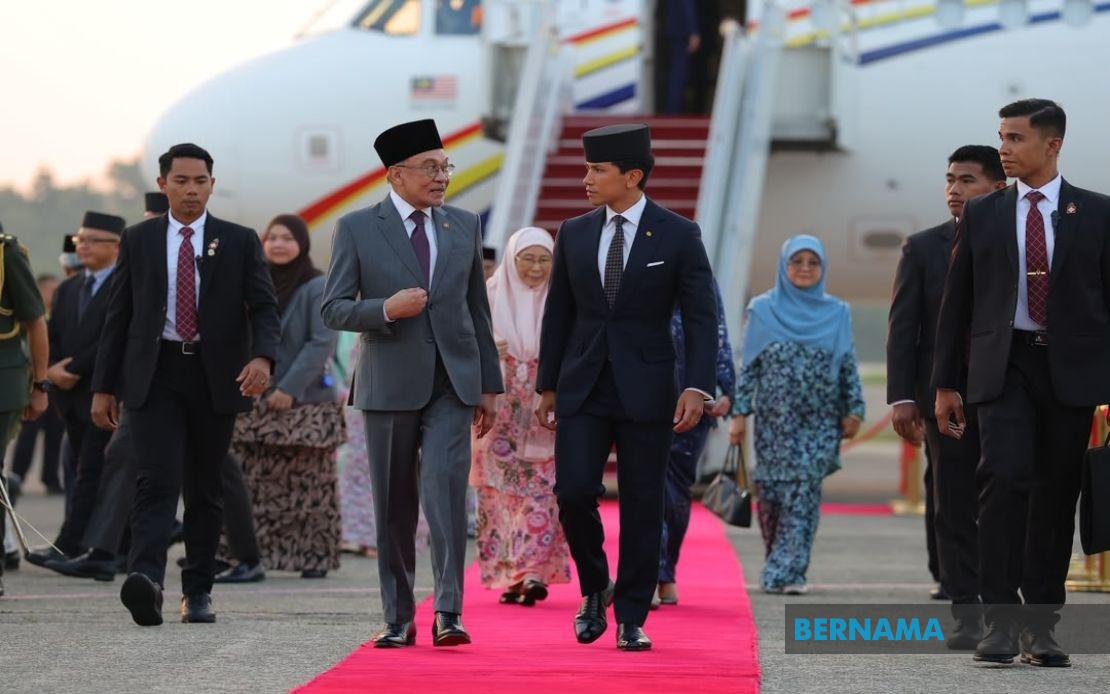
Prime Minister Datuk Seri Anwar Ibrahim touched down in Brunei on August 21 for a two-day working visit centred on the 27th Annual Leaders' Consultation (ALC-27), reinforcing the strategic partnership between Malaysia and the oil-rich sultanate. Accompanied by his wife Datuk Seri Dr Wan Azizah Wan Ismail, Anwar's aircraft landed at Brunei International Airport at 6.10 pm, where he was received by Prince Abdul Mateen Bolkiah, the sultanate's Minister of Foreign Affairs. The welcoming delegation included Foreign Minister Datuk Seri Mohamad Hasan, Foreign Ministry secretary-general Tan Sri Amran Mohamed Zin, and Malaysian High Commissioner to Brunei Datuk Mohd Aini Atan, signalling the ceremonial importance of the occasion.
The visit marks a continuation of the annual tradition whereby the two neighbouring nations' top leadership convene to chart the course of bilateral relations. The ALC mechanism represents the apex of Malaysia-Brunei cooperation, providing both leaders with a structured platform to assess progress across multiple sectors, address shared challenges, and synchronise positions on broader regional and international concerns. This consistency in high-level engagement demonstrates the stability and maturity of the bilateral relationship, which spans diplomatic, economic, and cultural dimensions.
During the two-day stay, Anwar is scheduled to be received in audience by Sultan Hassanal Bolkiah at the Istana Nurul Iman Palace. Beyond the ceremonial aspects, the Prime Minister will engage in substantive bilateral discussions with the sultanate's monarch in a one-on-one setting, allowing for candid exchange on matters of strategic importance to both nations. These tête-à-tête meetings often serve as the foundation for more detailed discussions conducted by technical delegations, ensuring that policy directions are aligned at the highest political level.
A significant development expected during the visit is the signing of a Memorandum of Understanding on disaster management cooperation between Malaysia and Brunei. The accord reflects both nations' recognition of climate vulnerability and the increasing frequency of natural disasters across Southeast Asia. With Malaysia's experience managing floods, haze episodes, and other environmental hazards, and Brunei's focus on tsunami preparedness and tropical weather challenges, the partnership promises to enhance mutual preparedness and response capabilities. Sultan Hassanal Bolkiah and Anwar are anticipated to jointly witness the signing, underscoring its political significance.
Trade remains a cornerstone of the Malaysia-Brunei relationship, though the bilateral economic engagement reflects the sultanate's resource-based economy and limited manufacturing base. In 2025, total bilateral trade reached RM5.86 billion (US$1.37 billion), with Malaysian exports accounting for RM4.20 billion (US$0.98 billion) and imports at RM1.66 billion (US$0.39 billion). This trade composition indicates Malaysia's role as a significant supplier of goods to Brunei, encompassing manufactured products, food items, and services. The preliminary figures for the first half of 2026 show total trade at RM2.38 billion (US$600 million), suggesting that bilateral commerce continues on a stable trajectory despite global economic uncertainties.
For Malaysia, Brunei occupies a special place in ASEAN architecture and bilateral relations. The sultanate, though small in population and landmass, wields disproportionate influence in regional forums due to its wealth and strategic location along shipping lanes critical to Southeast Asian trade. Brunei's chairmanship of ASEAN in past years and its role as a rotating chair in ASEAN decision-making structures mean that strong bilateral ties with the sultanate serve broader Malaysian interests in the region. The annual leaders' consultation ensures that both nations maintain alignment on ASEAN initiatives, South China Sea concerns, and other multilateral issues.
The disaster management accord also carries broader strategic implications. The recurrence of transboundary environmental challenges, particularly haze from forest fires in Indonesia and flooding patterns affecting both nations, underscores the necessity for coordinated regional responses. By formalising cooperation mechanisms, Malaysia and Brunei strengthen the foundation for more comprehensive Southeast Asian disaster management frameworks. This initiative may also serve as a model for other ASEAN bilateral partnerships seeking to address climate-related risks.
Anwar's visit takes place against a backdrop of Malaysia's efforts to deepen regional engagement and strengthen partnerships across ASEAN. Following periods of political transition and domestic focus, the Prime Minister's consistent attendance at bilateral and multilateral engagements signals Malaysia's renewed commitment to regional leadership. For Brunei, the visit reflects the sultanate's emphasis on maintaining strong bilateral relationships with larger neighbours, ensuring that Malaysian support for Brunei's development and security objectives remains robust.
The 27th ALC also provides an opportunity for both leaders to discuss contemporary regional security challenges, including maritime safety, counterterrorism cooperation, and border management. While Malaysia and Brunei share no disputed territorial claims and maintain friendly relations, the proliferation of transnational security threats in Southeast Asia necessitates regular dialogue on intelligence sharing, law enforcement cooperation, and joint capacity-building initiatives. These technical discussions, though less visible than ceremonial meetings, form the operational backbone of the bilateral security partnership.
Looking forward, the economic dimension of Malaysia-Brunei relations may evolve as both nations pursue post-pandemic recovery and diversification strategies. While Brunei remains heavily dependent on hydrocarbon revenues, Brunei's 2035 vision emphasises economic diversification and private sector development. Malaysia, as a more diversified economy with established manufacturing and services sectors, could explore expanded collaborations in renewable energy, technology transfer, and human capital development. The leaders' consultation provides a suitable venue for exploring such deeper integration.
The visit also underscores Malaysia's strategic interest in maintaining stability and prosperity across Brunei, given the sultanate's significance to regional prosperity and security. A stable, well-governed Brunei benefits Malaysian economic interests and contributes to broader ASEAN cohesion. The consistent high-level engagement between Kuala Lumpur and Bandar Seri Begawan thus represents not merely bilateral protocol, but a deliberate investment in regional stability and shared prosperity across one of Asia's most dynamic and interconnected regions.

