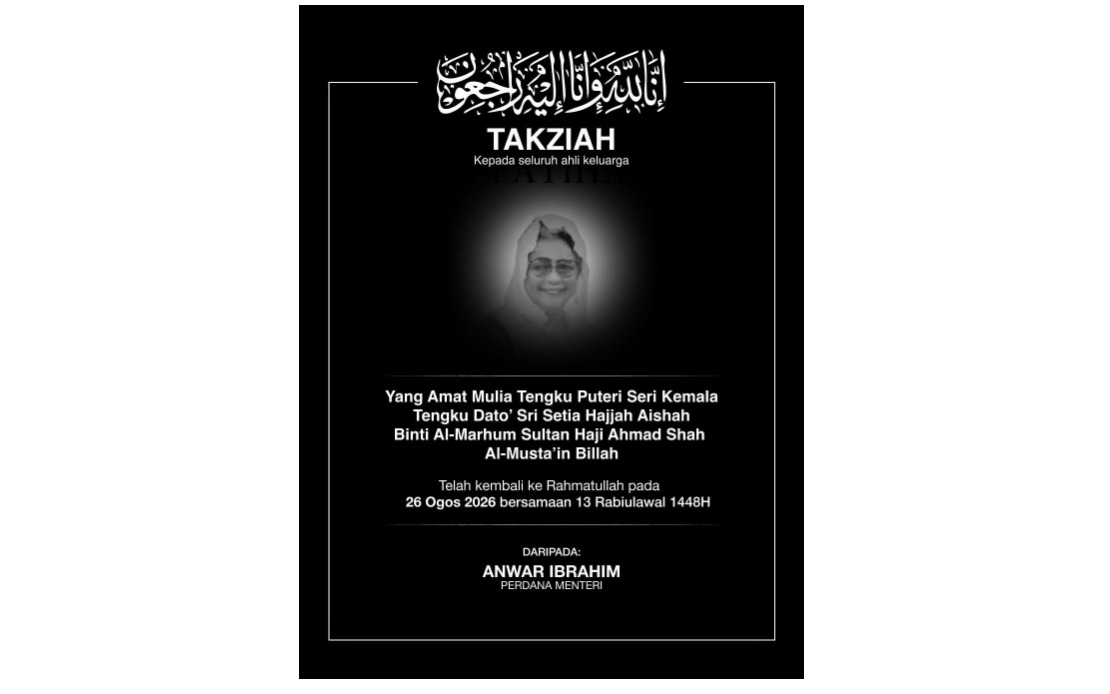
Prime Minister Datuk Seri Anwar Ibrahim has extended his sympathies to Pahang Sultan Al-Sultan Abdullah Ri'ayatuddin Al-Mustafa Billah Shah and members of the Pahang Royal Family following the death of the Sultan's elder sister, Tengku Puteri Seri Kemala Tengku Datuk Seri Aishah Almarhum Sultan Ahmad Shah, who passed away on August 26.
The Prime Minister shared his condolences through a Facebook post, reflecting the Malaysian tradition of senior government officials publicly expressing their respects during times of royal loss. Such gestures underscore the constitutional relationship between the executive branch and the institution of the sultanate, which remains a cornerstone of Malaysia's constitutional monarchy framework. The posting followed established protocol for conveying official sympathy to members of the royal households across the federation's different states.
In his message, Anwar invoked Islamic prayers and supplications for the deceased, requesting that Allah SWT bestow His infinite mercy upon Tengku Datuk Seri Aishah's soul, forgive her transgressions, and grant her a place among the righteous in the hereafter. This religious dimension to the condolence reflects the intertwining of Islamic values with formal state occasions in Malaysia, where such expressions carry both spiritual and ceremonial significance.
Beyond prayers for the departed, the Prime Minister also sought divine assistance for the bereaved family members. He specifically mentioned Al-Sultan Abdullah, the reigning Sultan; Tengku Ampuan of Pahang Tunku Azizah Aminah Maimunah Iskandariah; and the broader Pahang Royal Family, praying that they would find the strength and inner fortitude necessary to navigate their period of mourning. Such inclusive acknowledgment of multiple family members demonstrates the comprehensive nature of state sympathy during royal bereavements.
Tengku Datuk Seri Aishah breathed her last at a Kuala Lumpur hospital at 9.15 pm on August 26, concluding what would have been a period of hospitalisation. The timing and location of her passing, in the nation's capital rather than Pahang, suggests she may have been receiving specialised medical treatment at one of the country's premier medical facilities. Her death represents the loss of a member of Pahang's senior royal lineage, with historical connections to the sultanate's recent past through her father, the late Sultan Ahmad Shah.
Following established Islamic and royal protocols, Tengku Datuk Seri Aishah's funeral arrangements proceeded with her remains being committed to the Pahang Royal Mausoleum in Pekan on August 27. This burial site serves as the traditional resting place for members of the Pahang royal household, preserving the family's continuity and connection to the state's heritage. The interment in Pekan, rather than in Kuala Lumpur where she had passed away, reaffirmed her deep roots within Pahang's royal institution.
The passing of royal family members, particularly those of seniority within the household, typically generates wider reflections on the institution of monarchy in Malaysia. The sultanates occupy a constitutionally protected position, with the nine hereditary rulers forming the Conference of Rulers, which plays a crucial role in matters affecting the federation. Deaths within royal families thus carry implications beyond the immediate household, touching upon questions of succession, institutional continuity, and the broader health and stability of the constitutional framework.
Pahang, as one of Malaysia's largest states both geographically and in terms of population, holds particular significance within the federation's political economy. The state has historically been economically important due to its mineral resources, agricultural production, and tourism potential. The sultanate's stability and the well-being of its royal institution therefore matter to stakeholders across multiple sectors and regions within the country.
The expression of condolences by the Prime Minister, carried through modern digital platforms such as Facebook, illustrates how contemporary Malaysian governance blends traditional protocols with modern communication methods. While the substance and sentiment of condolence remain rooted in longstanding custom, the medium reflects the evolution of how state officials engage with the public and discharge their ceremonial duties. This approach ensures broad visibility and acknowledgment of the event within the national consciousness.
For the Pahang Royal Family, the coming weeks will likely involve a period of formal mourning that may include additional religious observances and state ceremonies. The Malaysian public, particularly those in Pahang, may engage in various forms of tribute and respect-paying as part of the broader cultural response to the loss of a senior royal figure. Such occasions typically reinforce social cohesion and reaffirm the emotional and institutional bonds connecting the sultanate to its subjects.

