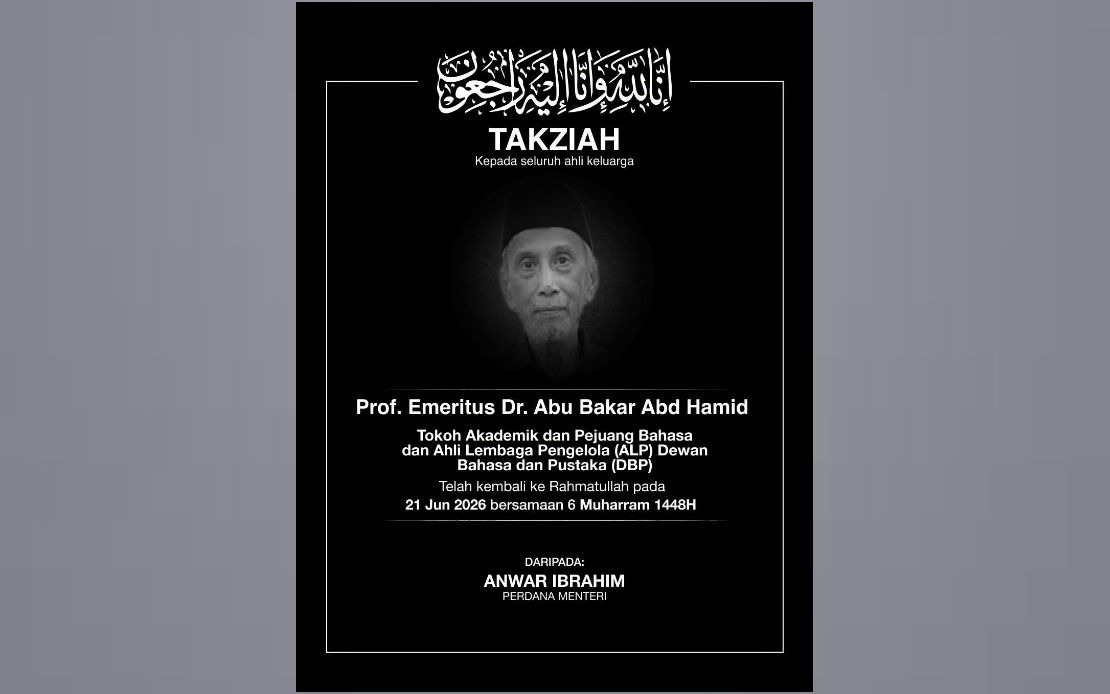
Prime Minister Datuk Seri Anwar Ibrahim has mourned the loss of Professor Emeritus Datuk Abu Bakar Abd Hamid, one of Malaysia's most revered scholars and literary figures, who passed away last Sunday at his home in Petaling Jaya, Selangor. In a heartfelt Facebook message released today, Anwar reflected on the passing of an intellectual giant whose contributions to Malaysian academia and culture left an indelible mark on generations of students and the nation's literary landscape. The Prime Minister's public tribute underscores the profound respect commanded by Abu Bakar within both political and academic circles, a testament to his enduring influence across diverse spheres of Malaysian public life.
Anwar, who counted himself among Abu Bakar's former students, spoke of the profound personal loss felt by those who had benefited from the professor's mentorship and wisdom. The Prime Minister described Abu Bakar as not merely an educator but a beacon of intellectual passion who consistently challenged and inspired those around him to pursue knowledge with rigour and purpose. This personal dimension to Anwar's statement reveals the depth of Abu Bakar's impact beyond his institutional roles, highlighting how his pedagogical approach transcended the lecture hall and shaped the worldview of prominent figures in contemporary Malaysian politics and society.
The Johor-born scholar died at approximately 10:30 pm on June 21 following a sudden onset of severe respiratory distress at his residence, leading to his passing at an advanced age enriched by decades of scholarly endeavour. Abu Bakar was subsequently laid to rest at Bukit Kiara Muslim Cemetery on Monday, concluding a life dedicated to advancing Malaysian intellectual traditions and cultural expression. His death represents a significant loss to the academic community and particularly to those institutions and initiatives to which he devoted his considerable talents and energy throughout his long and productive career.
During his tenure as deputy vice-chancellor at Universiti Malaya beginning in 1987, Abu Bakar held one of the nation's most senior academic positions at a time when Malaysian universities were consolidating their standing as centres of intellectual excellence. His role proved instrumental in shaping institutional policies and academic directions during a formative period in the development of Malaysia's higher education sector. Beyond his administrative responsibilities, Abu Bakar maintained his scholarly pursuits, earning widespread recognition for his foundational work in Malay literary studies and criticism, fields to which he brought both analytical rigour and deep cultural understanding.
One of Abu Bakar's most significant contributions to Malaysia's institutional fabric came through his instrumental role in the establishment of Universiti Kebangsaan Malaysia. Serving as joint secretary of the founding committee in 1968, he helped shepherd into existence what would become the national university, an institution designed to champion Malay language education and promote research rooted in Malaysian cultural and social contexts. This founding contribution secured Abu Bakar's place in the historical narrative of Malaysia's post-independence nation-building project, particularly in the educational sphere where UKM emerged as a distinctive force for culturally-grounded academic inquiry.
Beyond the universities, Abu Bakar's influence extended into the highest levels of Malaysia's national information apparatus. He served as chairman of the Board of Governors of Bernama, the Malaysian National News Agency, from 1996 to 2000, a period during which Malaysia's national media landscape was undergoing significant transformation. This role positioned him at the intersection of academic values and journalistic practice, allowing him to contribute to debates about how knowledge and information should be communicated to the Malaysian public during a critical juncture in the nation's media development.
Throughout his distinguished career, Abu Bakar accumulated numerous prestigious awards and accolades recognising his exceptional contributions to the advancement and preservation of Malay literature and culture. These honours reflected not only the quality of his scholarly work but also the respect and esteem with which the academic and cultural establishments regarded his efforts. His award-winning body of work helped establish standards of excellence in literary criticism and cultural scholarship that influenced subsequent generations of Malaysian academics working in the humanities.
Anwar's public mourning resonates within the broader Malaysian context where the death of prominent intellectuals prompts national reflection on the continuity of scholarly traditions and institutional memory. The Prime Minister's invocation of Islamic prayers for Abu Bakar's soul and the wish that he find peace in the afterlife reflects both personal piety and the cultural conventions through which Malaysian society processes the loss of esteemed figures. Such public tributes serve important social functions, affirming the value placed on intellectual contribution and cultural stewardship within national life.
The passing of Abu Bakar marks another chapter in the gradual transition of Malaysia's founding generation of intellectuals who shaped the nation's post-independence cultural and educational institutions. As members of this pioneering cohort reach the end of their lifespans, their accumulated wisdom and institutional knowledge face the risk of being lost if not properly documented and transmitted to successor generations. Abu Bakar's life story exemplifies the trajectory of Malaysian scholars who combined administrative leadership, creative scholarship, and institutional nation-building during the formative decades following independence.
For Malaysian readers and particularly for those engaged in literary studies, education policy, and cultural preservation, Abu Bakar's death invites consideration of how contemporary institutions might honour and continue the legacies established by such foundational figures. The challenge facing Malaysia's academic and cultural sectors involves ensuring that the standards of rigorous humanistic inquiry and the commitment to preserving and advancing Malay literary traditions that Abu Bakar exemplified continue to inform institutional priorities. His passing underscores the imperative for deliberate efforts to document and sustain the intellectual traditions he helped establish, ensuring that future generations of Malaysian students and scholars benefit from understanding the historical development of the nation's cultural and educational institutions.

